North Carolina Created a Healthcare Affordability Commission. Guess Who’s Not in the Room?
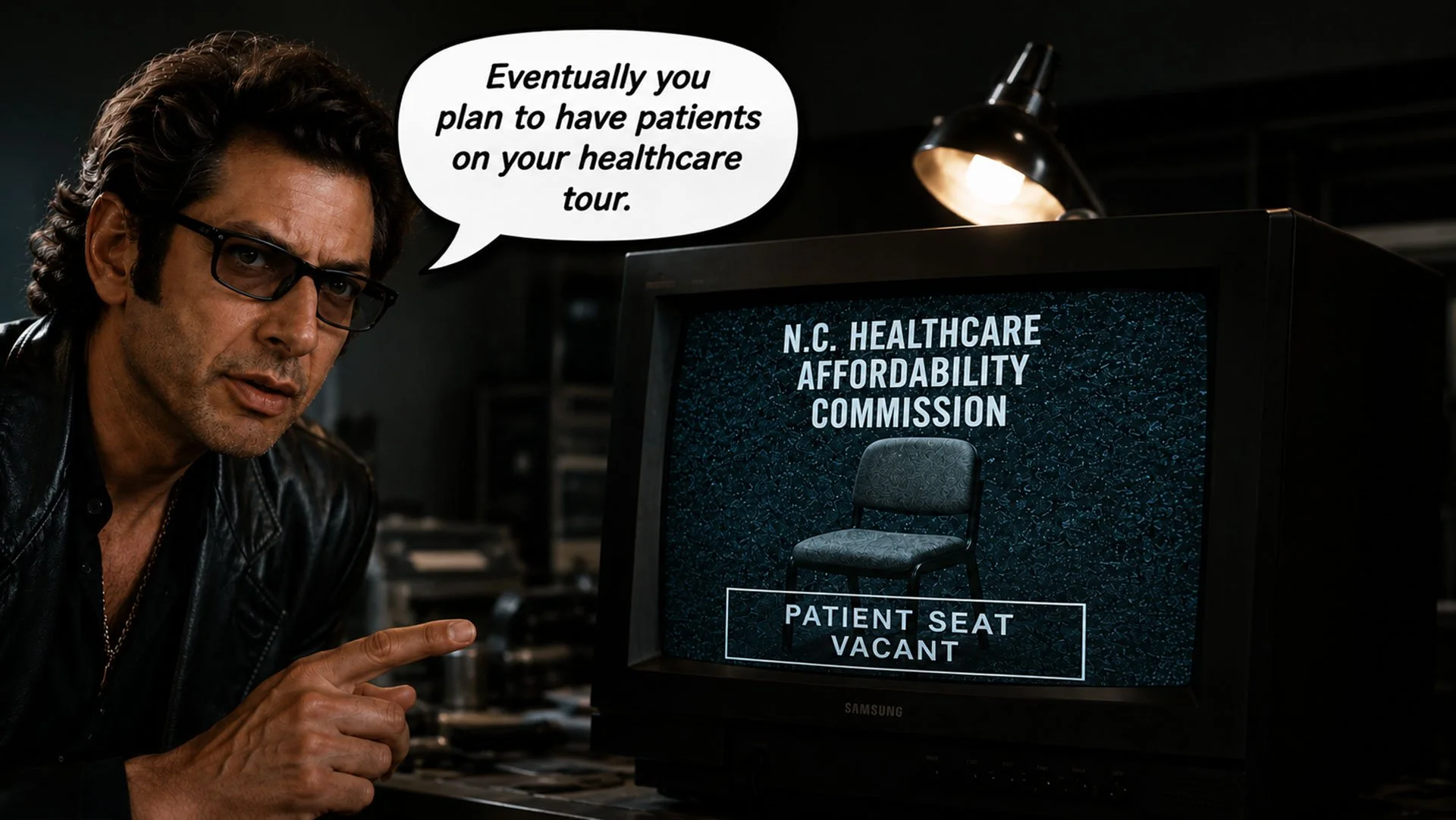
North Carolina recently created an Advisory Committee on Health Care Affordability, assembling representatives from across the healthcare ecosystem to help address one of the most consequential issues facing residents of the state. Hospitals have a voice. Insurers have a voice. Employers, government agencies, industry organizations, and people with decades of healthcare policy experience have a voice. The committee brings together an impressive collection of institutional knowledge about how healthcare is financed, delivered, regulated, and purchased, yet somehow, among all that expertise, there is one rather conspicuous omission: the people who actually have to use the healthcare system.
There are no patients.
My friend and colleague Sally Neely Nix noticed this after reviewing the committee’s membership and wrote directly to Governor Josh Stein. Her argument was neither complicated nor particularly controversial, or at least it should not be. If North Carolina is going to convene experts to determine why healthcare has become unaffordable and what should be done about it, then the people experiencing that unaffordability firsthand should have meaningful representation in the room. As Sally wrote, patients possess a kind of expertise that cannot be learned from policy papers, claims data, or board meetings because they understand where the system fails by living through those failures themselves.
It immediately reminded me of one of the great lines from Jurassic Park, when Ian Malcolm, having toured a dinosaur park conspicuously lacking in visible dinosaurs, asks whether they eventually plan to have dinosaurs on the dinosaur tour. More than 30 years later, the question feels strangely appropriate for American healthcare: Eventually, you do plan to have patients on your healthcare tour, right?
The absurdity would be funnier if it were not so deeply embedded in the way healthcare policy is made in this country. We routinely assemble rooms full of extraordinarily accomplished people to discuss patients, study patients, measure patients, design programs for patients, calculate the costs associated with patients, and determine what patients supposedly need. Then, after the priorities have been established and the agenda has been written, someone notices that there are no actual patients involved and decides to invite one to tell an inspirational story at the next meeting. The institution can then declare the process “patient centered,” everyone takes a photograph, and the machinery continues operating exactly as it did before.
This is not an argument against professional expertise. Healthcare is enormously complicated, and any serious attempt to address affordability requires people who understand hospital economics, insurance markets, employer-sponsored benefits, Medicaid, Medicare, reimbursement, regulation, public policy, and the many other forces that determine how care is financed and delivered. The problem is that we have spent decades treating institutional expertise as though it represents the complete picture while relegating lived experience to the category of anecdote. That distinction has allowed healthcare organizations to consider patients valuable sources of testimony without recognizing them as legitimate sources of knowledge.
A claims database can tell you that a prior authorization was denied, but it cannot fully explain what happened to the human being after the denial arrived. It cannot show the hours spent calling an insurer, the physician pulled away from other patients to complete another appeal, the family member who became an unpaid case manager, or the fear created when evidence-based treatment sits in administrative limbo while a disease continues to progress. A spreadsheet can document an out-of-pocket expense, but it cannot tell you what a family stopped buying to pay it. A provider directory can technically demonstrate network adequacy while a patient spends an afternoon calling specialists who have retired, moved, stopped accepting the insurance plan, or cannot offer an appointment for six months.
Those experiences are not sentimental additions to the “real” data. They are part of the data, and any serious effort to understand healthcare affordability that excludes them is working with an incomplete dataset.
This matters particularly when we talk about affordability because the word means something very different depending on which side of the table you occupy. Institutions tend to discuss affordability through premiums, deductibles, reimbursement rates, utilization, total cost of care, and actuarial projections. Patients experience affordability through a much more immediate series of questions: Can I fill this prescription? Can I afford the deductible and still pay my rent? Can I take another unpaid afternoon off work to fight an insurance denial? Can I travel three hours to see the specialist who actually treats my condition? Can I continue paying for the care that is keeping me alive without financially destabilizing my entire family?
The American healthcare system has become remarkably sophisticated at measuring spending while remaining remarkably unsophisticated at measuring burden. There is no insurance claim generated for the six hours someone spends navigating a denial. There is no billing code for the daughter who becomes her father’s unpaid benefits administrator or the spouse who spends lunch breaks calling medical billing departments. We rarely capture the prescription abandoned at the pharmacy counter because the price was unexpectedly high, the appointment postponed because the copay arrived during a difficult month, or the treatment delayed because the administrative process became too confusing and exhausting to navigate. Yet all of these experiences are part of what healthcare costs, and the people experiencing them understand dimensions of affordability that cannot be reconstructed from claims data alone.
The larger problem is that patient engagement throughout healthcare is too often designed to occur after the consequential decisions have already been made. The experts convene, define the problem, establish the priorities, develop the vocabulary, draft the recommendations, and construct the framework. Patients are subsequently invited to react to what has already been built, which allows institutions to claim that patients participated without requiring those institutions to surrender any meaningful influence over the process itself. There is an enormous difference between asking patients what they think about a proposed solution and allowing them to help determine which problems deserve to be solved in the first place.
Meaningful patient representation does not mean that every commission needs to become an unmanageable public forum, nor does lived experience automatically confer expertise in every area of healthcare policy. Patients should not replace economists, clinicians, regulators, employers, or other professionals whose specialized knowledge is essential to solving complex problems. The point is precisely the opposite: no single category of expertise is sufficient on its own. If healthcare affordability is the problem being examined, then lived experience should sit alongside institutional expertise from the beginning of the process, with patients given enough information, access, and authority to influence what the group ultimately recommends.
That is what genuine patient-centered policymaking would look like. It would not treat patients as ceremonial representatives of their own existence or invite them into the room primarily to provide emotional texture. It would recognize that patients possess knowledge unavailable to anyone else because they are the only participants who experience the entire system from the receiving end. Hospitals understand their operations. Insurers understand their products. Employers understand their benefits. Policymakers understand regulation. Patients are the ones expected to somehow navigate all of those systems simultaneously, frequently while sick, frightened, financially vulnerable, or responsible for the care of someone they love.
This is ultimately why the absence of patients from a healthcare affordability commission matters beyond North Carolina. It reflects a much larger habit in American healthcare of treating patients as a population to be managed rather than a constituency entitled to representation. We have become comfortable studying patients, surveying patients, marketing to patients, measuring patient satisfaction, and invoking the phrase “patient centered” while maintaining systems in which patients possess remarkably little actual power. The language of patient engagement has advanced much faster than the distribution of authority.
The larger idea behind We the Patients is that this dynamic will not fundamentally change through better terminology or another round of listening sessions. Patients need to be understood not merely as recipients of healthcare but as a civic constituency with economic and political power. More than 90 percent of Americans interact with the healthcare system in some form, and nearly everyone eventually becomes a patient, caregiver, or family member trying to navigate it on behalf of someone they love. The potential constituency is enormous, yet it remains fragmented precisely because healthcare has conditioned us to experience these failures privately rather than recognize them as shared systemic problems.
North Carolina has an opportunity to correct this omission, and doing so would strengthen rather than diminish the work of its affordability committee. If the state genuinely wants to understand why healthcare has become unaffordable, it should hear directly and consistently from the people forced to make impossible financial decisions because of that unaffordability. Patients should not be invited after the agenda has been set to validate conclusions reached without them. They should be involved early enough to challenge assumptions, identify blind spots, and influence the recommendations that ultimately emerge.
Healthcare does not become patient centered because institutions become better at talking about patients. It becomes patient centered when patients have enough representation and actual influence to help shape the decisions being made about their lives. If we are serious about fixing healthcare, the people who have to navigate it, pay for it, depend on it, and occasionally fight for their lives against its bureaucracy cannot continue to be the one stakeholder group perpetually waiting outside the room.
So, with apologies to Ian Malcolm, the question remains: Eventually, you do plan to have patients on your healthcare tour, right?
Welcome to 2026, the Year of the Patient, where the sick shall inherit the ballot.