

You Got Denied. Here's Exactly What to Do Next.
You opened a letter. Or an app notification. Or a phone call you almost didn't answer. And somewhere in the legalese was the word "denied." Maybe it was a scan. A drug. A treatment your own doctor prescribed. Doesn't matter — the sentence you heard was no.
Here's the thing nobody puts in bold on that letter: insurance companies win by exhaustion. Most people read "denied," assume the professionals got it right, and quietly go find another way to pay — or don't get the care at all. Here's the real secret: fewer than 1 out of every 100 people who get denied ever appeal. That's not a typo. Insurance companies count on that number staying that low. The people who do appeal win — often. Keep reading for the real numbers, broken down by the kind of plan you have.
This page is the plain-English version of everything you need to fight back — no jargon, no 40-page PDF, no hoping you stumble onto the right nonprofit's website. If you want the deeper research and the receipts, they're linked at the bottom, credited by name.
- Before You Appeal: Pre-Authorization
- Step 1: What Kind of Plan Do You Have
- Step 2: The Three Phases of an Appeal
- How Often Do Appeals Actually Win?
- Step 3: Your Deadlines
- Step 4: Find Out Why You Were Denied
- Step 5: Build the Appeal
- Step 6: Don't Stop at "No" Twice
- Keep Yourself Organized
- Matthew's Favorite Sites
Before You Even Get to Appeal: Know If You Need Pre-Authorization First
Here's a version of this story that happens constantly: someone's doctor orders an MRI. It's a covered service under their plan, so they just go get it. Weeks later, a bill shows up — over a thousand dollars — because the insurer required pre-authorization before the scan, nobody asked for it, and now the insurer isn't required to pay a dime. Not because the care wasn't medically necessary. Because a form didn't get filed first.
This is a different fight than the appeal itself, and it's worth knowing about before you're in it.
What pre-authorization is: written, advance approval from your insurer for certain treatments, procedures, medical devices, or prescriptions — also called prior auth, pre-cert, or a treatment authorization request.
The part that catches people off guard: insurers generally don't hand you a list of what needs pre-auth. You have to ask, every time, for anything non-routine — especially imaging, specialty drugs, anything out-of-network, or any treatment with a cheaper alternative the insurer would rather you try first.
Whose job is it to get it? Officially, yours — even though your doctor's office often handles the paperwork. If they don't file it and you get the care anyway, the insurer can refuse to pay, full stop, regardless of whether the care was the right call medically.
How to not get burned by this:
- Before any non-routine procedure, scan, device, or specialty drug, ask your insurer directly: "Does this require pre-authorization?"
- Ask your doctor's office whether they're filing it or whether it's on you.
- Get everything in writing or time-stamped — confirmation emails, reference numbers, copies of the submitted form.
- If it's denied, you're not stuck — a pre-authorization denial can be appealed exactly like any other denial, internal appeal first, external review second, same deadlines as below.
Step 1: Figure Out What Kind of Plan You Actually Have
This matters because who regulates your appeal — and how fast they have to answer you — depends entirely on this.
Call the number on the back of your insurance card and ask: "Is my plan fully insured or self-funded?" If they don't know what that means, ask whoever handles your employer's benefits.
- Bought it yourself, lasts a full year? → Individual marketplace plan.
- Employer plan, insurance company takes the financial risk? → "Funded" group plan.
- Employer plan, employer pays claims directly out of its own funds? → "Self-funded" plan (different rules, still federally protected).
- Government plan → Medicare, Medicaid, TRICARE, or VA — each has its own appeal track.
- Short-term plan, health-sharing ministry, farm bureau policy? → You may have far fewer legal protections. Worth confirming immediately.
Step 2: Understand the Three Phases of an Appeal
- The denial itself — the insurer says no, either before care (prior authorization denial) or after (claims denial).
- Internal appeal — you ask the same company to reconsider.
- External review — if they say no again, an independent reviewer outside the insurance company makes the final call — and by law, the insurer has to accept that decision if it goes your way.
Most people quit after step 1. That's exactly what the system is counting on.
How Often Do Appeals Actually Win?
Here are the real numbers. No guessing, no rounding up.
If you have a job-based plan or a Marketplace plan (the kind you buy yourself on HealthCare.gov):
- Almost nobody appeals. Fewer than 1 out of every 100 people who get denied ever file an appeal.
- When people do appeal, they win about 1 out of every 3 times.
If you have Medicare Advantage:
- Most people still don't appeal — only about 1 out of every 9 people who get denied do.
- But when they do appeal, they win about 8 out of every 10 times.
Both sets of numbers come from the same place: the Kaiser Family Foundation, using 2024 data insurers had to report to the federal government. Not a blog. Not an ad. The real data.
The pattern is the same no matter what kind of plan you have: people who don't appeal lose by default. People who do appeal usually get somewhere.
Step 3: Know Your Deadlines — Write These Down
| What | Deadline |
|---|---|
| Insurer must explain a denial in writing | 15 days (prior auth) / 30 days (already received care) / 72 hours (urgent) |
| You must file your internal appeal | Within 180 days of the denial notice |
| Insurer must decide your internal appeal | 30 days (not yet received) / 60 days (already received) |
| You must file external review | Within 4 months of the final internal denial |
| External reviewer must decide | 45 days standard / 72 hours or less if urgent |
If your situation is urgent, you don't have to wait in line — you can file an internal appeal and request an expedited external review at the same time.
Step 4: Find Out Exactly Why You Were Denied
Before you write a single word of an appeal, get the real reason. Common ones:
- "Not medically necessary"
- Out-of-network provider
- "Experimental or investigational" treatment
- No prior authorization on file
- Drug isn't on the formulary
- You've hit a benefit limit
- A data-entry error (misspelled name, wrong date of service, wrong code)
Sometimes it's just a typo. Call and ask, plainly: "What specifically was the reason for this denial, in the exact language you used?"
Step 5: Build the Appeal That Actually Works
- Get your doctor involved. A letter of medical necessity from your care team carries real weight — ask them to address the specific reason for denial, not just restate the diagnosis.
- Pull your full medical record. You have the legal right to it, at any time, for any reason, and a provider can't withhold it over an unpaid bill. Use it to build your timeline.
- Cite the specific denial reason and rebut it directly. Don't write a general appeal — mirror their language and take it apart point by point.
- Include guidelines and evidence — treatment guidelines from recognized medical organizations, peer-reviewed research, anything that shows this is standard care, not a long shot.
- Don't threaten. Don't vent in the letter. Save the anger for calling your legislator. In the appeal itself, write like someone who's already won — calm, specific, sourced.
- Ask for a supervisor or Medical Director if you hit a wall on the phone. They have more authority to make exceptions than the first person who answers.
- Send it certified, or with tracking. If they "never received it," you need proof they're wrong.
Step 6: Don't Stop at "No" Twice
If the internal appeal fails, you're not out of options — you're one step closer to someone outside the insurance company looking at your case. External reviewers overturn denials at meaningfully high rates, especially for medical-necessity disputes. Most people never get here. That's exactly why the ones who do, often win.
Your state may also have a free Consumer Assistance Program or Department of Insurance that will file the appeal for you, at no cost. Most people have never heard this exists.
Keep Yourself Organized
Fighting a denial while you're sick, scared, or exhausted is its own battle. Track every call, every letter, every deadline. A simple tracker — who you talked to, when, what they said, what's due next — is often the difference between winning and missing a deadline you didn't know existed.
Matthew's Favorite Sites for This Fight
I didn't invent the process above — the law did. What I did is boil down years of work from organizations who've spent decades documenting it, so you don't have to dig through their sites the hard way. Full credit, no shortcuts:
- Triage Cancer — comprehensive, free legal and financial guides on health insurance, appeals, and cancer-specific navigation. Twenty-five years in this fight, and they know more about this than almost anyone in the country.
- HealthCare.gov — the federal government's own authoritative breakdown of internal appeals and external review rights. The primary source, straight from the agency that regulates it.
- Patient Advocate Foundation — practical tips and one-on-one case management help for patients navigating denials.
- Kaiser Family Foundation (KFF) — nonpartisan health policy research. The appeal win-rate numbers on this page come straight from their data.
- ProPublica — investigative journalism on how external review actually works in practice, and why so few people use it.
I wrote this because I've spent [X years] on the other side of this exact letter. Read my book, We the Patients, for the full story of what's broken in American healthcare — and why fighting back works more often than they want you to know.
A Note on Sources
This page reflects publicly available laws, regulations, and processes (like the Affordable Care Act's appeals framework and HIPAA's medical records rules) along with practical guidance drawn from and inspired by the organizations linked above. The facts and procedures described are not owned by anyone — they're how the system actually works. Where an idea, framework, or phrasing originated with a specific organization, I've credited them directly rather than presenting their work as my own. This page is general information, not legal or medical advice, and isn't a substitute for guidance from your own doctor, insurer, or a licensed attorney or patient advocate familiar with your specific situation.
THE AMERICAN HEALTHCARE SYSTEM ISN’T BROKEN.
IT WAS BUILT THIS WAY
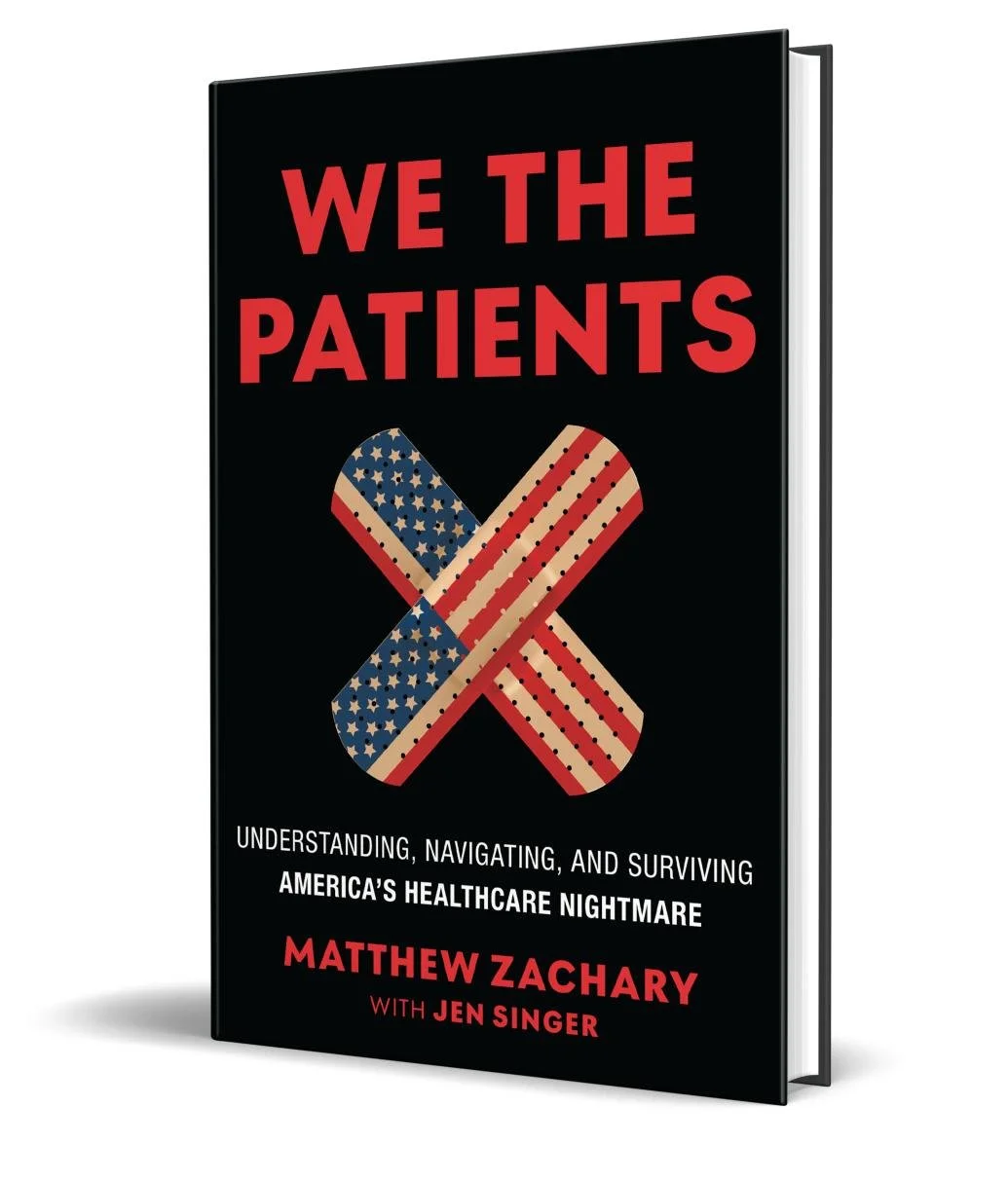
It’s time to rig the system in our favor.
PRE-ORDER NOW
“We the Patients is essential reading for Americans wronged by our convoluted healthcare system and lays out a revolutionary solution that gives power back to patients."
– Jeremy Abbate, Publisher, Scientific American
“ESSENTIAL READING.”
“We The Patients restores humanity to healthcare. Matthew blends critique with hope and reminds us what’s at stake when we stop listening to patients.”
— Henry S Friedman, MD, Deputy Director of the Preston Robert Tisch Brain Tumor Center at Duke University Medical Center
“RESTORES HUMANITY.”
“A clarion call for how we can all work together to rig the system in order to better serve the needs of patients, not corporate interests.”
— Wendell Potter, Healthcare Whistleblower, Publisher and Executive Editor of HEALTH CARE un-Covered
“A CLARION CALL.”
“We The Patients shows why medical progress means nothing without patient accountability. Required reading for anyone shaping cancer care."
– Karen E. Knudsen, MBA PhD, CEO, Parker Institute for Cancer Immunotherapy, Former CEO, American Cancer Society
“REQUIRED READING.”
“We The Patients brilliantly explains how American healthcare got here while giving hope to millions who have felt unseen navigating it. I could not put this book down."
– Jody Hoyos, CEO, Prevent Cancer Foundation
“A BRILLIANT EXPLAINER.”
“Matthew lays the groundwork for the coming healthcare revolution, led by cancer survivors and the people who love and care for them, to change the system that failed them."
– Lisa C. Richardson, MD, MPH, Former Division Director, Cancer Prevention and Control at the Centers for Disease Control and Prevention
“A HEALTHCARE REVOLUTION.”
“We The Patients gives voice to the people who live inside the data. Matthew shows how stories and science together can make healthcare more honest and more human.”
– Jim Weiss, Founder & Chairman, Real Chemistry
_____________________
“Matthew Zachary is a truth telling, straight shooter who draws from his experiences as a cancer survivor to educate us. We The Patients belongs to every person fatigued, frustrated, and forsaken by the maze that passes for our healthcare system.”
– Lisa Fitzpatrick, MD, MPH, MPA Former Chief Medical Officer, Medicaid
“We The Patients reframes patients not as endpoints or data sources, but as essential partners in progress. This book belongs in the hands of anyone designing the future of care..”
– Jessica Federer, Former Chief Digital Officer Bayer AG
“We The Patients explains why patients feel angry and lost and shows they are not failing the system. The system is failing them.”
– Barb Collura, Former CEO, RESOLVE: The National Infertility Association
“Matthew Zachary has given voice to what patients and advocates have long known—our system works best when it truly listens..”
– Candice Roth, MSN, RN, CENP, Executive Director, AONN+
“I've operated inside this broken system and been crushed by it. We the Patients is the wake-up call and the roadmap to fix it.”
– LynAnn Henderson, Founder & CEO, Kynexions, RosettaFest Co-Creator

Out of Patients?
Join the recurring Out of Patients dispatch from Matthew Zachary covering the latest American healthcare shenanigans. Essays, podcast episodes, media appearances, book updates, and live events delivered with a sardonic Gen X perspective from a patient who simply refuses to shut up.
Get the dispatch