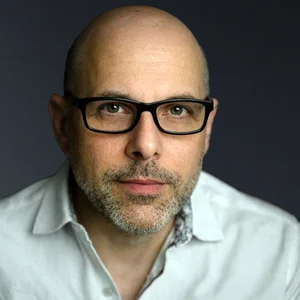
There are people you meet in life who immediately make sense to you, even when absolutely nothing about them makes sense to anyone else. People whose brains operate at roughly the same ridiculous speed as yours, who can bounce between healthcare policy, existential philosophy, pop culture, institutional corruption, and the merits of a proper New York bagel without stopping to explain how any of those subjects are connected.
My friend Dr. Natanya Wachtel is one of those people.
Natanya is a behavioral scientist, entrepreneur, media personality, and professional collector of interesting humans. She's also one of those rare people who can somehow make 17 different conversations happen simultaneously and still remember what everyone was talking about. I suspect her brain requires an industrial cooling system.
We have a lot in common, not least of which is a shared fascination with why people behave the way they do, why institutions behave even worse, and why the American healthcare system has managed to turn the basic act of staying alive into an elaborate administrative obstacle course.
So when she invited me onto The Natanya Experience, I knew we were going to have a good time. I also knew there was virtually no chance we'd stay on topic.
We began, naturally, with a disagreement about bagels.
And somehow ended up discussing the birth of my children.
Everything in between was pretty much what you'd expect from 2 kindred animals who have spent enough time around healthcare to know that sometimes the only reasonable response is to laugh at the sheer fucking absurdity of it all.
The Kid Before the Cancer Guy
One of the things I appreciated about Natanya's approach was that she wasn't particularly interested in starting with the usual résumé of my life. Brain cancer at 21, founded Stupid Cancer, pioneered young adult cancer advocacy, started podcasting before podcasting was cool, wrote a book, blah blah blah.
Instead, she wanted to know who I was before any of that happened.
Which is a much more interesting question, especially when you've spent 30 years being introduced to people through the worst thing that ever happened to you.
Before I was the cancer guy, I was the piano guy. I started playing at 11, discovered I had a knack for composing, and spent my teenage years writing music for orchestras, theater, dance companies, and anyone else willing to let an overly enthusiastic kid near a keyboard.
By college, I was studying music at Binghamton, composing constantly, and planning to attend USC film school. I wanted to write movie scores. That was the plan. I had the talent, the ambition, the cassette tapes, and a fairly unhealthy obsession with the idea that I might someday become the next John Williams.
Then, in 1995, my left hand started behaving like it had joined a union without telling me.
At first, I figured I was out of practice. Then I couldn't write properly. Then I couldn't finish an exam. Eventually, the symptoms became impossible to ignore, although the medical establishment certainly gave ignoring them the old college try.
There were appointments, theories, misdiagnoses, and, at one point, Robitussin. Because apparently cough syrup was considered a reasonable response to a 21-year-old developing neurological problems.
An MRI finally revealed a malignant tumor in my cerebellum. By January 1996, I was undergoing brain surgery, and the life I'd spent a decade building had been abruptly replaced with a very different set of priorities.
The music career was over. Or at least the version of it I'd imagined.
What I found especially interesting about talking with Natanya was that she understood the distinction between losing an ability and losing an identity. She's had her own experiences with neurological injuries, and we both know there's a peculiar kind of grief attached to remembering what your brain and body used to do without asking permission.
I still have recordings of music I wrote when I was 17 or 18. Sometimes I listen to them and wonder who the hell that kid was. I recognize the music, but I can't entirely recognize the mind that made it.
And yes, we somehow managed to discuss all of this while making references to Amadeus, Back to the Future, and the Spin Doctors.
Because Gen X.
Thirty Years Later, We're Still Fighting. Just for Different Reasons.
Eventually, Natanya steered us toward the work I've spent the last 20 years doing, and why my new book, We the Patients: Understanding, Navigating, and Surviving America's Healthcare Nightmare, exists in the first place.
When I was diagnosed, the fight was largely about surviving cancer. We had fewer treatments, fewer options, almost no infrastructure for young adults, and a healthcare culture that treated people between pediatric and geriatric oncology as some kind of statistical rounding error.
I didn't meet another young adult cancer survivor for 7 years. Seven. Imagine going through something that profoundly rearranges your life and not knowing a single other person your age who understands what the hell just happened.
Eventually, I met my friend Craig, discovered there were other people like me, and realized I could build something I desperately wished had existed when I needed it.
That became Stupid Cancer. And the conferences, media platforms, support networks, industry relationships, and 20 years of advocacy that followed.
But here's the thing Natanya and I kept coming back to: the fight has changed.
Thirty years ago, we were fighting to live because medical science couldn't always keep us alive. Today, medical science can do extraordinary things, but the healthcare economy has developed an astonishing talent for preventing people from accessing them.
We've got precision medicine, targeted therapies, sophisticated diagnostics, and technologies that would have looked like props from Star Trek when I was diagnosed. Meanwhile, patients are still being denied medically necessary care by insurance companies whose business models depend, at least in part, on making healthcare more difficult to obtain.
Congratulations, America. We invented the future and put it behind a prior authorization form.
That's the central argument of We the Patients, and it's why my work has evolved from building communities to exploring how patients might become an actual political constituency.
Communities matter. They always will. People need support, navigation, mental healthcare, financial assistance, and other humans who understand what they're going through.
But communities don't necessarily have political power.
Farmers have constituencies. Teachers have constituencies. Veterans have constituencies. Industries have armies of lobbyists making sure their interests are represented whenever someone in Washington reaches for a pen.
Patients? We have awareness months, inspirational stories, and the occasional photograph with a senator.
I'm increasingly interested in what happens when patients stop being treated exclusively as people who need help and start being recognized as people whose votes, economic power, and collective interests carry consequences.
That's a very different conversation from the one I was having when I founded Stupid Cancer.
And it's one Natanya understands instinctively, because so much of her work lives at the intersection of human behavior, institutional systems, and what actually motivates people to do something.
The Piano, the Book, and a Question I Didn't Expect
Toward the end of our conversation, Natanya brought up something that happened this past April.
After more than 20 years away from public concert performance, I decided to celebrate the publication of my first book by doing something completely reasonable: retraining my hands, writing new music, and performing a 2-hour concert at Merkin Hall in New York City.
Five hundred people showed up. My father spoke. My children participated. Wendell Potter joined us. There were readings from the book, music I'd spent months preparing, and a 9-foot grand piano that probably had no idea what it was getting itself into.
It was one of the most consequential nights of my life, not because it erased anything that happened in 1996, but because I got to revisit something I thought I'd permanently lost.
I told Natanya it felt like a redemption arc. I still think that's the closest description I've got.
And then, just when I thought we were wrapping up, she pulled out a stack of random questions and had me choose one.
What moment of your life do you wish you could live again?
After 48 minutes of talking about brain cancer, lost identities, medical malpractice, healthcare economics, political power, and reclaiming the piano, you'd think I'd have some grand, cinematic answer ready.
I didn't.
I said the birth of my children.
Which probably tells you more about me than the preceding 47 minutes.
Anyway, I had a terrific time with Natanya, as I always do. She's smart, curious, wonderfully unconventional, and entirely comfortable letting a conversation wander into places neither of us expected. Those are my favorite kinds of people, and increasingly my favorite kinds of conversations.
My thanks to her and everyone at New Solutions Network for making this happen.
The full episode is below. It's 48 minutes of cancer, music, healthcare fuckery, philosophical detours, and 2 friends who probably should have been given a time limit and adult supervision.
And for the record, a bagel without cream cheese is perfectly acceptable.
Natanya remains unconvinced.