
What I Did On My 2024 ASCO Cancercation
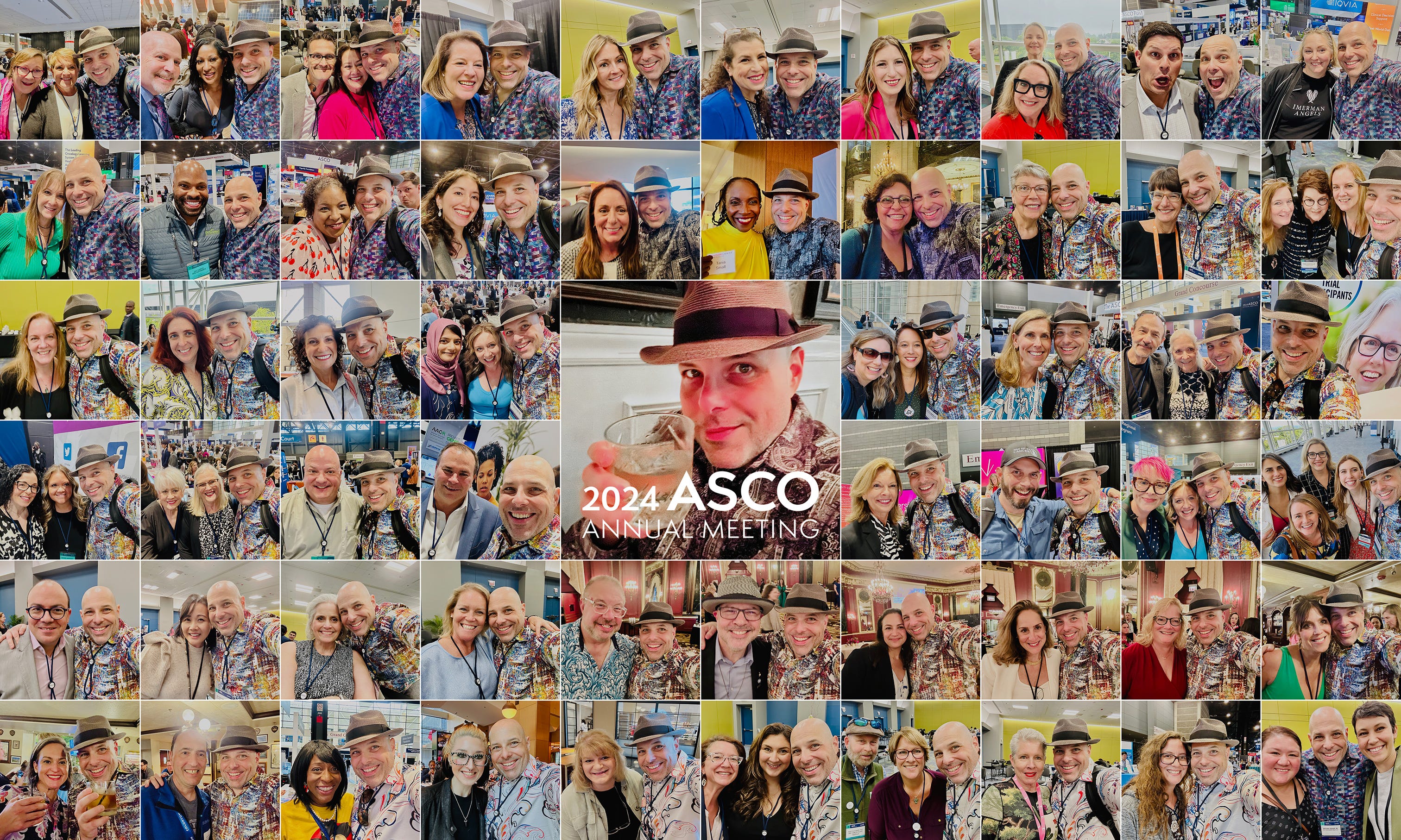
Another year, another 80,000 steps, and aching thighs after (at least for me) three days of epic reunions, random interactions, passion-filled conversations, new and exciting connections, social events, special presentations, workshops, briefings, and seminars.
Coming in as Press this year for the first time, I decided not to perseverate on the usual reporting topics such as the latest science and innovation but instead as your friendly neighborhood pseudo-journalist and "Greek Chorus observer" dissecting and opining on the intricacies of advocacy engagement and experience through the conference with gratitude and brutal honesty.
As a student of history, it's hard to see progress unless through the lens of perspective on where we were decades ago. After all, history is a teacher, and, as the cat posters say, "past is prologue."
For example, as shared in my documentary, The Cancer Mavericks: A History of Survivorship, the very word "survivorship" did not exist until 1986, wasn't put into practice or policy until 1998, and didn't become a standard of care until the mid-2000s, thanks to the efforts of many unsung advocacy heroes.
At my first ASCO in 2008, nonprofits didn't have much to contribute, and they were relegated to the cheap seats in the back of the exhibit hall with little to no value to the conference agenda or concern to the attendees.
The very concept and inception of the "Patient Advocacy Lounge" (PAL) were groundbreaking and extraordinarily well-received, as it was a long overdue validation and recognition of our value to the conference and the ASCO community.
While no longer a modicum of progress and more an institutionalized value, the PAL — as evidenced by ASCO's lack of response to last month's LinkedIn post (https://emz.ee/3X3Dcnc) asking to co-curate an advocacy master class — still remains a gaping missed opportunity.
Progress is slow, but it does happen, and I am optimistic that we've hit a tipping point for them to invest in further broadening and strengthening the critical and ever-deepening relationship between the patient advocate and the entire life sciences industry.
The events and workshops held with the PAL seemed thoughtfully curated. However, I did not understand that they considered what may have mattered most to the advocacy community outside of their well-intended assumptions. However, let's give ASCO big props for doubling the size of the PAL for 2024 to accommodate more people and provide a less cramped and more open environment conducive to more engaging and individualized conversations. For that, we are grateful.
The limited program kicked off with a relatively germane meet-and-greet with ASCO President Dr. Lynn M. Schuchter and President-Elect Dr. Robin Zon. But things heated up later when the new NCI Director, Dr. Kimryn Rathmell, took the stage. It would have been nice to see more butts in seats and engagement from the advocacy community, but the quantity of attendees was more than made up for by the quality of their questions.
It got a little tense and almost uncomfortable at one point when the advocates relentlessly grilled Dr. Rathmell about clinical trial mandates, DEI practices, and various other issues. Yes, we're passionate, but, IMHO, they toed the line on being disrespectful. And while I do not believe for a second that her participation should be considered lip service, I'm pretty sure she did not give of her time to be thrown to the wolves. Plus, she's brand new. At least let her put 100 miles on the engine before you floor the gas and drift in the Mall parking lot.
Next came the big announcement that the American Cancer Society (ACS) would be assuming content from ASCO, which received mixed reviews based on the many hot takes I received.
As I heard from attendees, ACS historically has not had the most favorable reputation for collaboration and outreach. Some attendees talked to me about their consistent closed-off rigidity and unwillingness to play in the sandbox with others, coupled with their ever-expanding "takeover of too many utensils in the kitchen," to quote one advocate.
"ACS rules prohibit me from sharing their info," said another attendee under the condition of anonymity.
So, as you can imagine, additional hot takes regarding the content partnership ranged from captiousness and skepticism to uncertainty and cockeyed optimism. But we shall see.
PAL programming concluded with a workshop about ASCO's current clinical trial imperatives in breast cancer facing older populations.
Outside the PAL, I was pleasantly surprised to see how far the nonprofit pavilion has come. Four large rectangles welcomed over 40 patient advocacy organizations, large and small. Font and center of the exhibit hall, to say it was a bustling area, would be an understatement. With my NPO hat on, I was very proud to see the evolution of NPO visibility to the tens of thousands of attendees. Back in the day, we were relegated to the dark crevasses of the back corners on proverbial picnic tables. So, once again, thank you, ASCO, for valuing our presence and honoring your commitment to keeping things budget-friendly.
Wrapping up with my "Standup Philosopher" hat on, I shall now coalesce the vapor of human experience into a viable and logical comprehension... in that I mean, here's what Stacy Hurt said:
"Patient engagement is not a rescue strategy. It should be an initial consideration for successful trial conduct as much as feasibility, regulatory, pharmacovigilance, etc.."
In conclusion, I've been attending ASCO since 2008, so through the lens of history and progress, I proudly sit atop a unique crow's nest with the best view possible to observe and report on all things life sciences, but always with a critical focus on the dual roles of the patient advocate, and the nonprofit patient advocacy communities: To support the community but to also support the industry.
We've always been here. All you need to do is ask. (And bring a check because we don't do things for free)
And now, in their own voices...
"I am always most impressed by the advocates who give every ounce of energy to ensure the people and patients they represent are heard. Unfortunately, these issues are not a priority for every company."
— Jody Hoyos, CEO, Prevent Cancer Foundation
"There's nothing quite like ASCO, where the sheer joy of gathering with your fellow patient advocates makes all the hard work worthwhile. However, the conference fell short by not offering more thoughtfully organized educational workshops, training, and networking events geared toward the patient advocate community. Perhaps 2025 will take advantage of what I consider a missed opportunity."
— Beth Blakey, Executive Director & COO, Cancer Hope Network
"While I am grateful for the number of clinicians and researchers who authentically desire to understand the perspective of patient advocates, I was disappointed to see many partners who spend time and money engaged in well-intentioned but largely ineffective activities."
— Craig Lustig, Associate Director. Georgetown Lombardi Comprehensive Cancer Center
"Kudos to the sheer number of Big Pharma giants hiring executives with lived cancer experience and patient engagement backgrounds. While this is a step in the right direction, the advocacy community requires better downstream lay speak to patients at all levels of scientific literacy."
— Trevor Maxwell, Founder & CEO, Man UpTo Cancer
"As a 1st-time patient advocate attendee, I was most impressed with the Patient Advocate Lounge, where more impactful conversations went down in the days than in the past three years of my career. With that said the Advocacy Pavilion was too compacted and not as conducive to engaging with fellow nonprofit staff and leadership."
— Kathy Baker. Founder & Executive Director, My Faulty Gene
"Nothing says collaboration than our annual convening at ASCO. Each year, I walk away more inspired and connected than before. We drop our egos and missions to learn from the industry, develop synergies, share leadership lifehacks, and face the same direction to support our patient communities without reinventing the wheel."
— Colin Ferro, Executive Director, Epic Experience
"ASCO is so many things to so many stakeholders. While at its core lies science and innovation, for those of us who do not don white lab coats, we still feel welcomed and seen within the oncology community."
— Tracy Rode, CEO, Patient Empowerment Network
"I love ASCO and what it stands for, but the patient advocate voice is always dwarfed against the event's backdrop. Connecting with peers is always a highlight, but as constructive feedback, differentiation is needed between nonprofit leaders and dedicated patient advocates."
— Megan Claire-Chase, Breast Cancer Program Director, SHARE Cancer Support