Thirty Years Later, I’m Going Home
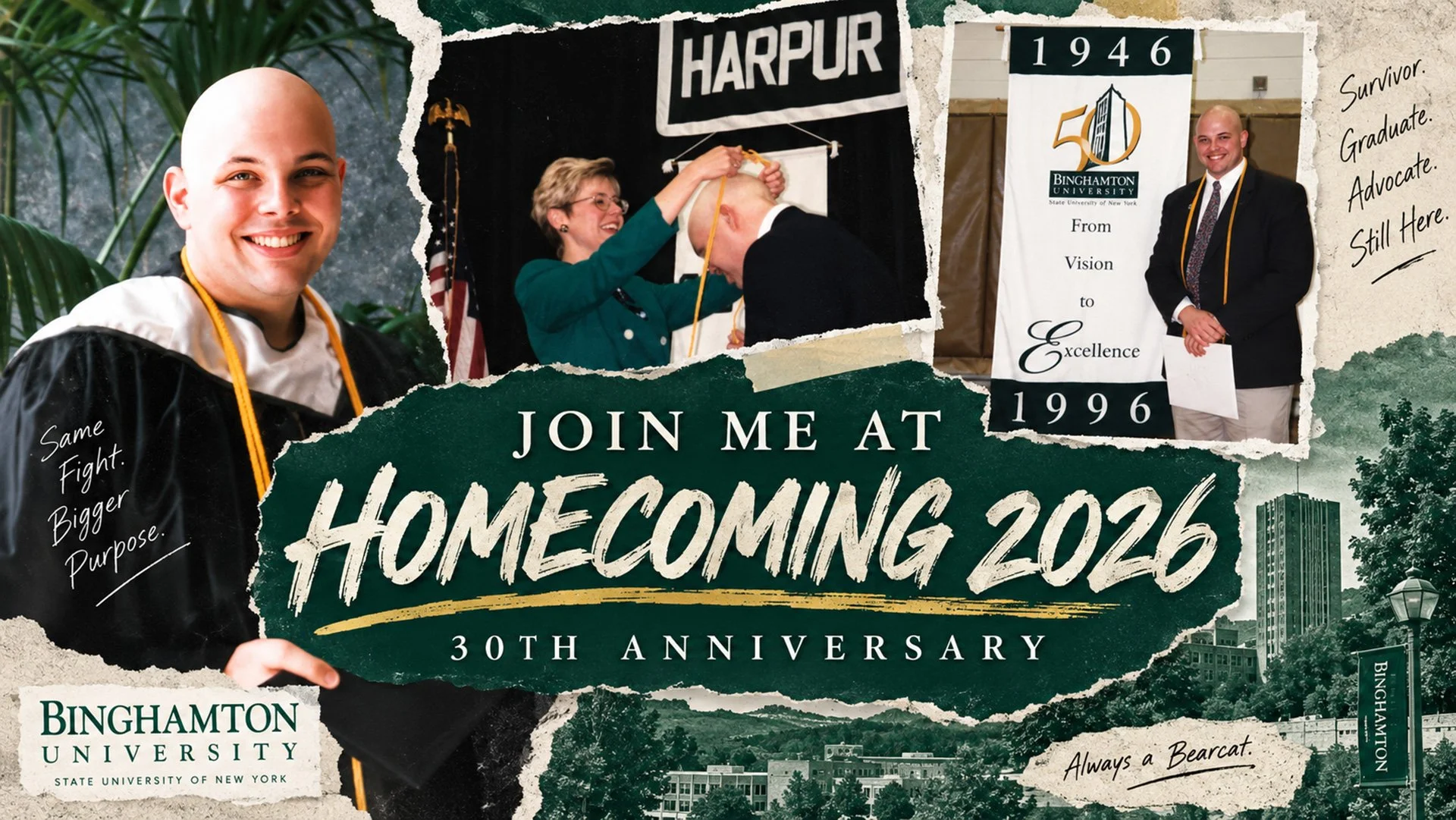
In the spring of 1996, Binghamton University was celebrating its 50th anniversary, which is how I ended up with a graduation photograph standing next to a giant banner that says 1946 at the top and 1996 at the bottom. I’m wearing a jacket and tie, khakis, gold honor cords, and the unmistakable haircut of someone going through cancer treatment.
I was 21 years old, although I look about 14 in the picture, and I had spent my senior year trying to graduate from college while being treated for brain cancer.
30 years later, I’m going back.
Binghamton has invited me to Homecoming this fall, and I have been almost embarrassingly excited about it. I’ll be meeting with the Dean of Harpur College, getting a tour of campus, attending the Paul Reiser concert, and spending time with students and alumni involved in music, theater, and the arts. I’m sure there will be buildings I don’t recognize, buildings I’m convinced used to be somewhere else, and at least 1 moment when I explain to somebody young enough to be my child that something very important used to be located right over there.
But this trip has become much more emotional for me than a nostalgic visit to college because 2026 marks 30 years since 2 things happened that I will never be able to separate from each other: I graduated from Binghamton, and I survived the year that cancer completely rearranged the trajectory of my life.
Before cancer, I was a pianist and composer. Music was not a hobby or something I did on the side. It was the organizing principle of my life and the future I expected to have. Then I was diagnosed with medulloblastoma during my senior year. I had brain surgery in January, followed by cancer treatment, and somewhere amid all of that I kept trying to finish college because apparently having a malignant brain tumor was not sufficient reason for me to stop worrying about graduating on time.
Cancer eventually took much of the future I had planned. Treatment damaged my hearing and my hands. The professional life in music I had imagined for myself became impossible, and there was no grand moment when I accepted that or gracefully pivoted to some exciting new purpose. Mostly, I was a very young person trying to survive something terrifying while everyone else my age was trying to figure out jobs, graduate school, relationships, apartments, and whatever normal people were supposed to worry about at 21.
That is 1 reason Binghamton has remained so important to me. It was the last place where the person I had been and the person I was becoming existed at the same time.
I was a cancer patient, but I was also still a student. I had doctors and treatment schedules and blood counts and scans, but I also had classes and professors and friends and music and a campus where I could still participate in a life that had nothing whatsoever to do with oncology. I don’t think I had the perspective at 21 to understand what that meant. 30 years later, I do.
There is something else about returning now that I never could have scripted.
Before Homecoming, I had the opportunity to send personally inscribed copies of We the Patients: Understanding, Navigating, and Surviving America’s Healthcare Nightmare, along with personal letters, to President D’Alleva and the leadership of Harpur College, Decker College of Nursing and Health Sciences, and the School of Pharmacy and Pharmaceutical Sciences.
Sitting there signing those books, the absurdity of the timeline finally caught up with me.
I entered the American healthcare system at Binghamton as a 21-year-old college senior with brain cancer. I knew absolutely nothing about healthcare because why the hell would I? I was trying to become a musician. Healthcare was a place you went when something was wrong and presumably a collection of responsible adults figured out what to do next.
30 years later, I have somehow written a book about the system I entered that year and spent most of my adult life trying to understand. I get to bring that book back to the university where this entire accidental career began, although nobody standing around me in 1996 could possibly have known that anything was beginning.
Certainly not me.
The strangest thing about surviving cancer for a very long time is that people inevitably tell the story backward. Once everyone knows you survived, the uncertainty gets edited out. The photographs become inspirational artifacts and the ending starts to feel inevitable, even though nothing about it felt inevitable to the person actually standing there.
When I look at those graduation pictures today, I know the bald kid in them gets 30 more years. He gets married. He has twins. He builds organizations and starts a radio show that somehow becomes a podcast and spends decades advocating for people whose lives have been sideswiped by illness. He gets to travel and speak and write and piss people off. Eventually, he publishes We the Patients: Understanding, Navigating, and Surviving America’s Healthcare Nightmare, a book about the healthcare system he first encountered when he was far too young to understand what it would ultimately mean to him.
I know all of that when I look at the picture now, but he knew none of it when the shutter clicked.
That is the part I keep coming back to as Homecoming approaches. I don’t really want to commemorate 30 years since I “beat cancer,” because I have never been comfortable with the tidy vocabulary of winning and losing disease, and I’m not particularly interested in giving cancer ownership of the anniversary anyway. What moves me is the 30 years themselves and the almost incomprehensible amount of ordinary life contained inside them.
Marriage, parenthood, friendships, careers, failures, reinventions, terrible decisions, good decisions, airports, birthdays, funerals, deadlines, arguments, inside jokes, watching my children grow up, watching myself grow older, and discovering that a life can become almost completely different from the 1 you planned without becoming any less yours.
Which is also why I’m particularly excited about spending time with the students and alumni studying music, theater, and art.
I don’t want to walk onto campus and deliver some survivor sermon about following your dreams because sometimes you don’t get to follow the dream. Sometimes the dream gets taken away from you through no fault of your own, and you have to live long enough to discover that there may be other things you are supposed to do. I had no idea that would be my story when I left Binghamton, and I certainly would not have believed anyone who tried to explain it to me.
I’m also looking forward to the wonderfully normal parts of going back. I get to walk around campus and see what changed and what somehow survived 3 decades of construction committees. I get to meet people, see Paul Reiser, and be around musicians and actors and artists again. Most of all, I get to visit the university as a 52-year-old husband, father, author, and advocate instead of the bald 21-year-old cancer patient who was desperately trying to finish his degree.
Somewhere during the weekend, I want to find the place where those old graduation photographs were taken. I don’t need some elaborate recreation, although knowing me there will probably be a photograph. I just want to stand there for a minute and consider the distance between the person who left in 1996 and the person coming back in 2026, because there are very few moments in life when you get such a clean view of the road behind you.
Most of the time we are too busy living to notice the accumulation. 30 years disappear into workdays and school pickups and doctor appointments and dinners and flights and all the other completely unremarkable things that turn out, eventually, to have been your life.
In 1996, I graduated from Binghamton University at 21 while going through cancer treatment with no idea what would happen next. Now, 30 years later, I have the extraordinary privilege of going back to the place where so much ended, so much began, and where, without realizing it at the time, I started becoming the person who gets to return in 2026.