[ICYMI] Your Denial Doesn’t Have to Be Correct. It Just Has to Exhaust You.
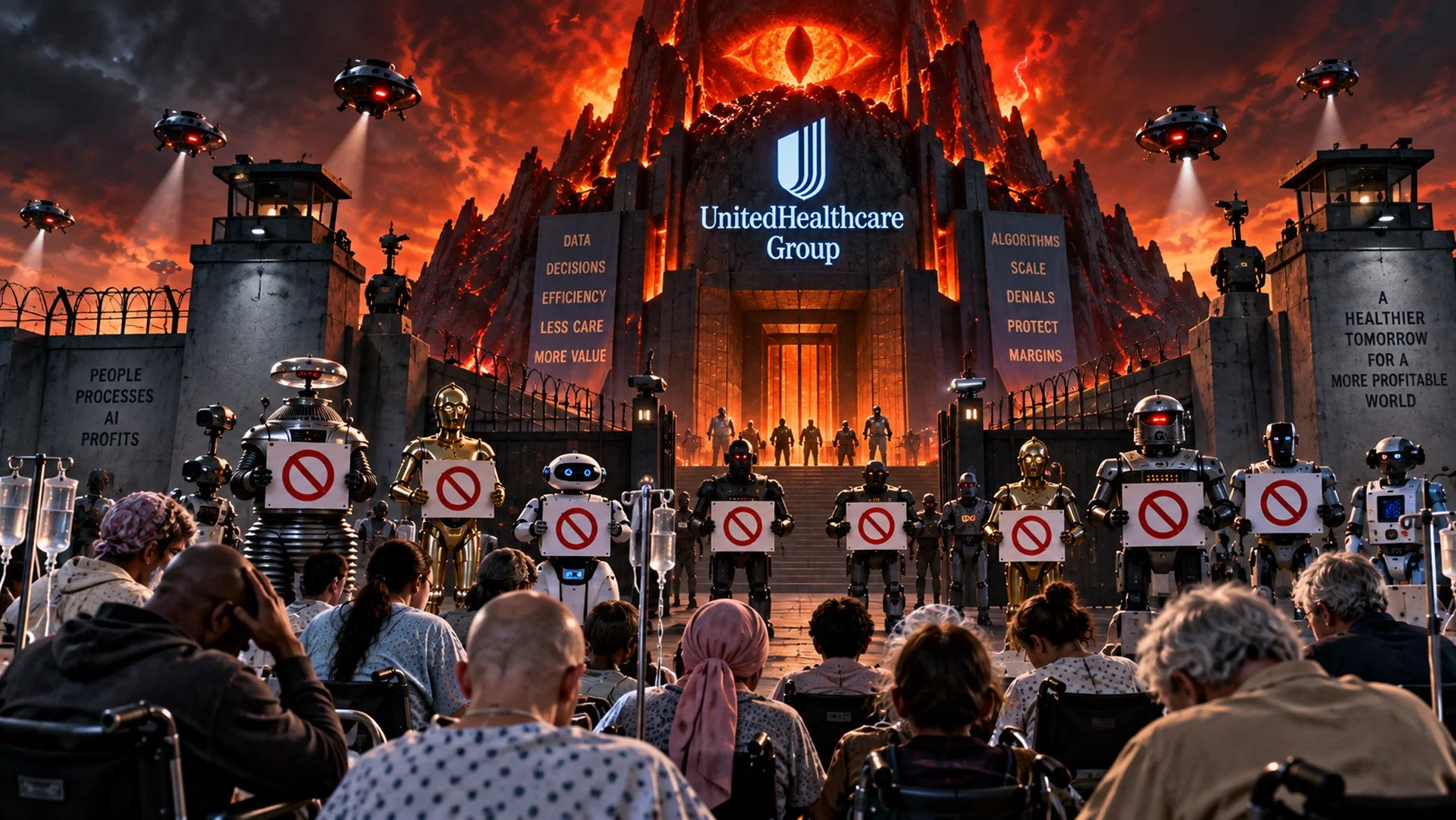
Way back in what now feels like 1722, by which I mean March of 2026, a federal judge ordered UnitedHealth Group to turn over documents about an algorithm called nH Predict.
I somehow missed this particular episode of American healthcare fuckery when it happened. In my defense, five months in American healthcare now feels roughly equivalent to the time between the invention of fire and the premiere of The Real World. There is always another acquisition, another denial, another congressional hearing, another CEO explaining that the thing everybody can plainly see happening is considerably more complicated than everybody can plainly see.
But this one is worth going back for, because nothing about the underlying problem feels particularly historical.
UnitedHealth Group is being sued over allegations involving nH Predict, an algorithm used in connection with post-acute care for Medicare Advantage patients. The plaintiffs allege that more than 90 percent of claim denials were reversed when appealed. They also allege that more than 80 percent of prior-authorization denials were reversed.
Please enjoy this brief Windows 95 error sound while that sinks in.
UnitedHealth Group disputes the allegations and denies using nH Predict to make coverage determinations. The litigation is ongoing, and allegations in a lawsuit are exactly that: allegations. But in March, the federal magistrate judge overseeing discovery ordered the company to produce documents concerning the development and use of nH Predict, writing that UnitedHealthcare’s alleged use of the system was “at the heart” of the plaintiffs’ claims.
And this is where the story gets much more interesting to me than another argument about artificial intelligence.
Because whether a computer denied the care, recommended the denial, informed the person considering the denial, predicted how much care somebody should need, or sat in the corner playing Minesweeper while a human being denied the care, the patient encounters exactly the same word:
DENIED.
We have spent an enormous amount of time debating whether AI should be allowed to make decisions about healthcare, and we should. There are enormous questions here about transparency, accountability, bias, clinical judgment, due process and what happens when an algorithm optimized inside a corporation collides with a human being whose body has inconveniently declined to behave like the model predicted.
But there is another question hiding underneath all of this, and it has almost nothing to do with artificial intelligence.
What happens after the denial?
You’re sick. Your doctor says you need care. Your insurance company says you don’t get it. Now the administrative burden transfers almost magically from the multibillion-dollar corporation that said no to the sick person who needs to prove that no should have been yes.
You have to understand that you can appeal. You have to find out how. You have to locate the right form, portal, fax number, phone number, department, case number or human being who may or may not exist. You may have to get your physician involved again. You may need records. You may need another letter. You may need to call repeatedly. You may need to explain the same story to four different people while taking notes because someday somebody will ask you whom you spoke with on August 17 at 2:13 p.m., and apparently your failure to document the conversation with Denise in Prior Authorization is now a character flaw.
All while you are sick.
That last part tends to disappear when healthcare people talk about “administrative burden.” Administrative burden sounds like your accountant asked you for another W-2. It does not adequately describe telling somebody recovering from a stroke, living with cancer, managing a disabled child, caring for an aging parent or trying to get through Tuesday with a chronic illness that congratulations, you have just been promoted to unpaid claims specialist.
And this is why the reversal numbers in the UnitedHealth Group lawsuit bother me so much.
If the plaintiffs’ allegations are ultimately borne out, the obvious question will be how so many initial decisions could have been reversed. But there is another number we may never know, and I think it matters just as much: How many people never appealed at all?
How many assumed DENIED meant denied?
How many trusted that somebody with greater knowledge, authority or medical expertise had carefully reviewed the facts and reached a conclusion?
How many were too sick, too scared, too exhausted, too poor, too busy, too overwhelmed or simply too unfamiliar with the machinery to fight back?
That is where this stops being an AI story and becomes an American healthcare story.
A denial does not have to be correct to work. It just has to exhaust you.
That sentence has been rattling around in my head because it explains so much of what patients experience without requiring some cartoon conspiracy in which insurance executives sit around a conference table stroking white cats and plotting our demise. Systems do not require evil masterminds when incentives will do the work perfectly well.
If creating friction reduces utilization, friction has economic value.
If requiring another form causes some percentage of people to abandon a claim, the form has economic value.
If requiring another appeal causes another percentage to disappear, the appeal process has economic value.
And if the people most likely to give up are also the sickest, oldest, poorest, least educated, least technologically fluent or least able to spend six hours on the telephone, then what healthcare calls “process” begins looking suspiciously like a sorting mechanism.
This is one of the reasons I wrote We the Patients: Understanding, Navigating, and Surviving America’s Healthcare Nightmare. I wanted patients to understand that the machinery surrounding their healthcare is not some natural phenomenon that descended from the heavens. People built it. Laws shaped it. Corporations operate inside it. Incentives influence it. And patients have been conditioned for decades to encounter its decisions as though Moses came down from Mount Sinai carrying a third tablet engraved with:
THOU SHALT NOT RECEIVE COVERAGE.
No.
A denial is a decision made inside a system. Decisions can be challenged. Appeals can succeed. External reviews exist. Regulators exist. Laws exist. Rights exist. None of that means the process is easy, fair or remotely appropriate for someone simultaneously trying to remain alive. It means patients need to understand what the word DENIED actually means before surrendering to it.
Because here we are, five months after that discovery order, approximately three centuries in Internet Time, still having the same conversation about prior authorization, algorithmic decision-making and patients fighting for care their physicians believe they need.
Which is why I went back to March.
The lawsuit will work its way through the courts. The documents may tell us considerably more about how nH Predict was actually used, and UnitedHealth Group will have every opportunity to defend itself. Those facts matter, and we should follow them wherever they lead.
But patients do not need to wait for the litigation to understand the larger lesson.
When your insurance company says no, ask why. Ask what criteria were used. Ask who made the decision. Ask whether a physician reviewed it. Ask how to appeal. Ask about external review. Write down names, dates and reference numbers. Make them explain the machinery that produced the answer.
And if you have the strength, keep going.
Because sometimes the most important word on a denial letter isn’t DENIED.
It’s APPEAL.