Charles Dickens Would Have Loved American Healthcare
We cured Victorian medicine and kept everything else.
“It was the best of times, it was the worst of times.”
Charles Dickens wrote that in 1859, which means he somehow managed to summarize American healthcare approximately 165 years before anybody had ever heard of a pharmacy benefit manager.
This has been bothering me lately. Not Dickens personally. I have nothing against the man. I read the books. I survived the required encounters with Great Expectations, Oliver Twist, A Christmas Carol and A Tale of Two Cities, and somewhere along the way I came to appreciate what Dickens was actually doing beneath all the fog, orphanages, debtors, waistcoats and people saying things that sounded vaguely like “Gov’nah.”
Dickens was fascinated by what happened when institutions supposedly created to deal with human problems became so consumed by their own rules, procedures and self-preservation that the actual humans became almost incidental. His world was populated by workhouses, courts, schools and bureaucracies that could explain in extraordinary detail why they were unable to help the miserable person standing directly in front of them.
Which, pip pip cheerio, brings us to American healthcare.
There has probably never been a better time in human history to get catastrophically sick. We can sequence tumors, replace joints, transplant organs, manipulate immune systems into attacking cancer and perform surgery with robots. Diseases that once meant certain death can become chronic conditions, and treatments that sounded like science fiction when I was diagnosed with brain cancer 30 years ago are now just things somebody complains about having to drive to New Jersey for.
I am not being glib about that part. I am alive because modern medicine was capable of doing extraordinary things to me in 1996. Some of them were barbaric, some left permanent damage, and all of them beat the alternative.
Unfortunately, there has probably never been a more administratively sophisticated time in human history to be catastrophically sick either.
Tiny Tim Meets the American Healthcare System
Nobody actually knows what was wrong with Tiny Tim. Dickens never tells us, and physicians have been reverse-engineering the poor fictional child’s medical chart ever since. Medical literature has proposed everything from rickets and tuberculosis to cerebral palsy and renal tubular acidosis.[1] I’m staying out of it because the last thing Tiny Tim needs is another nonphysician on the Internet diagnosing him.
Put him in 2026 and the possibilities change dramatically. He has advanced imaging, genetics, pediatric subspecialists, medications, surgery and an arsenal of modern medicine Bob Cratchit could not have imagined. Whatever his condition, he has diagnostic and therapeutic possibilities that would have looked like witchcraft in Victorian England.
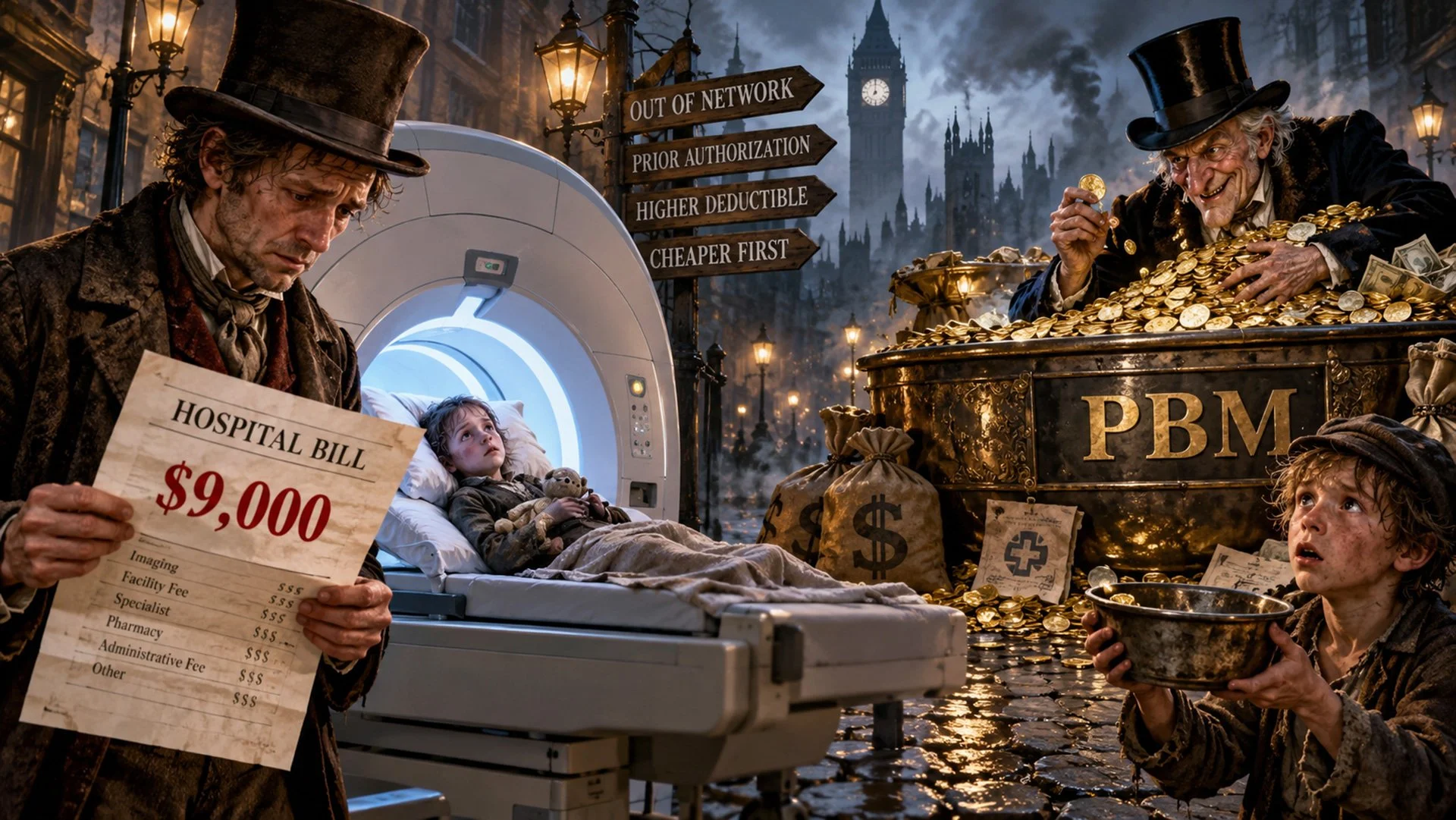
The good news is that Tiny Tim might live. The bad news is that Bob has employer-sponsored health insurance.
That distinction matters.
The average annual premium for employer-sponsored family coverage reached nearly $27,000 in 2025, according to KFF, with workers contributing an average of $6,850 themselves.[2] Depending on Bob’s plan, there may also be deductibles, coinsurance, networks, formularies and out-of-pocket costs waiting for the Cratchits once somebody actually gets sick. Having health insurance and being able to afford to use healthcare are not always the same thing.
So the pediatric specialist could be out of network. The medication could exist but require prior authorization. The pharmacy benefit manager might prefer another drug, which Tiny Tim may have to try first. The insurer may want additional documentation demonstrating medical necessity, which is apparently different from the documentation submitted by the physician who said the treatment was medically necessary.
Bob calls the number on the back of his insurance card and hears music. Christmas arrives while he is still on hold.
God bless us, every one.
God, however, is out of network.
Then there’s Oliver Twist, a desperately poor child processed through institutions ostensibly designed to deal with desperately poor children. Modern America would immediately recognize that Oliver has complex needs, because we are exceptionally good at recognizing complex needs. We would screen him for food insecurity, housing instability and adverse childhood experiences, carefully enter everything into an electronic health record, then give him a list of phone numbers for community resources.
“Please, sir, I want some more.”
“Certainly, Oliver. Have you tried the portal?”
The portal would tell him to call the office. The office would tell him to use the portal. Somewhere in London, Dickens would put down his quill and mutter, “Bit much, innit?”
The joke works because the underlying problem isn’t funny. The person standing inside this machinery may be sick, scared, exhausted, parenting, working, caring for someone else or trying to understand a diagnosis they learned 20 minutes ago. We keep handing people complexity precisely when they have the least capacity to absorb it.
I have spent enough of my life around patients to know that most people do not want to become experts in healthcare navigation. They become experts because something happened to them.
Scrooge Discovers Employee Benefits
And then there is Ebenezer Scrooge. The obvious move would be to make him the CEO of a health insurance company, because we have collectively decided that every healthcare story requires a villain twirling his mustache in a corner office.
But I think Scrooge is much more interesting as Bob Cratchit’s employer.
Imagine his confusion. Scrooge is already paying an obscene amount toward employee health benefits, and every year that amount goes up. His consultant explains that this is because healthcare costs keep increasing, an explanation for which the consultant will presumably send another invoice. Meanwhile, Bob still cannot afford Tiny Tim’s care.
This is not entirely fictional economics. That nearly $27,000 average family premium is being divided between employer and employee before anyone encounters the actual cost-sharing that comes with using the plan.[2] Employers spend enormous amounts purchasing healthcare for workers, workers spend enormous amounts participating in it, and both can arrive at the end wondering how everybody paid so much for something that remains so difficult to use.
Scrooge wants to know where all the money went. His health plan has an answer. So does his benefits consultant. His pharmacy benefit manager has several answers, although understanding them may require an advanced degree in medieval alchemy. There may also be a specialty pharmacy, a third-party administrator, a utilization-management vendor, a stop-loss carrier, a navigation company and possibly another company whose entire business model is helping employees understand the companies Scrooge is already paying to help his employees.
Everybody has dashboards, metrics and PowerPoints demonstrating the extraordinary value they created. Everybody saved Scrooge money. Scrooge somehow has less money, Bob Cratchit is crowdfunding Tiny Tim’s treatment, and the benefits consultant would like to schedule a meeting to discuss next year’s strategy.
At this point, Scrooge might reasonably ask the Ghost of Christmas Yet to Come whether death is still on the table.
Charles Dickens Invented Prior Authorization
But my favorite Dickensian contribution to American healthcare may be Bleak House.
At the center of the novel is Jarndyce v. Jarndyce, a case trapped in England’s Court of Chancery for so long that lives become organized around it, generations become entangled in it and, eventually, legal costs consume the estate everyone has been fighting over.
Charles Dickens invented prior authorization.
Officially, prior authorization is considerably less sinister. It is a process through which a health plan may require approval before a patient receives a service, treatment or prescription. CMS describes it as a mechanism payers use to control costs and determine whether care meets coverage and medical-necessity criteria.[3] That is the institutional explanation, and there are legitimate reasons not to pay indiscriminately for every medical service anyone happens to order.
Then the institution encounters the human.
A doctor prescribes something and the insurer denies it. The physician submits documentation, the insurer requests different documentation, and someone schedules a peer-to-peer review, a phrase that suggests 2 physicians thoughtfully discussing medicine but can also mean your doctor spending Tuesday afternoon trying to convince someone employed by a health plan that they meant it when they prescribed the thing they prescribed.
The American Medical Association’s most recent physician survey reported an average of 40 prior authorizations per physician per week, consuming about 13 hours of physician and staff time. Forty percent of physicians surveyed said their practices employed staff dedicated exclusively to prior authorization.[4] CMS itself has acknowledged that the process can create unnecessary delays, administrative burden and barriers between patients and care.[5]
Then come the appeals, reviews, resubmissions and faxes, because healthcare remains the last known natural habitat of the fax machine.
Eventually, the patient may receive the treatment. Or not. But the process will have been followed beautifully.
That is the part Dickens would recognize.
His stories weren’t simply about poverty, cruelty or rich people behaving badly. Again and again, Dickens returned to institutions whose internal logic had become more important than the people they ostensibly existed to serve. The machinery had rules. The rules had history. Everyone inside the machinery could explain why the machinery worked the way it did.
Meanwhile, somebody still needed help.
After 30 years inside American healthcare, first because brain cancer put me here and later because I apparently developed the unusual hobby of refusing to leave, that distinction has become impossible for me to ignore. It runs through much of what eventually became We the Patients: American healthcare can be filled with good people doing remarkable work and still produce outcomes that are bewildering, expensive and cruel. You do not need a secret cabal or a cartoon villain to create that result. Sometimes incentives, regulations, contracts, business models and institutional self-preservation will do just fine.
That may be what makes the Dickens comparison feel less cute the longer I sit with it.
American medicine has achieved things Dickens could barely have imagined. The science is astonishing. The people who practice it routinely do things that would have looked like sorcery in Victorian England. We solved problems his characters could not solve, then surrounded those solutions with an administrative and financial infrastructure he would have recognized immediately.
Tiny Tim can have access to extraordinary medicine, assuming Bob can afford to use it. Oliver can receive world-class care, assuming somebody can figure out which phone number he is supposed to call. Scrooge can spend a fortune providing health benefits his employees still struggle to use. And Jarndyce v. Jarndyce can finally be settled, just as soon as someone finishes the peer-to-peer.
It was the best of times. It was the worst of times.
The tragedy is that, in American healthcare, they are increasingly the same time.