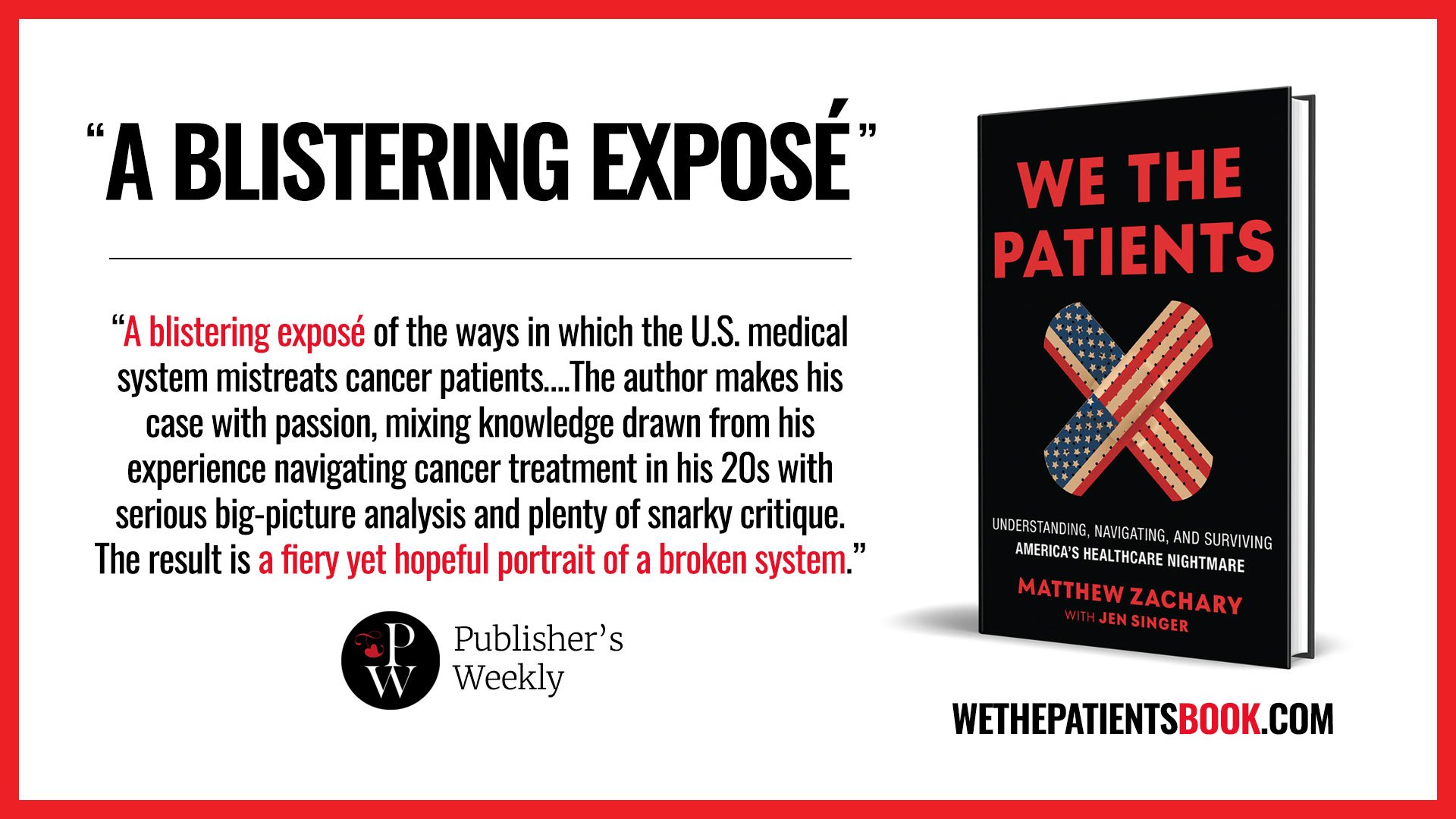
When I wrote We the Patients: Understanding, Navigating, and Surviving America’s Healthcare Nightmare, I had a reasonably clear idea of what I was doing. Or at least I had convinced myself that I did.
I was writing a book for patients, caregivers, and anyone who has ever entered the American healthcare system and wondered whether they’d accidentally wandered into a Kafka novel administered by UnitedHealthcare. It was part history, part civics lesson, part survival guide, part indictment, with enough Gen X gallows humor to keep everyone from throwing themselves into traffic.
What I was not writing was a medical textbook.
And yet, somehow, the book appears to be wandering toward medical education.
I recently had the privilege of speaking to scholars in the Robert A. Winn Excellence in Clinical Trials Award Program, an extraordinary group of future physicians and physician-scientists. We talked about healthcare from the side of the system where patients actually live: trust, bureaucracy, insurance, incentives, navigation, communication, power, and all the other things nobody puts on the examining-room wall next to the anatomical poster of the pancreas.
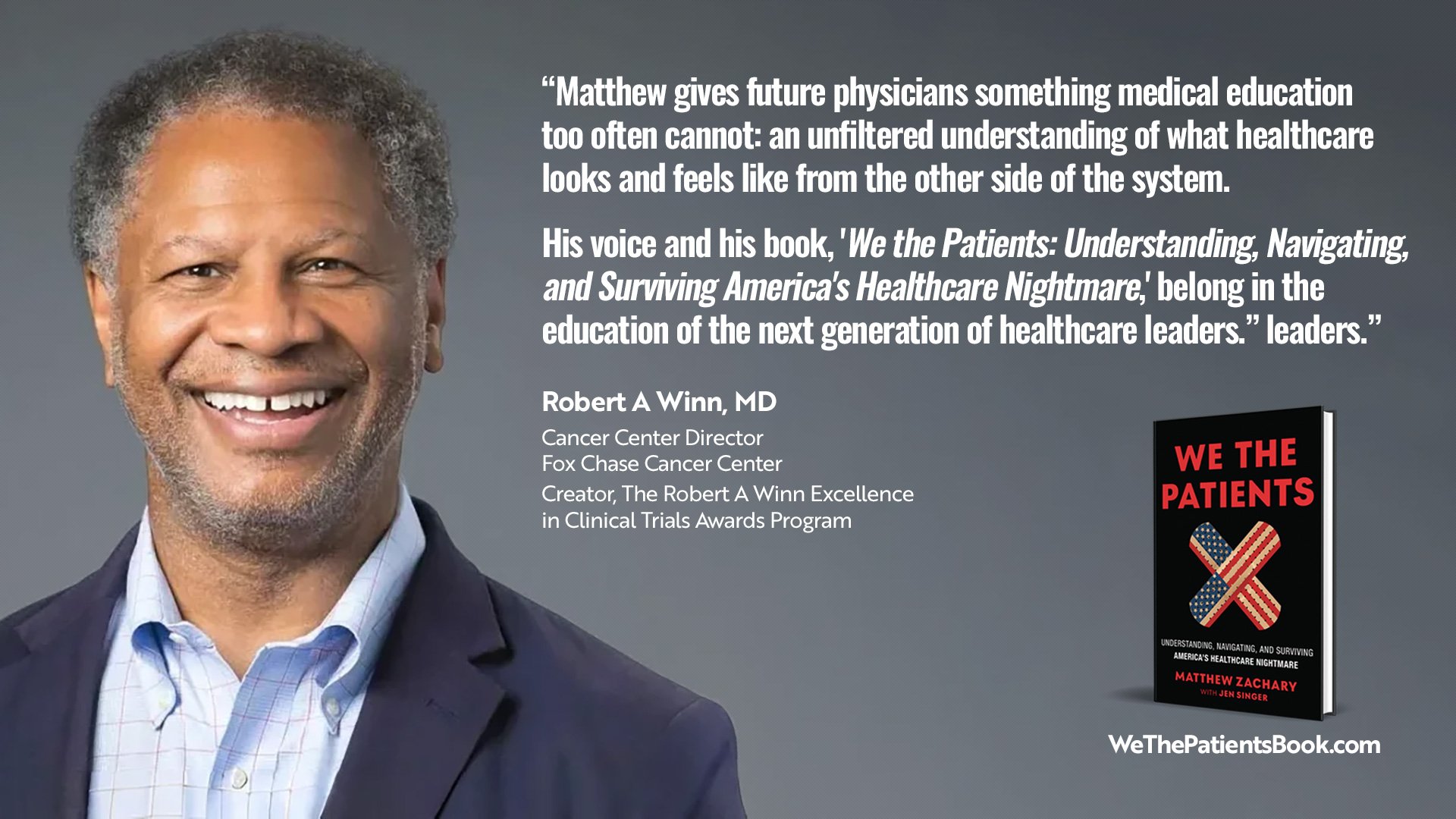
Then Dr. Robert A. Winn said this:
“Matthew gives future physicians something medical education too often cannot: an unfiltered understanding of what healthcare looks and feels like from the other side of the system. His voice and his book, ‘We the Patients: Understanding, Navigating, and Surviving America’s Healthcare Nightmare’, belong in the education of the next generation of healthcare.”
🤯
I have spent 30 years in and around cancer, advocacy, healthcare, media, policy, and the general three-ring circus we politely call the American healthcare system. I have received some extraordinary praise for this book. But belongs in the education of the next generation of healthcare was not on my bingo card.
And apparently Dr. Winn isn’t alone.
Over the past several months, physicians, researchers, educators, and academics have begun talking to me about my book as something that could have a place in medical education, public health, health policy, healthcare administration, and other disciplines. Wiley has now expanded the book into its academic channel, driven by interest from medical and academic audiences. There are early conversations about coursework and curriculum integration, and I’ve received some remarkable encouragement from people who actually know what they’re talking about when it comes to educating healthcare professionals.
“Few books capture the patient experience with the honesty and clarity found in We the Patients. Matthew Zachary provides a firsthand account of what patients and families face navigating diagnosis, treatment, and survivorship , offering future clinicians valuable insight into the realities that exist beyond the clinic.”
Henry Friedman, MD
Deputy Director, Preston Robert Tisch Brain Tumor Center at Duke University Medical Center
“As physicians, we spend much of our training learning to diagnose and treat disease, far less on understanding what patients and families experience navigating the system itself. We the Patients offers a candid look at the obstacles that shape care long before treatment begins.”
Allyson Ocean, MD
Professor of Clinical Medicine
Weill Cornell/NewYork-Presbyterian
“We the Patients offers a perspective missing from academic coursework on healthcare systems and policy. Matthew Zachary examines how insurance design, administrative burden, and institutional decision-making shape patient outcomes in ways rarely visible from within the system itself.”
Elizabeth Cohn, RN, PhD, FAAN
Professor of Medicine
CUNY School of Medicine
Which leaves me in the slightly surreal position of watching a decidedly non-academic book develop an academic life.
How the hell did that happen?
Maybe precisely because it isn’t a textbook.
Medical education is very good at teaching medicine. But there is another education in American healthcare that tends to begin only after somebody hands you a gown that doesn’t close in the back. Patients learn about administrative burden, insurance design, fragmented care, financial toxicity, perverse incentives, communication failures, and the enormous difference between how healthcare is designed on paper and how it feels when you’re the human being trapped inside it.
So I’ve become fascinated by a question I never intended to ask when I wrote this thing: What happens if we expose future healthcare professionals to more of that reality before their patients have to teach it to them?
I don’t know. And that’s the part that excites me.
I’m not declaring my book the missing Dead Sea Scroll of medical education. Nobody needs that, least of all medical education. But enough smart people are independently tugging on the same thread that it seems worth following, thoughtfully and with actual academic rigor, to see where it goes.
There is something deeply weird and wonderful about discovering that a book may have ambitions its author didn’t give it. You spend years writing the damn thing, deciding what it is and whom it’s for, and then you send it out into the world where, apparently, you are no longer management.
I thought I was writing something for patients about healthcare.
Increasingly, other people are making me wonder whether I also wrote something for healthcare about patients.
If that’s true, even a little bit, it would give this book a purpose I never knew to ask for. And if it can eventually help even a few future physicians, nurses, pharmacists, researchers, administrators, or policymakers understand what healthcare looks like from the other side of the system, then all I can really say is…
How the hell did that happen?
And thank you, Dr. Winn, for making me wonder.