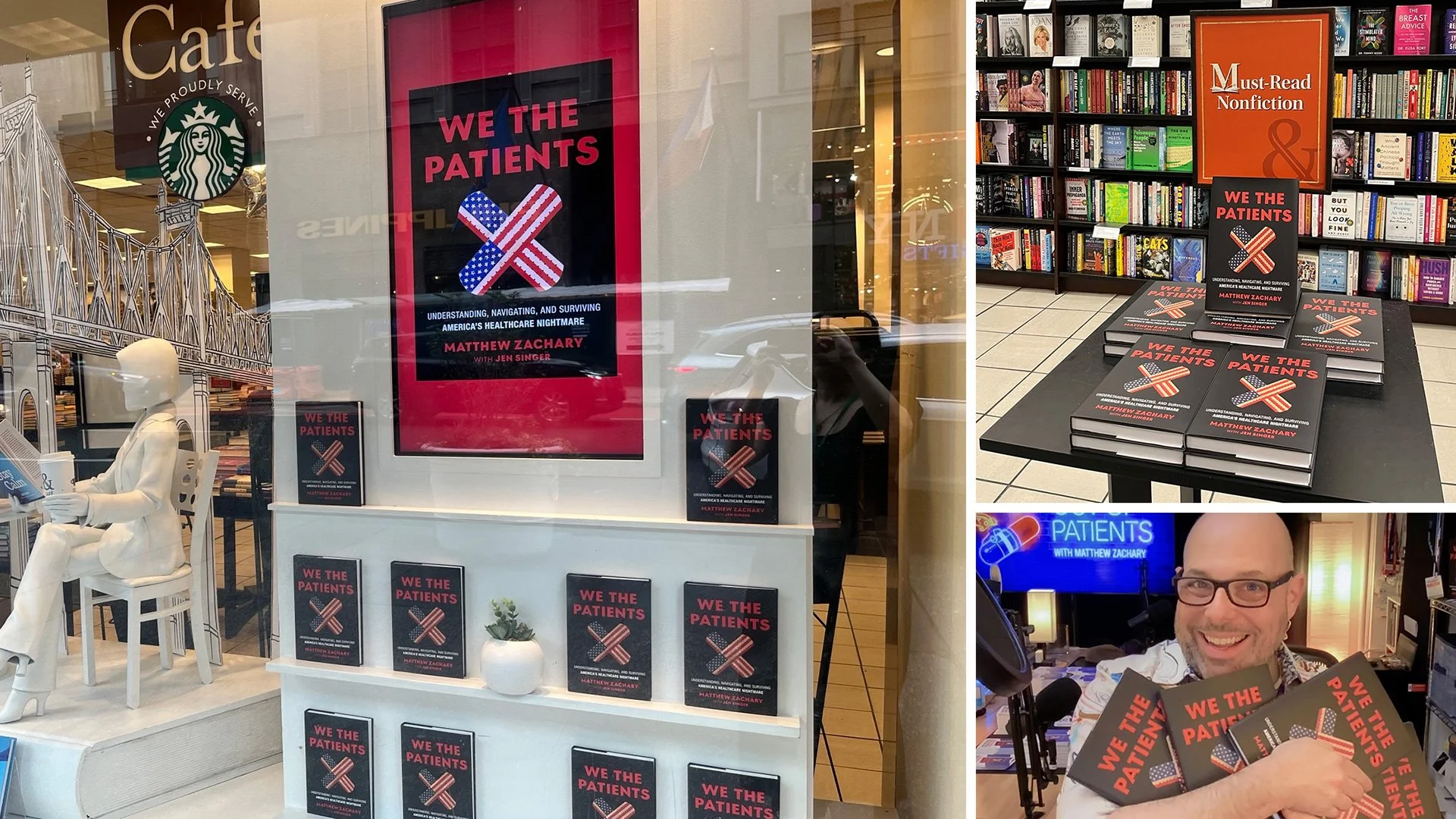
Today I walked up Fifth Avenue in Manhattan and saw something I was not remotely emotionally prepared for: my fucking book was in the window of Barnes & Noble.
Not “available at Barnes & Noble.” Not tucked somewhere in Health & Wellness between a book about gut bacteria and another one explaining why I should meditate more. We the Patients: Understanding, Navigating, and Surviving America’s Healthcare Nightmare was featured in the front window of the flagship Barnes & Noble on Fifth Avenue, complete with a gigantic reproduction of the cover and stacks of books underneath it. Then I walked inside and found another pile sitting on the Must-Read Nonfiction table.
There are occasions when language fails you, even after someone has inexplicably paid you to write a book. This was one of them. I stood outside taking pictures and staring through the glass, went inside, stared some more, went back outside, and generally behaved the way you might expect someone to behave after discovering that a piece of prime Fifth Avenue commercial real estate had temporarily been converted into a monument to the thing he has been yelling about for most of his adult life.
Thirty years ago, none of this was particularly foreseeable. In 1996, I was 21 years old when I was diagnosed with brain cancer. I wasn’t thinking about healthcare policy or patient advocacy or writing books. I certainly wasn’t imagining that three decades later my name would be hanging in a bookstore window in Manhattan. I was trying not to die.
Cancer eventually introduced me to an entire universe I didn’t know existed, and unfortunately I’ve had plenty of time since then to get acquainted with it. Insurance, billing, access, survivorship, clinical trials, financial toxicity, prior authorization, advocacy, and all the strange little systems surrounding the supposedly straightforward business of keeping human beings alive. I started talking about those things, then organizing around them, and eventually spent 25 years professionally yelling about them. Apparently enough of that accumulated to fill a book.
But standing on Fifth Avenue today, I realized it wasn’t actually my name in the window that was getting to me. It was the three words above it: We the Patients.
That’s the argument I’ve been trying to make for years, and ultimately the reason I wrote the book. American healthcare has no shortage of organized constituencies. Hospitals have associations. Doctors have associations. Insurers have associations. Pharmaceutical companies have associations. Employers have associations. Everybody has lobbyists, trade groups, PACs, policy shops, consultants, lawyers, conferences, acronyms, and presumably very nice hors d’oeuvres.
Patients have stories.
We have millions upon millions of them, and they’re remarkably familiar once people start comparing notes. The claim that got denied. The medication we couldn’t afford. The specialist who wasn’t in-network. The prior authorization that disappeared into whatever administrative wormhole prior authorizations go to die in. The bill nobody could explain. The diagnosis that changed everything. The three-hour phone call with an insurance company. The person we loved who got swallowed by all of it.
The problem is that we tend to experience these things separately, complain about them separately, and survive them separately. What looks like an individual nightmare from inside your own life often turns out to be a mass-produced experience once you hear from enough other people. Yet somehow, the largest group in American healthcare has rarely behaved like a group at all.
That was the book I wanted to write. Not another manual teaching patients to become better consumers of healthcare. Not another inspirational survivor story. Not 300 pages of “be your own advocate,” as though the fundamental defect in a $5 trillion healthcare system is that sick people simply aren’t trying hard enough. I wanted to explain the machine: how we got here, who benefits, why so much of what patients experience as random bureaucratic insanity isn’t random at all, and what might happen if the people who actually use American healthcare stopped behaving exclusively as individual customers and started recognizing themselves as a constituency.
Which is probably why that bookstore window affected me more than I expected.
For most of my career, patient advocacy has happened inside healthcare. We gather at healthcare conferences, speak on healthcare panels, attend healthcare summits, testify at healthcare hearings, and spend an enormous amount of time talking to people who already understand that something has gone terribly sideways. There was something different about seeing that giant American-flag Band-Aid staring out onto Fifth Avenue at anybody who happened to walk past.
Maybe I’m reading too much into a bookstore window. I’m the author. I’m allowed.
But books are funny things. You spend years making one in private, then one day it stops belonging entirely to you. People buy it, underline things, argue with it, recommend it, hand it to friends, post pictures of it, write reviews, and email you stories you wish they never had reason to tell. We the Patients went back to press, and then it went back again. Somewhere along the way, what began as a book started finding people who recognized themselves in its argument.
None of that happens because an author wants it badly enough. It happens because readers decide something is worth carrying forward. So thank you to Wiley for believing there was a book here, to Jen Singer for helping me wrestle decades of accumulated healthcare insanity onto the page, to everyone who trusted me with their stories, and especially to the readers who have bought it, reviewed it, recommended it, posted about it, and put it into somebody else’s hands.
And thank you to Barnes & Noble for putting patients in the fucking window.
I’ve spent most of my adult life trying to get patients into rooms where somebody else decided whether we belonged. For one ridiculous, wonderful week, we’re on Fifth Avenue.
I’m going to take the win.
Then we’ll get back to work.