Breaking Up Big Medicine
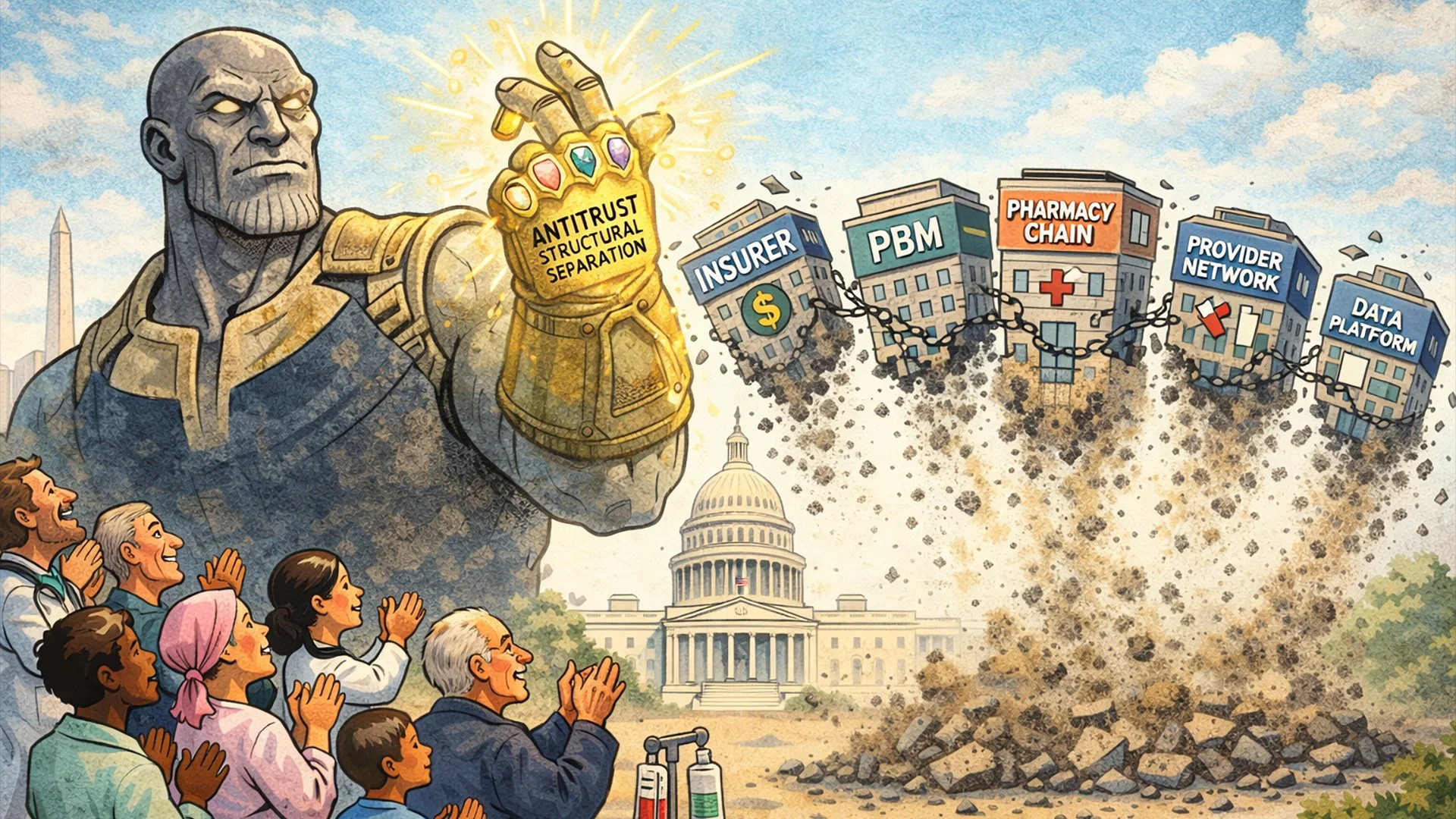
Congress rarely produces moments where ideology steps aside and structure takes center stage. The Break Up Big Medicine Act introduced by Senators Josh Hawley and Elizabeth Warren signals one of those moments. The proposal would prohibit common ownership between insurers, pharmacy benefit managers, wholesalers, and provider organizations and would force divestiture within 1 year of enactment . That single structural move deserves attention because the United States built its modern health economy on consolidation, then spent 30 years pretending that consolidation served patients.
The present crisis centers on affordability, access, and medical debt. Those outcomes look random from the outside. They follow predictable financial logic from the inside. The largest corporations in American health care now function as vertically integrated financial platforms that route premium dollars through subsidiaries they own. UnitedHealth Group controls an insurer, a bank managing health savings accounts, data companies, pharmacy benefit managers, and thousands of provider organizations . CVS Health combines insurance through Aetna, a pharmacy benefit manager through Caremark, and retail pharmacies . Cigna generates more revenue from pharmacy supply operations than from health plans . Elevance operates Blue Cross plans while running a pharmacy benefit manager and financial services arm .
Those facts carry consequences. They define how prices form, how care gets authorized, and why patients encounter denial before treatment. The system rewards internal revenue circulation rather than medical outcomes. The proposed legislation attempts to restore a boundary that earlier regulators once considered essential in banking. The authors deliberately modeled the bill on the 1933 Glass Steagall Act . Banking regulators learned that ownership overlap between lending and speculation produced instability. Health policy followed the opposite path and allowed ownership overlap across every stage of care financing and delivery.
The Affordable Care Act introduced a rule called the medical loss ratio. Insurers must spend 80 percent to 85 percent of premium revenue on medical care. Congress intended that threshold to protect consumers from excessive administrative profit. Vertical integration rewrote the meaning of the word spend. When an insurer pays a provider it owns or a pharmacy benefit manager it owns, the payment qualifies as medical care even though the parent corporation retains the revenue. Companies can raise the internal price they charge themselves and still meet the ratio while increasing total profit .
Patients experience that accounting decision as a prior authorization denial, a specialty drug copay, or a delayed diagnostic scan. The denial does not originate from a doctor or nurse. It originates from a balance sheet that prefers internal transfer payments to external competition. I have lived inside that machinery long enough to recognize the pattern. I saw it in the late 1990s when managed care still separated insurance from hospitals. The friction frustrated people but at least the parties negotiated across a table. Today the negotiation happens inside one corporation.
Executives defend integration by citing efficiency. They argue that shared data improves coordination and reduces duplication. The claim sounds logical. It ignores incentives. If coordination lowered revenue inside a vertically integrated corporation, leadership would reverse it immediately. Investors demand growth, not equilibrium. Vertical integration therefore produces coordination that maximizes billable activity and restricts activity that bypasses internal channels. That incentive explains why independent physicians struggle to obtain network contracts while employed physicians inside corporate networks expand.
Another defense claims that pharmacy benefit managers negotiate lower drug prices. That statement contains a narrow truth. Negotiation lowers the list price paid by the insurer but the parent corporation may recover margin through rebate retention, spread pricing, or specialty pharmacy ownership. The patient rarely sees the negotiated price. The patient pays coinsurance tied to the higher list price or faces step therapy that directs prescriptions toward preferred internal products. The corporation still benefits even if the plan premium remains stable.
Critics of the bill warn that forced divestiture could disrupt care delivery. Disruption already defines the daily patient experience. Patients switch plans annually because employers shop for premiums. Physicians leave networks because reimbursement rates change. Pharmacies close because reimbursement contracts move. Structural separation would introduce a different kind of disruption that restores adversarial negotiation between independent entities. Markets require friction to produce price discovery. Health care eliminated that friction and replaced it with internal pricing.
The medical debt crisis demonstrates the result. Households now carry billions in unpaid medical bills. Public anger often targets hospitals or physicians because they issue the statements. The financial structure sits upstream. Integrated corporations set payment rates, network participation rules, and pharmacy formularies that determine patient liability long before a bill reaches a mailbox. The bill attempts to move accountability upstream by preventing one entity from controlling every lever.
I understand the discomfort among clinicians. Many physicians joined large systems for stability. Administrative overhead, electronic record mandates, and reimbursement complexity drove consolidation. Separation alone will not reverse those pressures. The proposal addresses financial ownership, not clinical employment contracts. Yet ownership defines power. When an insurer owns the physician group, the appeal process loses independence. When an insurer owns the pharmacy channel, formulary design loses neutrality. Structural independence restores at least the possibility of dispute resolution.
Some policy analysts prefer incremental regulation. They propose tighter rules on prior authorization or rebate disclosure. Regulators have tried that approach for decades. Each rule produced new workarounds because ownership concentration enables internal adaptation faster than oversight can respond. Structural reform operates differently. It changes incentives instead of policing behavior. The banking sector learned that lesson after the Great Depression. Health policy has avoided it.
I remember a period before integrated dominance when patient advocacy focused on coverage rather than corporate architecture. People fought for access to insurance. The country largely achieved that goal through public programs and the Affordable Care Act. The current debate has shifted from coverage to control. Who controls the pathway between diagnosis and treatment determines affordability more than whether a card exists in a wallet.
The bill alone will not solve pricing or administrative complexity. It will expose them. Independent insurers will negotiate with independent providers. Pharmacy benefit managers will compete for contracts rather than serve captive parent companies. Wholesalers will price against market demand instead of internal accounting targets. Those changes may raise premiums in the short term as hidden cross subsidies unwind. Transparency often carries an initial cost. The long term effect should produce clearer pricing signals and reduce the incentive to deny care to protect internal margins.
Opponents also warn about enforcement feasibility. Divestiture across national corporations requires detailed oversight. The Federal Trade Commission would enforce penalties for noncompliance . Regulators already oversee mergers and antitrust actions. They possess the technical capability. The challenge lies in political endurance. Structural reforms require years of monitoring. Legislators must resist pressure to dilute provisions once lobbyists predict economic instability.
Health care companies will argue that integrated capital allows investment in innovation. Innovation in this sector often means administrative technology that manages utilization rather than clinical breakthroughs. Venture capital already funds drug development and medical devices. Separation would not prevent collaboration. It would prevent self payment under the guise of care delivery. Innovation should compete for external customers. If a product improves outcomes, independent buyers will purchase it.
Some readers may assume that a survivor writing about corporate structure seeks moral vindication. I seek functional clarity. The system operates exactly as designed. It converts predictable illness into predictable revenue streams across subsidiaries. Patients interpret delays as incompetence. The pattern reflects strategy. A corporation that controls insurance approval, drug distribution, and clinical employment can optimize revenue regardless of outcome variability. Structural separation removes that guarantee.
The timing matters. Bipartisan cooperation signals recognition that affordability now threatens economic stability. Medical debt affects credit markets, employment mobility, and retirement security. Policymakers from different ideologies have reached the same diagnosis. Concentrated ownership distorts incentives and pricing. They differ on many solutions. They converge on this one because market structure transcends political preference.
The public conversation often frames health care reform as a debate over government versus private sector control. The present reality features private sector concentration with limited competitive pressure. The proposed law does not nationalize health care. It restores a boundary that permits competition to function. Whether competition alone will deliver equitable access remains an open question. It will at least make pricing visible.
If Congress passes the bill, executives will reorganize holdings, spin off subsidiaries, and renegotiate contracts. Analysts will model revenue changes. Patients will notice slower formulary shifts and clearer network distinctions. Physicians may regain leverage in contract negotiations. None of these outcomes guarantee lower premiums immediately. They realign accountability. When a plan denies care, it can no longer pay itself to justify the denial.
If Congress fails, consolidation will continue. Corporations will deepen ownership across data analytics, telehealth, and home care. The medical loss ratio will remain a mathematical exercise rather than a consumer protection. Premium growth will track corporate earnings because internal transfer payments will keep rising. Public frustration will intensify without a clear structural explanation.
Every reform effort eventually confronts incentives. Regulation that ignores ownership patterns cannot keep pace with corporate adaptation. The Break Up Big Medicine Act targets ownership directly. It asks whether the same company should decide coverage, deliver treatment, dispense medication, and manage patient funds. The answer determines whether the health system functions as a service or a revenue platform.
Lawmakers must now decide whether they accept current incentives as permanent or whether they prefer a market where independent actors negotiate openly. Continuing the present arrangement will preserve stability for corporate balance sheets and instability for households. Structural separation will introduce corporate instability and potential patient relief. The choice involves tradeoffs. Only one option changes the direction of harm accumulation.
Health care has reached a point where technical tweaks cannot restore trust. People do not demand perfection. They demand a system where denial and approval follow medical judgment rather than internal accounting. Ownership boundaries create the conditions for that expectation. Without them, every policy conversation will circle the same outcome. Prices will rise, blame will diffuse, and patients will absorb the cost.