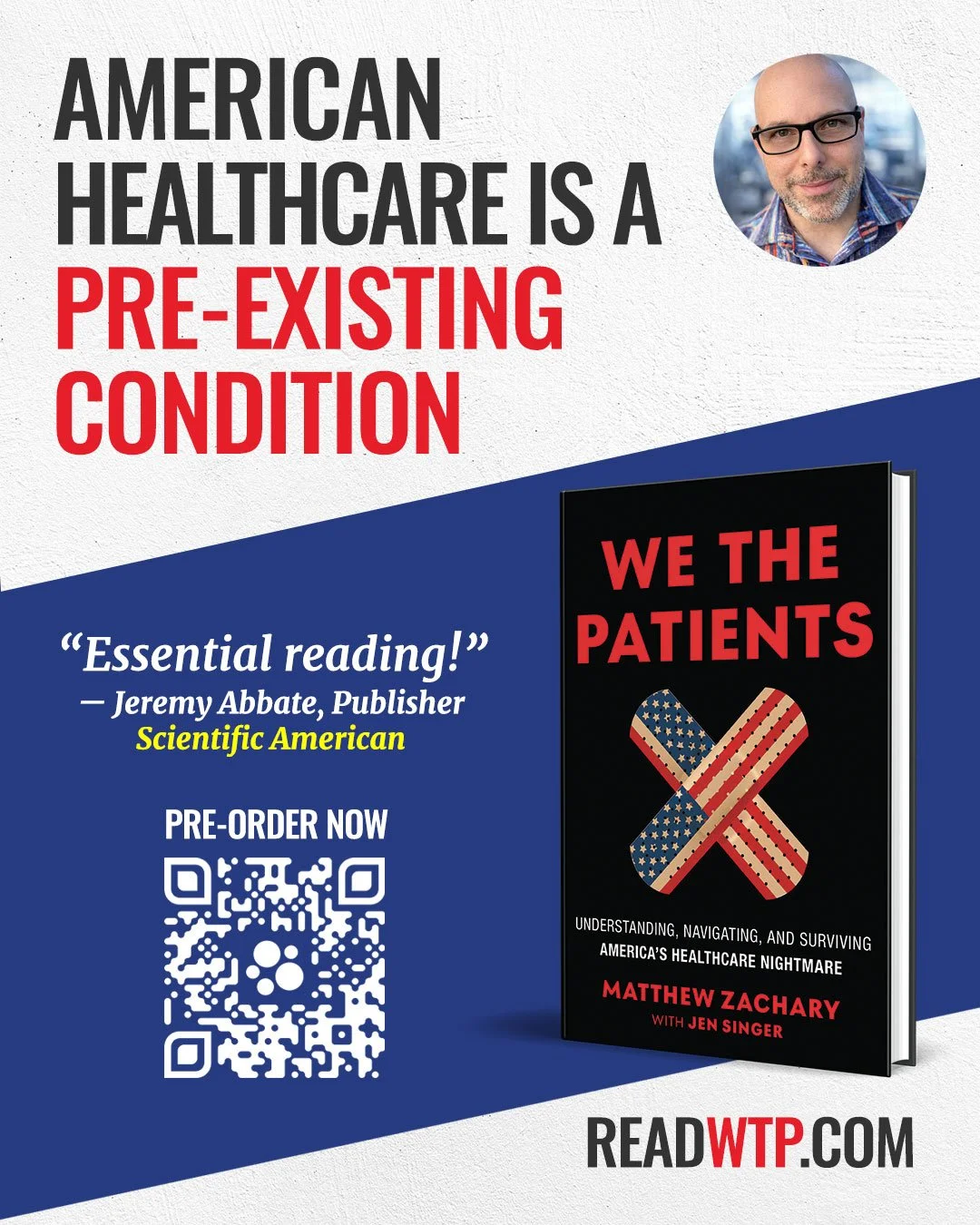
My Dad Drove on the Sidewalk: Behind We the Patients | Story 1 of 5
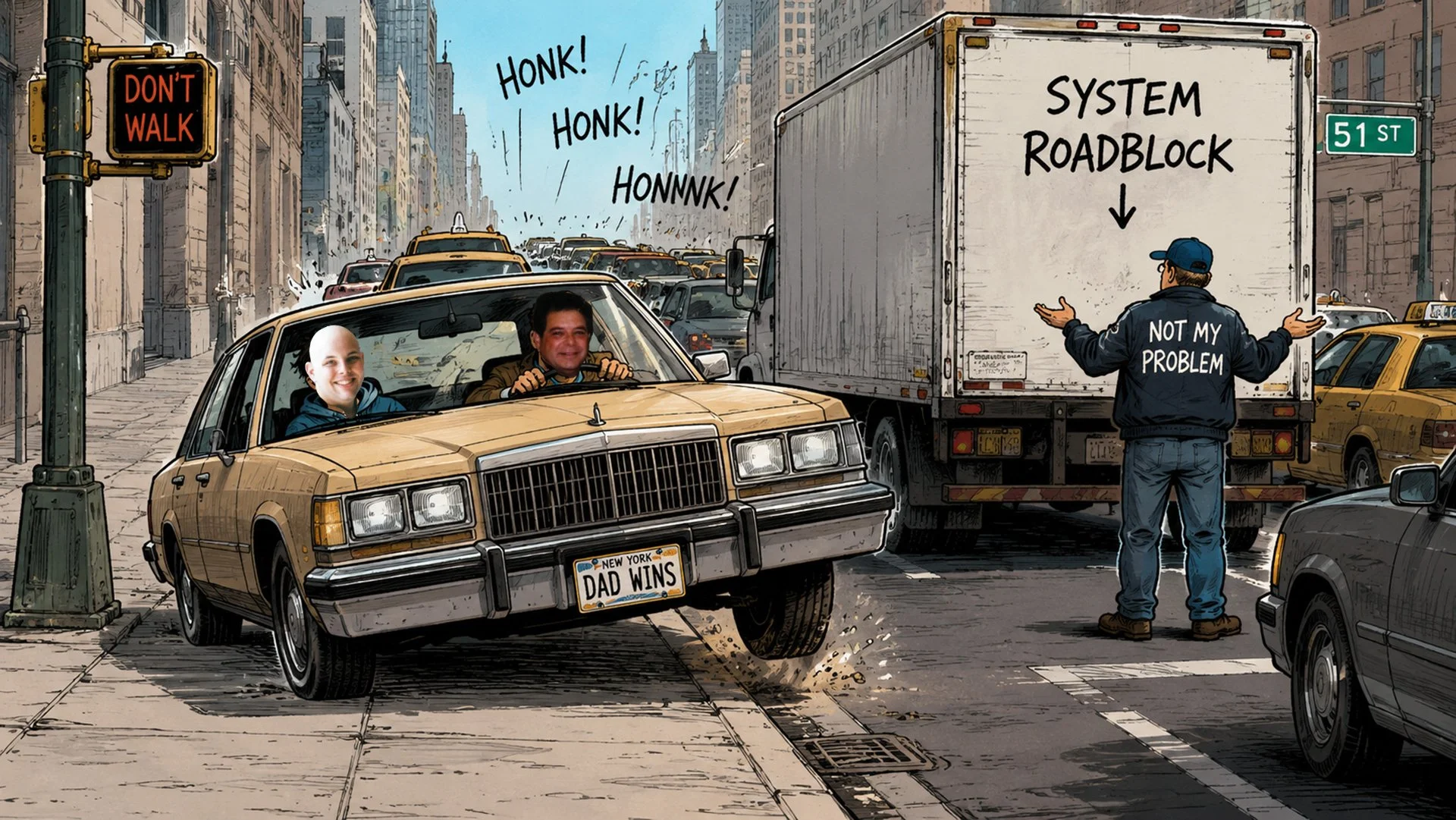
I was 21 years old when my father drove his car onto a Manhattan sidewalk.
This was not an act of late-middle-aged rebellion. My father was not having some kind of Michael Douglas in Falling Down moment. He was trying to get his kid home from brain cancer treatment.
We were on 51st Street in Manhattan when we came upon a disabled truck blocking the road. There was nowhere to go. Traffic began piling up behind us, followed by the inevitable chorus of horns because New Yorkers have long maintained the charming belief that sufficient honking can alter the laws of physics.
The truck driver had apparently exhausted his available fucks. He shrugged, turned his back and left the rest of us to contemplate our circumstances.
My father had other plans.
He looked at the truck. He looked at the sidewalk. He looked back at the truck.
Then he drove up onto the curb.
Across the sidewalk we went, around the disabled truck, back down onto 51st Street and on our way home.
I don't remember having some profound reaction to this at the time. I was 21. I had brain cancer. My father had just driven on the sidewalk. Weird shit was happening to me with sufficient regularity that this probably didn't crack the top ten.
But I never forgot it.
The Truck in the Road
Almost 30 years later, when Jen Singer and I were writing We the Patients: Understanding, Navigating, and Surviving America's Healthcare Nightmare, I kept coming back to that story.
I finally understood why.
That one ridiculous block of Manhattan contained almost everything I had subsequently learned about being a patient in America.
There is always a truck in the road.
Sometimes it's an insurance company demanding prior authorization before your doctor can do what your doctor has already decided you need. Sometimes it's a claim that gets denied for reasons nobody can adequately explain. Your specialist suddenly isn't in network. Your medication isn't on the formulary. The appointment you need isn't available for three months. One department tells you to call another department, which tells you the first department gave you the wrong number.
Eventually you encounter the healthcare equivalent of the truck driver. Someone who may not have created the problem, probably cannot solve the problem, and has absolutely no incentive to move the truck.
Meanwhile, you're sick.
That's the part that gets lost whenever healthcare gets discussed as an abstraction.
The person navigating all of this isn't sitting in perfect health at a mahogany desk with a legal pad and an afternoon blocked off for administrative problem-solving. They may have cancer. They may be in pain. They may be frightened. They may be exhausted from treatment, caring for someone they love, missing work or trying to understand what the hell the doctor just told them.
And now they also have to figure out how to get around the truck.
We Became Very Good at Sidewalks
American patients have developed an extraordinary body of folk knowledge for navigating healthcare.
We know to ask for the supervisor. We learn which words trigger an appeal. We discover that the first "no" sometimes means no, sometimes means maybe, and sometimes means you haven't yet reached the employee with sufficient authority to turn it into a yes.
We learn to call again.
We learn to document everything.
We learn to Google terminology nobody taught us, hunt down obscure phone numbers, ask friends for introductions, find patient communities, involve employers, contact manufacturers, appeal denials and occasionally deploy the most powerful phrase in the American healthcare lexicon: "Can I speak to your manager?"
These skills are useful. Some are lifesaving.
They are also evidence of something deeply fucked up.
We have become so accustomed to navigating around obstacles that we rarely stop to ask why the obstacles are there in the first place.
There is an entire vocabulary built around helping patients do this. Navigation. Advocacy. Health literacy. Patient engagement. Empowerment. All of these things can be enormously valuable, and I have spent much of my adult life helping build them.
But eventually I became interested in a different question.
Why are we spending so much energy teaching sick people how to drive on sidewalks?
Why I Wrote the Book
That question became one of the reasons I wrote We the Patients.
After 30 years as a professional patient, advocate, accidental healthcare insider and occasional pain in the ass, I didn't want to write another book telling patients they needed to become better consumers of healthcare.
I wanted to understand the road.
Who built it? Who controls it? Why are the trucks there? Who benefits from the obstacles? What rights do patients actually have when they encounter one? Which roadblocks are accidental consequences of an enormously complicated system, and which exist because somebody, somewhere, makes money when getting through becomes difficult?
And, yes, until we fix those things, I wanted people to know where the sidewalks are.
Because my father didn't remove that truck from 51st Street. He didn't repair it. He didn't reorganize Manhattan traffic policy or convene a blue-ribbon commission on disabled commercial vehicles.
He had a sick kid in the car who needed to get home.
So Dad found another way through.
Thirty years later, I'm considerably less satisfied with that solution.
Patients shouldn't need a father willing to jump the curb. They shouldn't need an insider who knows the secret number, a physician willing to spend an hour fighting an insurer, a viral social media post, a friend at the pharmaceutical company or enough education and stamina to decipher an appeal process while they're sick.
Sometimes survival requires finding the sidewalk.
But if millions of us keep having to drive on it, maybe it's time to stop congratulating ourselves for being good navigators and start asking who keeps blocking the fucking road.
If you've read We the Patients: Understanding, Navigating, and Surviving America's Healthcare Nightmare, I'd genuinely love to know which story stayed with you after you closed the book. And if you haven't, there are now 85 five-star Amazon reviews suggesting my father wasn't the only person who thought it was worth taking a slightly unconventional route. You can find the book wherever books are sold.