You Should Not Need To Know Mark Cuban To Get Unfucked From American Healthcare.
There is something uniquely American about successfully transplanting a human heart and then screwing up access to the medication required to keep it beating.
Payton Herres is 26 years old. She received a heart transplant when she was a preteen and, beginning about a year later, took everolimus, a generic version of Novartis’s anti-rejection drug Zortress, off-label. This is one of those extraordinary accomplishments of modern medicine that we have somehow learned to regard as ordinary. A child needed a new heart. A donor family made an unimaginable decision. Surgeons performed the transplant. Medicine gave Payton years of life that would have been impossible not terribly long ago.
Then Elevance Health decided it would no longer cover the drug.
According to reporting republished by Yahoo Finance, Payton responded by posting about what was happening on Facebook because, as she later explained, she didn’t know what else to do. Thousands of people shared the post. A day later, her coverage was restored, although “restored” requires a fairly generous interpretation of the English language. Her previous cost had been $180 for a 90-day supply. The new price was $1,000.
Payton called it a “ghost approval,” and I would like to nominate that phrase for immediate inclusion in the American healthcare lexicon alongside prior authorization, medical necessity, step therapy, peer-to-peer review, and all the other pleasant-sounding euphemisms we have invented for standing between sick people and their care. The insurer had technically approved the medication. It had also made the medication financially inaccessible to the person who needed it. Both things could now be true at the same time.
The story might have ended there, except the human history of Payton’s heart makes what happened next almost impossible to believe. The heart belonged to the 24-year-old son of Mary Cutter, who died in 2012. When Cutter learned about Payton’s difficulty affording the anti-rejection medication, she offered to pay for it herself. A mother who had already endured the death of her only child was now contemplating personally financing the medication necessary to protect the heart he donated.
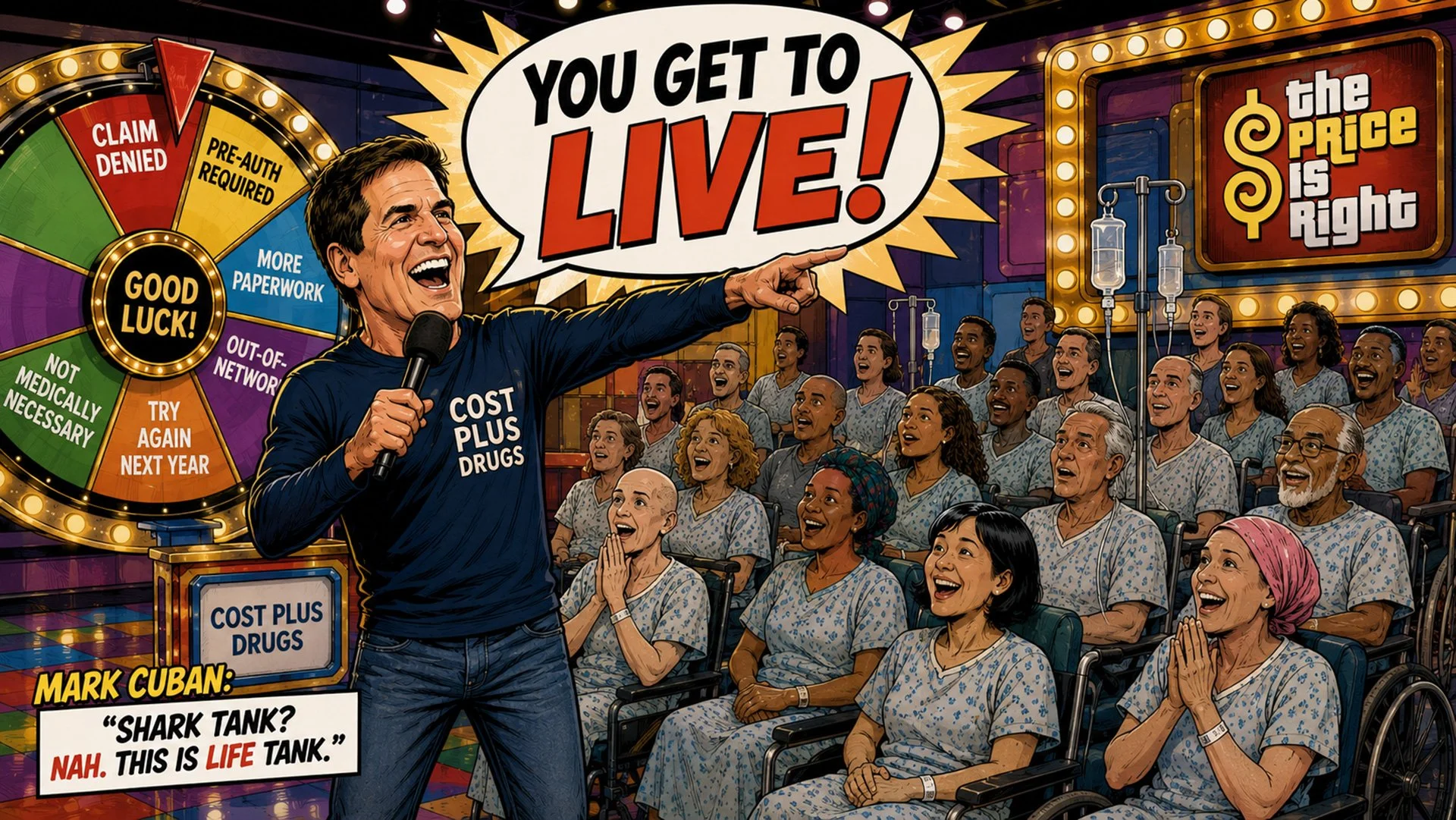
That part of the story eventually traveled through social media as well. Warris Bokhari, CEO and co-founder of the AI startup Claimable, was tagged, as was Mark Cuban. Cuban noticed the absurdity immediately: the system had paid for the heart transplant but was creating a barrier to the generic anti-rejection medication afterward. Cost Plus Drugs ultimately stepped in and now supplies Payton’s medication for about $300 for a 90-day supply, while a nonprofit associated with Claimable covers the cost.
There is a temptation to read this as one of those uplifting stories about the Internet doing something useful for a change. A young transplant survivor needed help. People rallied around her. Mark Cuban saw the story. His company found a solution. Everyone goes home feeling slightly better about humanity.
I think that interpretation lets the healthcare system off the hook.
What happened to Payton was not evidence of a functioning safety net. It was evidence that we have begun constructing an unofficial second appeals system alongside the official one. The official system involves formularies, coverage determinations, appeals, external reviews and insurance regulators. The unofficial system involves Facebook posts, journalists, viral outrage, GoFundMe campaigns, influential strangers, celebrities and billionaires. If the first system fails you spectacularly enough, perhaps the second one will notice.
That is an insane way to allocate healthcare.
It also creates a particularly cruel form of inequality because virality is not a benefit guaranteed by your insurance policy. There is no appeals code for “my post only got eleven likes.” There is no regulatory requirement that an influential person encounter your story at exactly the right moment. Most people fighting an insurer are not going to become national news. They are going to make phone calls during lunch, fill out forms after putting their children to bed, ask their doctor’s office to submit something again, stare at a portal message they do not understand and wonder how long they can afford to keep fighting.
Payton’s experience matters precisely because the underlying problem is not unusual. The article cites IQVIA research finding that 70 percent of commercially insured patients were initially denied coverage for at least one newly prescribed branded medicine in 2024. It also cites Commonwealth Fund research finding that 21 percent of working-age adults with private insurance said they or a family member had experienced a denial for care recommended by a doctor. Among those experiencing a denial, nearly 70 percent reported that it cost their household more money.
Those statistics are the part of the story that should make the Mark Cuban intervention less comforting, not more. For every patient whose circumstances become outrageous enough to attract public attention, there are countless others whose battles remain completely private. Their stories happen at kitchen tables, in pharmacy lines, inside patient portals and during endless telephone calls accompanied by hold music apparently designed in violation of the Geneva Conventions.
I have spent years arguing that many of the indignities Americans experience in healthcare are not random glitches in an otherwise sensible machine. They are consequences of incentives, administrative structures and power arrangements that ordinary patients are expected to navigate individually. We call that navigation. Sometimes it looks suspiciously like abandonment with a brochure.
Mark Cuban deserves credit for stepping in. Cost Plus Drugs solved a real problem for a real person, and Payton gets access to the medication she needs. But the existence of a billionaire willing to intervene cannot become part of our healthcare architecture. “Maybe Mark Cuban will see it” is not a patient protection.
The question worth asking is not why Payton was fortunate enough to get noticed. It is what happens to everyone who doesn’t.
Nobody should need an audience to stay alive.