RosettaFest 2026: I Didn’t Expect Employer-Sponsored Healthcare to Restore My Faith in American Healthcare
For most of my adult life, I have looked at American healthcare through a single window.
It is not the window most people choose voluntarily. It is the one you inherit after a catastrophic diagnosis. Mine began in 1996 with a brain tumor and never really ended. Treatment gave way to survivorship, survivorship gave way to advocacy, advocacy somehow became a career, and somewhere along the way thousands of people started trusting me with stories they hadn’t told anyone else. If you listen long enough, individual tragedies begin to reveal patterns. The names change. The diagnoses change. The insurance cards change. The underlying experience often does not.
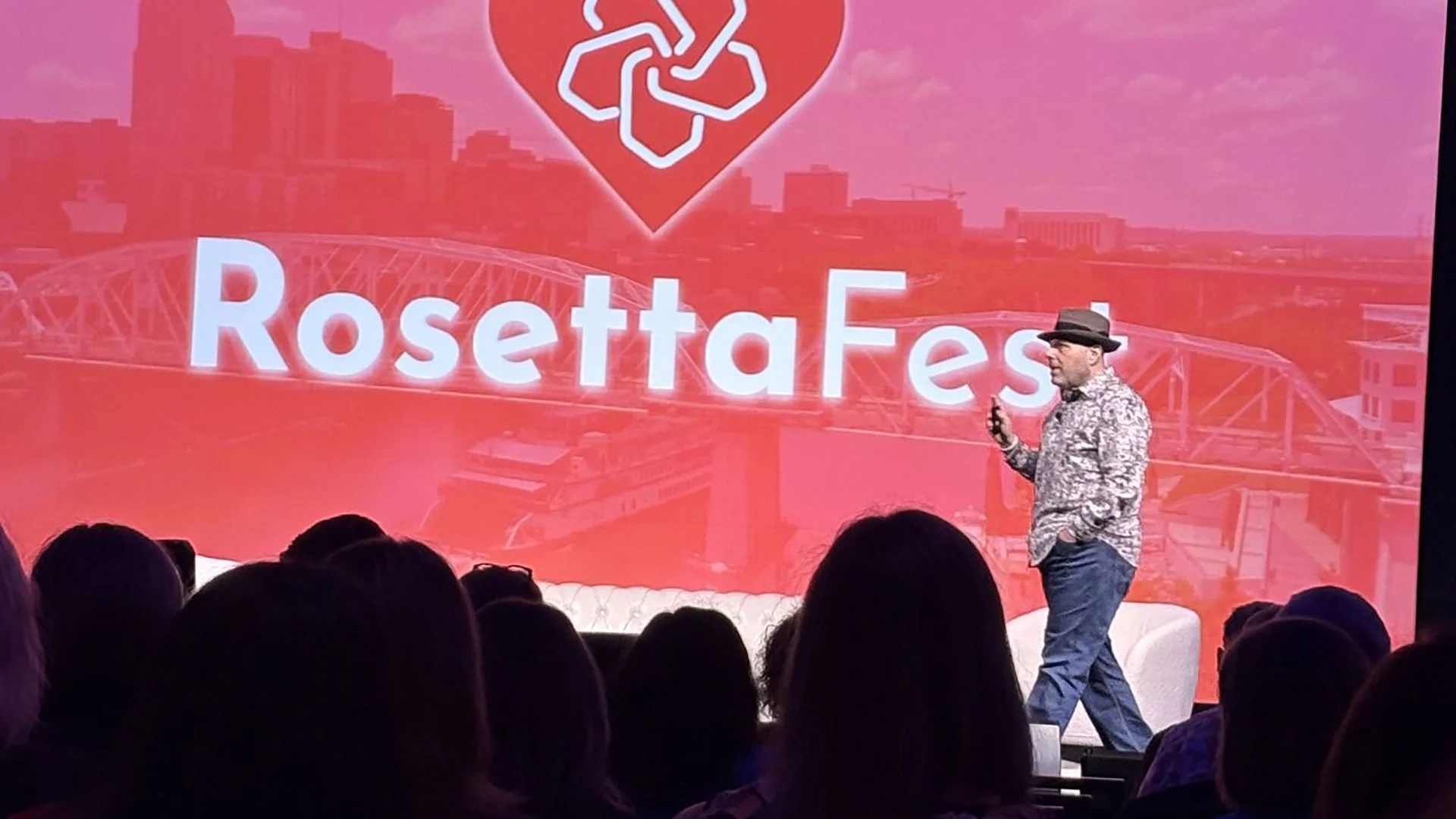
That’s the perspective I packed when I flew to Nashville for RosettaFest.
Health Rosetta had invited me to deliver the opening keynote at its annual gathering of employers, benefits leaders, clinicians, entrepreneurs, and people whose professional lives revolve around one deceptively simple question: how should healthcare actually work? I was honored to be invited. I’d also be lying if I said I wasn’t a little out of my depth. Self-funded employers, fiduciary responsibility, direct contracting, reference-based pricing. I could pronounce most of those phrases. I wasn’t entirely sure I understood them. For years, employer-sponsored insurance had occupied a fairly modest place in my mental map of American healthcare. Employers bought insurance. Insurance companies administered it. Employees hoped for the best.
That assumption lasted until I met the nurse navigators.
Someone introduced them to me between sessions. I assumed I knew where the conversation was headed. I’ve known oncology nurse navigators for years. They’re some of the finest people in medicine, helping patients coordinate appointments, untangle insurance requirements, and somehow remain calm while everyone around them is quietly losing their minds. I’ve argued for years that navigation isn’t optional. It’s infrastructure.
So I thought I understood what I was being told. I didn’t.
These weren’t hospital nurse navigators. They weren’t employed by cancer centers or physician practices. Their patients weren’t sitting in infusion chairs or recovering from surgery.
They worked for employers.
I actually stopped the conversation.
“You mean,” I asked, “your job is helping employees navigate the healthcare system their employer purchased?”
Exactly.
That sentence has stayed with me ever since. It sounds deceptively simple, but it represents an entirely different philosophy of healthcare. Most organizations wait until something breaks before they intervene. These nurses exist because someone recognized that the healthcare system itself often becomes part of the crisis. They reduce friction before friction becomes catastrophe. They help employees find the right care, understand confusing benefits, resolve administrative problems, and intervene before small problems metastasize into large ones. In other words, they’re doing many of the things patient advocates have been begging the healthcare system to recognize for decades. Only they aren’t waiting for the healthcare system to decide it’s a good idea.
They’re simply doing it.
Before any of that, though, something happened that completely caught me off guard. Before I ever stepped onto the stage, Health Rosetta presented me with the Marshall Allen Award. I didn’t know it existed until my name was announced. It is difficult to overstate how disorienting it is to be genuinely surprised in public. One moment I was preparing mentally for a keynote. The next I was standing in front of several hundred people trying to process the fact that they’d managed to keep an enormous secret from me. Marshall Allen has spent years exposing the structural absurdities that quietly define American healthcare, often by doing the patient-centered journalism too few people were willing to do. To receive an award carrying his name, from people I had only just met, in a world I had barely entered, was something I didn’t have language for in the moment.
The keynote that followed was unapologetically patient-centered. I talked about what healthcare looks like from the receiving end. I showed photographs from the mid-1990s, when my generation of cancer survivors was treated with protocols that often felt less like precision medicine than an Easy-Bake Oven with an oncology fellowship. I talked about surviving cancer and then discovering that surviving healthcare is a separate and ongoing achievement. I talked about exhaustion, prior authorization, invisible labor, and the accumulated weight of spending thirty years inside systems designed around transactions while your life stubbornly insists on remaining a life.
The room gave me a standing ovation. I’m still not entirely sure I deserved it, but I know what it meant. They weren’t strangers to what I was describing. They had spouses with multiple sclerosis, parents with Alzheimer’s disease, children with complex medical needs, and stories of their own that sounded remarkably similar to the stories patients have been telling me for years. The difference wasn’t empathy. The difference was agency. For the first time in a very long time, I found myself surrounded not only by people who understood the consequences of a broken healthcare system, but by people who spent their working lives trying to change the experience of healthcare for others.
That realization unsettled me in the best possible way. I had spent years documenting what happens when healthcare fails. What I slowly understood over the next several days was that an entire community of employers had reached a very different conclusion than the one I carried into that conference. They had stopped asking how to buy cheaper healthcare. They had started asking how to buy better healthcare, and in doing so had quietly become one of the few places in American healthcare where someone still believed design mattered.
That belief became even clearer during a small dinner Dave Chase organized around the Nuka System of Care, the Alaska Native model developed by Southcentral Foundation. It wasn’t a panel discussion. There were no presentations, no slide decks, no microphones. Just a table of people who had spent their careers approaching healthcare from different directions, trying to understand what happens when those perspectives are allowed to intersect.
April Kyle and LaZell Hammons from Southcentral Foundation weren’t merely students of the Nuka model. They were architects and stewards of the organization itself. Bryce Heinbaugh brought the perspective of redesigning employer-sponsored healthcare around transparency and value, having rebuilt his own convictions after surviving open-heart surgery. Casey Billington represented the practical reality of nurse navigation at the employer level. Dr. Dani Kimlinger added the behavioral health lens, reminding everyone at the table that mental health and organizational culture are inseparable from physical health, no matter how often healthcare financing pretends otherwise. Dave, as always, played the role he seems born to play: not the loudest voice in the room but the person most interested in creating one.
Then there was me. At first, I honestly wondered why.
Everyone else had spent a career building healthcare systems. Healthcare had happened to me.
It took most of the evening to understand that those are not competing qualifications. They are complementary ones. Each person at that table understood a critical part of healthcare extraordinarily well. My contribution wasn’t another specialty. It was continuity. I was the only person whose experience naturally flowed through every discipline represented because patients don’t experience healthcare in organizational charts. They experience it as a single, uninterrupted life. The system sees behavioral health, pharmacy, transportation, oncology, insurance, and primary care. Patients see Tuesday.
I asked whether a model like Nuka succeeds partly because it grew from a community with an unusually strong sense of collective responsibility. The me versus we of American culture, the idea that your healthcare crisis isn’t my problem until it is, runs deep. We didn’t leave dinner with unanimous agreement, and I’m glad we didn’t. Interesting conversations rarely end that way. They end with everyone carrying home a slightly better question than the one they brought.
By the time I boarded the flight back to New York, I realized the most important thing I had learned in Nashville had nothing to do with employer benefits.
It had to do with hope.
Not naïve optimism. Not the kind that ignores structural failures or pretends the insurance industry has suddenly become enlightened. A more disciplined form of hope rooted in evidence. I had met an entire community of people who wake up each morning asking how to remove unnecessary suffering from the healthcare experience, not because regulators required it, but because they believed it was the right thing to do.
For years my work has naturally attracted horror stories. Nobody calls a patient advocate because everything worked perfectly. Spend enough years immersed in those stories and you begin to believe they are the whole story. They’re not. They’re the most urgent part of the story, but Nashville reminded me that another chapter has been unfolding almost entirely outside the field of view occupied by most patient advocates.
Employers, when they choose to exercise the influence they already possess, can become one of the most powerful consumer protection forces in American healthcare. They don’t have to wait for Congress. They don’t have to wait for insurers to reinvent themselves. They can begin making different choices tomorrow morning.
That isn’t the entire solution. It never will be. But Dave Chase didn’t invite me to Nashville because he needed another keynote speaker. He invited me because every movement eventually benefits from someone willing to ask the simplest question in the room.
What does this feel like for the person who has to live inside it?
That’s the question I’ve spent thirty years trying to answer.
No matter how elegant the strategy, how sophisticated the financing, or how innovative the model, every healthcare system eventually arrives in exactly the same place.
Someone’s life.
And that’s where all of this either works.