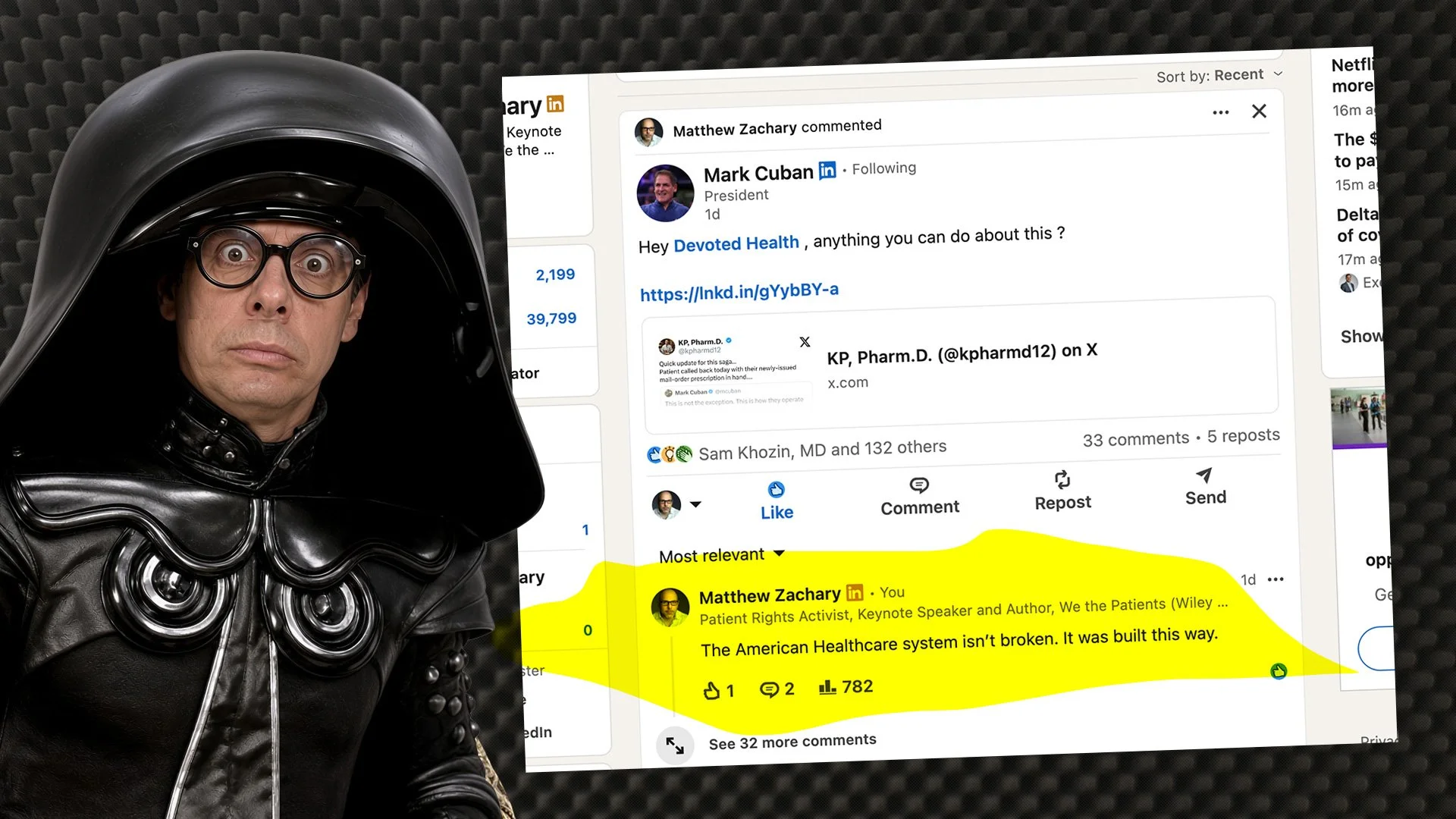
Mark Cuban recently shared a pharmacist’s account on LinkedIn alleging that an unauthorized prescription had been written and filled through a process involving Devoted Health. The allegations were disturbing, although the underlying facts remain unverified and there are legitimate questions about what actually happened. Cuban tagged the company and asked whether someone could look into it. The comments started rolling in, and before long, the familiar machinery of American healthcare discourse was operating at full capacity.
I found myself considerably more interested in the comments than in the original allegation.
Not because the allegation didn’t matter. If someone is receiving medication they never requested, prescribed by a physician they’ve never met, that’s a serious matter deserving investigation. But the ensuing conversation offered something else: a remarkably revealing look at how people understand healthcare problems based on where they sit within the healthcare economy.
The pharmacist saw a prescribing problem. The physician saw a clinical oversight problem. The benefits consultant saw a contracting problem. The healthcare executive saw a governance problem. Businesspeople saw incentives. Concerned citizens saw potential criminal misconduct. Cuban, understandably, saw an opportunity to use his considerable public influence to get someone’s attention.
The proposed remedies followed accordingly. Report it to the authorities. Investigate the prescribing physician. Review the contracts. Fine the company. Change the incentives. Bring in regulators. Make somebody accountable.
These are all reasonable responses. Some might even work.
What interested me was how thoroughly the conversation depended on somebody other than the patient possessing the authority to do something about the problem.
I have spent thirty years watching this happen. I was diagnosed with brain cancer at twenty-one, back when being a young adult with cancer was apparently an administrative error nobody had thought to correct. I subsequently founded Stupid Cancer, built a career in patient advocacy, and spent the better part of three decades working alongside extraordinarily dedicated people trying to make healthcare less punishing for the people who need it.
Along the way, I’ve attended more healthcare conferences, advisory boards, policy meetings, and industry discussions than any reasonable person should have to endure without receiving frequent-flyer miles toward a second life.
And I keep noticing the same thing.
We have an entire economy organized around patients, populated by people who spend their professional lives discussing what patients need. Yet when the conversation turns to changing the rules, the patient is usually represented by someone whose power comes from somewhere else.
A medical license. A corporate title. A regulatory agency. A professional association. An employer contract. A congressional office.
These are legitimate sources of authority. But they are not the patient’s own.
The Consumer Who Can’t Leave
One particularly interesting response to the LinkedIn discussion suggested that if people were sufficiently angry about healthcare, they would eventually abandon the existing system for a better one. If they didn’t, perhaps their dissatisfaction wasn’t as serious as everyone assumed.
I understand the argument. In ordinary markets, dissatisfied customers can take their business elsewhere. Companies that fail to satisfy demand lose customers, and competitors have an incentive to do better. It’s a foundational assumption of consumer capitalism, and under the right conditions, it works.
Unfortunately, being sick has a way of exposing the limitations of economic theory.
Patients don’t necessarily choose their insurance companies. Their employers often do. They don’t necessarily choose their hospitals. Their insurance networks, geography, clinical circumstances, and financial resources frequently determine which options are available. They may not even have the luxury of waiting until a better option appears.
Try explaining the virtues of competitive markets to someone who needs chemotherapy on Thursday.
Healthcare consumers are also operating under conditions that would make most ordinary purchasing decisions impossible. Information is incomplete. Prices can be opaque. The consequences of making the wrong decision can be catastrophic. And the person supposedly exercising consumer choice may be frightened, exhausted, medicated, financially vulnerable, or trying to keep a family together while receiving treatment.
This doesn’t mean competition is irrelevant to healthcare. It means the ability to leave a marketplace is not the same thing as having power within it.
More importantly, consumer dissatisfaction is not the same thing as political organization.
An angry customer might switch brands. An organized constituency can demand changes to the rules governing every brand.
Those are fundamentally different forms of influence.
Thirty Years of Speaking for Patients
The modern patient advocacy movement has accomplished extraordinary things. Disease-specific organizations have transformed research funding, public awareness, treatment access, survivorship, and the relationships between patients and medical institutions. Patient advocates have helped change legislation, challenged insurers, educated policymakers, and forced previously ignored communities into public view.
I know because I’ve been part of that world for most of my adult life. I have enormous respect for the people doing the work.
But I’ve also become increasingly interested in what the movement has not yet established.
We have cancer advocates, diabetes advocates, rare disease advocates, disability advocates, mental health advocates, and countless other communities organized around diagnoses, experiences, and specific policy priorities. We have coalitions that bring these organizations together. We have lobbying campaigns, petitions, awareness months, congressional briefings, and enough branded tote bags to alter the Earth’s gravitational field.
What we don’t yet know is whether the people represented by these efforts recognize themselves as members of a larger patient constituency with shared political interests.
That’s not an accusation. It’s a research question.
A coalition of organizations is not necessarily a constituency of individuals. The existence of patient advocates doesn’t establish that patients themselves share a political identity. And widespread frustration with healthcare doesn’t automatically translate into collective action.
People can agree that insurance denials are outrageous while disagreeing about government regulation. They can despise medical bills while voting for entirely different economic policies. They can identify passionately with their diagnosis without identifying politically as patients.
The question is whether something exists beneath those differences that hasn’t been adequately measured.
Could the experience of navigating American healthcare create common interests strong enough to influence civic behavior across diagnoses, income levels, geography, and political affiliation?
Could people who disagree about almost everything else recognize a shared interest in administrative protections, accountability, transparency, and the basic right to receive necessary care without fighting an obstacle course of paperwork?
I don’t know.
And after thirty years in this business, I’ve become considerably more interested in finding out than in pretending the answer is obvious.
Being Heard Isn’t the Same as Having Power
Healthcare institutions have become remarkably sophisticated at soliciting patient perspectives. There are patient advisory councils, experience surveys, listening sessions, focus groups, community engagement programs, and entire departments devoted to understanding the patient journey.
Some of these efforts are valuable. Others produce beautiful PowerPoint presentations that eventually disappear into the corporate equivalent of the Bermuda Triangle.
But participation and power are not interchangeable.
A patient can describe an insurance denial in devastating detail. An organization can publish that story, circulate it among policymakers, and use it to support reform. That might be enormously helpful. It still leaves an important question unanswered.
What influence does that patient possess when the listening session ends?
Professional associations have members, political relationships, and organized economic interests. Corporations have lobbyists and financial leverage. Insurers have trade associations. Employers negotiate contracts. Physicians have licensing boards and professional societies.
Patients have advocates, organizations, and stories, but their collective political influence remains difficult to identify, quantify, and mobilize.
That distinction matters because the American healthcare system doesn’t operate on empathy alone. It responds to incentives, institutional pressure, legislation, organized interests, and consequences.
If patients are going to influence those forces directly, we first need to understand whether they constitute a recognizable civic group rather than simply assuming that everyone who’s ever been sick belongs to the same movement.
That’s the premise behind the independent research we’re developing through We The Patients. Before proposing another national organization, another campaign, or another expensive exercise in getting people excited about healthcare reform, I want to investigate whether a measurable patient constituency actually exists.
Not manufacture one through clever messaging. Not declare one into existence because the idea makes for a compelling keynote.
Measure it.
The Question Nobody Was Asking
I keep returning to that LinkedIn thread because I don’t think anybody participating in it was necessarily wrong. The professionals identified legitimate concerns. The suggested remedies deserved consideration. People were trying to help.
But the discussion illustrated a limitation I’ve encountered throughout my career: when something happens to patients, we instinctively look toward the institutions surrounding them to determine who has the power to respond.
We rarely begin by asking what power patients might exercise together.
Perhaps the answer is that there isn’t enough common ground to organize around. Perhaps diagnosis, political affiliation, and personal circumstances will always outweigh a broader patient identity. Or perhaps we’ve spent decades looking at the same population through so many professional and disease-specific lenses that we’ve overlooked something consequential.
Either outcome would be worth knowing.
What I find increasingly difficult to accept is the assumption that patients must remain primarily the subjects of other people’s decisions, interventions, and expertise.
I’m grateful for the professionals who fight for patients. I have worked alongside them, learned from them, and depended on them. This isn’t an argument for replacing their authority or dismissing their contributions.
It’s an argument for investigating whether patients might possess a source of influence that doesn’t depend entirely on someone else speaking on their behalf.
Because thinking about patients isn’t the same as thinking as patients. And speaking for patients isn’t the same as patients having power themselves.
After thirty years, I still believe American healthcare can change. I just think we may have been asking an incomplete question about who gets to change it.
Everyone has a solution for patients.
I’d like to know what happens when patients become part of the solution on their own terms.
And if the answer turns out to be that a genuine patient constituency exists, somebody should probably tell the people running American healthcare.
They may want to update their assumptions.
I write about American healthcare, patient rights, politics, economics, and the occasionally spectacular absurdity of being sick in the United States. If these are conversations you think deserve more attention, subscribe to receive my essays directly. The healthcare industry has enough newsletters written for itself. This one’s for the rest of us.