Prevention Is Being Prevented
What happens when the patient trying to get healthcare and the company trying to deliver it discover they’re fighting the same machinery?
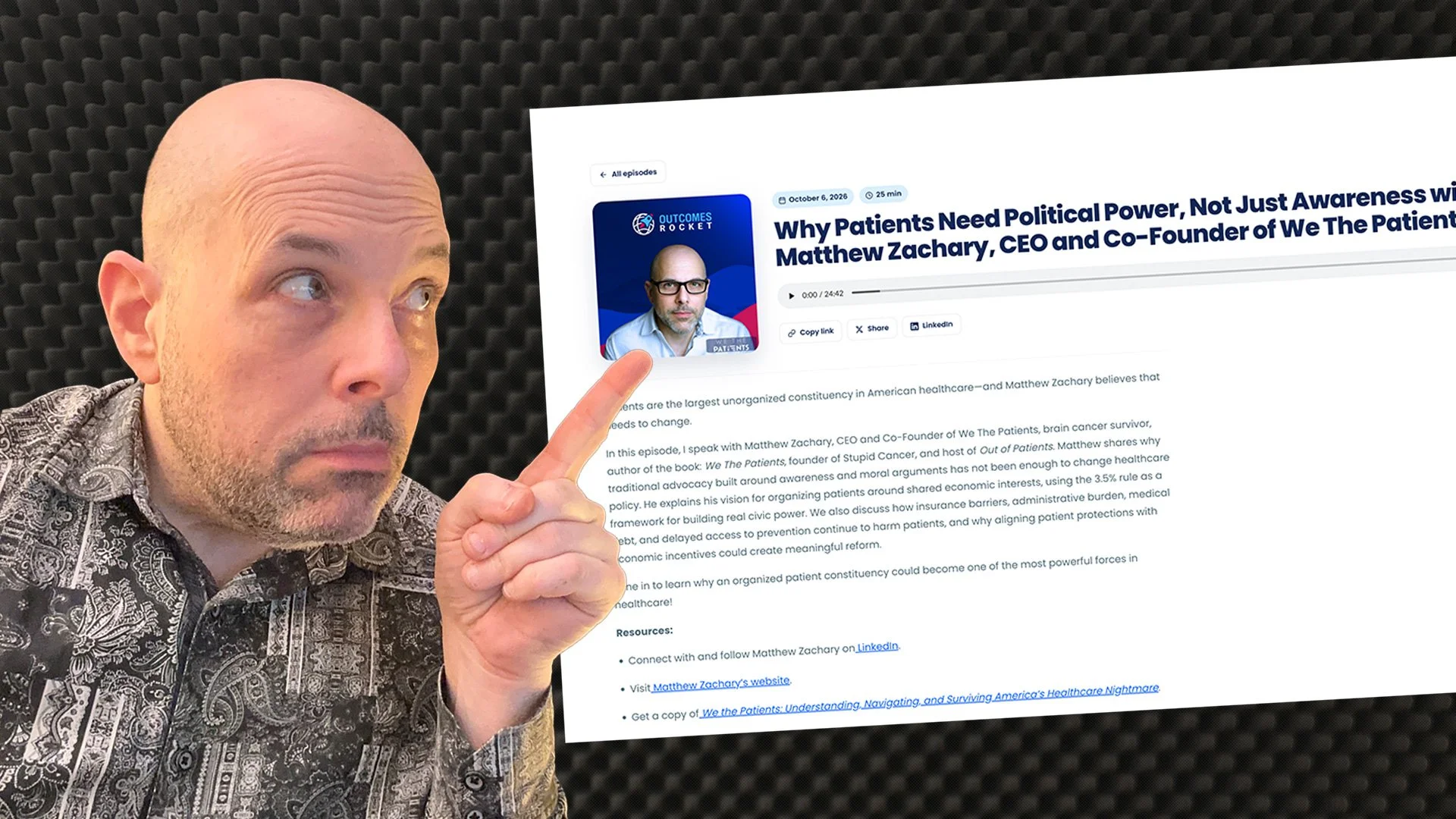
There was a moment during a recent conversation with Saul Marquez when I realized I had spent the better part of 30 years looking at American healthcare from only one side of a locked door.
That’s probably unfair to myself. I’ve looked through the windows. I’ve crawled through the vents. I’ve occasionally been escorted from the premises. But I came into this world as a 21-year-old cancer patient, and almost everything I’ve done since has grown from the fairly uncomplicated premise that people who get sick should suffer less from the experience of getting healthcare.
This seemed like a reasonable career objective.
Saul came at healthcare from somewhere very different. Before founding Outcomes Rocket, he spent years at Stryker, NuVasive and Medtronic. Today he works with the people building and commercializing technologies, devices and companies trying to make their way through the healthcare economy. His basic proposition, after 20 years in the business and more than 2,300 interviews, is that healthcare remains a relationship game and that growth can be engineered rather than wished into existence.
So naturally, we ended up talking about political power.
My book, We the Patients: Understanding, Navigating, and Surviving America’s Healthcare Nightmare, sent me somewhere I didn’t entirely expect to go. I spent most of my advocacy career helping build patient communities. Cancer communities. Young adult communities. Disease communities. Caregiver communities. We organized around biology, age, experience and circumstance. We found one another, demanded better science, changed standards of care, built nonprofits, held Hill Days and became very good at telling institutions what was happening to us.
A lot of that work mattered enormously. Some of it changed lives.
But somewhere along the way, I started wondering whether we had confused having a voice with having power.
Healthcare organized itself very differently. Hospitals organized around their economic interests. Insurers organized around theirs. Pharmaceutical companies, PBMs, physicians, employers, device companies and health systems all developed trade associations, lobbyists, data, political strategies and fairly sophisticated ways of making sure the people who write laws understand what happens when their interests are ignored.
Patients organized around diseases.
That asymmetry has been eating at me.
The patient and the innovator may be fighting the same problem
I brought this up with Saul because Outcomes Rocket lives largely in a world of healthcare executives, founders, commercial leaders and people trying to get actual innovations into the actual marketplace. I wanted to pressure-test something I’ve increasingly come to believe: an organized patient constituency could be good for patients while also being economically useful to parts of healthcare that genuinely produce things patients need.
This gets uncomfortable quickly, which is usually a sign that I’m interested.
Consider what happens when somebody invents a diagnostic that can identify a deadly disease earlier. The science can work. The product can exist. Physicians can believe in it. Patients can desperately want what it offers. And somewhere between invention and adoption sits an obstacle course of reimbursement, coverage, coding, procurement, regulation and competing economic incentives.
During our conversation, we talked about Lucid Diagnostics and its EsoGuard esophageal DNA test, a company and technology I’ve come to know through my speaking work. I’m neither their spokesperson nor their investor. I’m interested in the absurdity their story exposes.
EsoGuard is designed to detect Barrett’s esophagus and related precancerous changes in at-risk patients before they progress to esophageal adenocarcinoma. CMS itself acknowledges the clinical problem: esophageal adenocarcinoma remains among the cancers with the lowest 5-year survival rates, prognosis deteriorates sharply with later-stage disease, and improving early detection and prevention remains a medical need. Yet one current Medicare contractor coverage determination says molecular tests in this category are non-covered while establishing criteria such tests would be expected to meet.
Meanwhile, Lucid continues navigating the payment and coverage machinery. In September 2026, the company reported progress through Medicare payment, billing and coding processes while still awaiting the final outcome of a reconsidered local coverage determination for EsoGuard. That description comes from Lucid, so it should be read as a company account of its own regulatory progress, not independent applause from me.
We have reached a point where prevention itself can encounter enormous structural resistance.
Or, as it came out of my mouth talking to Saul: prevention is being prevented.
That sentence has been following me around ever since.
Healthcare companies usually describe this as a market-access problem. Patients experience the other end of it as a healthcare-access problem. Those sound like different subjects because healthcare has developed different professional languages for everyone involved. One gets discussed in a conference ballroom by people wearing badges. The other gets discussed at somebody’s kitchen table next to an Explanation of Benefits nobody can explain.
Sometimes they are the same locked door.
And the person at the kitchen table does not care whether the obstruction belongs to a payer, PBM, benefits administrator, hospital, government contractor or something called a “coverage determination.” They may be sick. They may be working. They may be raising children. They may have already spent 47 minutes on hold. The healthcare economy gets to experience the problem as a business process.
The patient just needs the fucking test.
Patient advocacy was built for a different kind of leverage
For decades, healthcare advocacy has leaned heavily on the moral argument. People are suffering. People are dying. People deserve access. People shouldn’t go bankrupt because they got cancer. Doctors shouldn’t spend their lives fighting insurance companies. Families shouldn’t need graduate degrees in administrative warfare to figure out why somebody denied a treatment.
I believe every word of that.
I’m increasingly unconvinced that believing it produces sufficient leverage.
American healthcare does not run primarily on moral consensus. It runs on incentives. Money moves. Risk moves. Political pressure moves. Markets respond. Institutions protect themselves. And everyone participating in that economy behaves, with remarkable consistency, according to whatever incentives we have constructed for them.
The history of consumer protection offers plenty of evidence that morality and economics do not have to be enemies. Ralph Nader’s Unsafe at Any Speed helped force automobile safety into public and political consciousness in the 1960s. Congressional debate over what became the National Traffic and Motor Vehicle Safety Act explicitly cited Nader’s argument that the public bearing the consequences of automobile safety decisions deserved a role in determining safety policy. Federal standards followed, including requirements for seat belts in new passenger cars.
Automobile executives did not all awaken one morning spiritually transformed by shoulder restraints. Safety became regulation, liability, consumer expectation and eventually competitive reality. Saving lives and making money managed to occupy the same sentence.
Healthcare needs many more sentences like that.
Instead of asking healthcare to care more about patients, I’ve become interested in what happens if patients acquire enough organized economic and political power that caring about their interests becomes rational.
That is where Erica Chenoweth’s research on civil resistance entered my thinking. Her work is frequently distilled into the “3.5% rule,” the observation that historically, governments have not withstood challenges in which 3.5% of the population mobilized against them at a peak event. The shorthand is seductive, particularly if you happen to be trying to organize tens of millions of pissed-off patients.
The actual research deserves more respect than the slogan.
Chenoweth has explicitly cautioned that 3.5% is a descriptive historical statistic, not a magic threshold or prediction machine. Organization, momentum, strategic leadership, diversity and sustained participation also matter, and more recent research has identified exceptions.
Good. I don’t need a magic number.
I need evidence that meaningful political power does not require persuading 340 million Americans to agree with one another, because I’ve met Americans.
You need enough people to recognize that despite different diagnoses, insurance cards, employers, incomes, ZIP codes and political affiliations, they share certain interests. They don’t want to be financially destroyed by illness. They want to know what things cost. They want someone competent helping them navigate a system whose complexity benefits almost everyone except them. They want medical decisions made for medical reasons. They want access to useful innovation. They want accountability when institutions abuse their power.
None of those ideas requires Americans to agree on universal healthcare, Medicare for All, Obamacare, Trump, Democrats, Republicans or which cable news network is currently destroying civilization.
They require people to notice that they’re patients.
What patient political power could actually mean
This is where my conversation with Saul got particularly interesting. I told him very plainly that I see this as compatible with capitalism. I have no interest in pretending we are going to excavate American healthcare from capitalism and install some magical replacement system before lunch.
Capitalism requires functioning markets. Functioning markets require consequences. And American healthcare has accumulated extraordinary places where the customer has remarkably little ability to impose one.
That doesn’t mean a patient constituency becomes the political wing of healthcare innovation. Quite the opposite.
An independent patient constituency would sometimes align with pharmaceutical companies and sometimes oppose them. It would sometimes help hospitals and sometimes make their executives miserable. It might support a diagnostic company fighting to get a useful technology covered while demanding accountability from another company charging indefensible prices. It might align with employers trying to control healthcare spending and then oppose those same employers when benefit design harms workers.
Independence is the entire point.
A constituency captured by an industry becomes a marketing department with better T-shirts.
The patient’s interest has to remain the patient’s interest.
That idea now sits at the center of the larger work behind We the Patients. After decades spent inside cancer advocacy, healthcare media and patient organizing, I’m interested in whether patient experience can become something American politics has never really had: a durable civic identity capable of producing consequences.
For the first time in 30 years, I’m also looking beyond the traditional patient community and seeing potential allies I didn’t fully understand before. Employers drowning in healthcare costs. Physicians drowning in administrative burden. Innovators watching useful products die in reimbursement purgatory. Researchers who can invent things faster than institutions can figure out how to pay for them.
Their interests will not always align with ours. They shouldn’t.
But sometimes the company trying to get something useful to a patient and the patient trying to get something useful from healthcare discover they’ve been pounding on opposite sides of the same locked door.
Saul asked me near the end of our conversation what happens next. Which bill comes first?
I told him the legislation comes last.
Washington already has plenty of organizations deciding what patients need and then recruiting patients to support it. I want to know what happens if we reverse the order. Listen first. Poll independently. Find out whether a coherent patient identity actually exists outside the professional advocacy world. Determine what people agree on before handing them an agenda somebody else wrote.
Then find out what happens when enough of them recognize the door.
Maybe somebody finally has an incentive to open it.