The Answering Machine Was Blinking: Behind We the Patients | Story 3 of 5
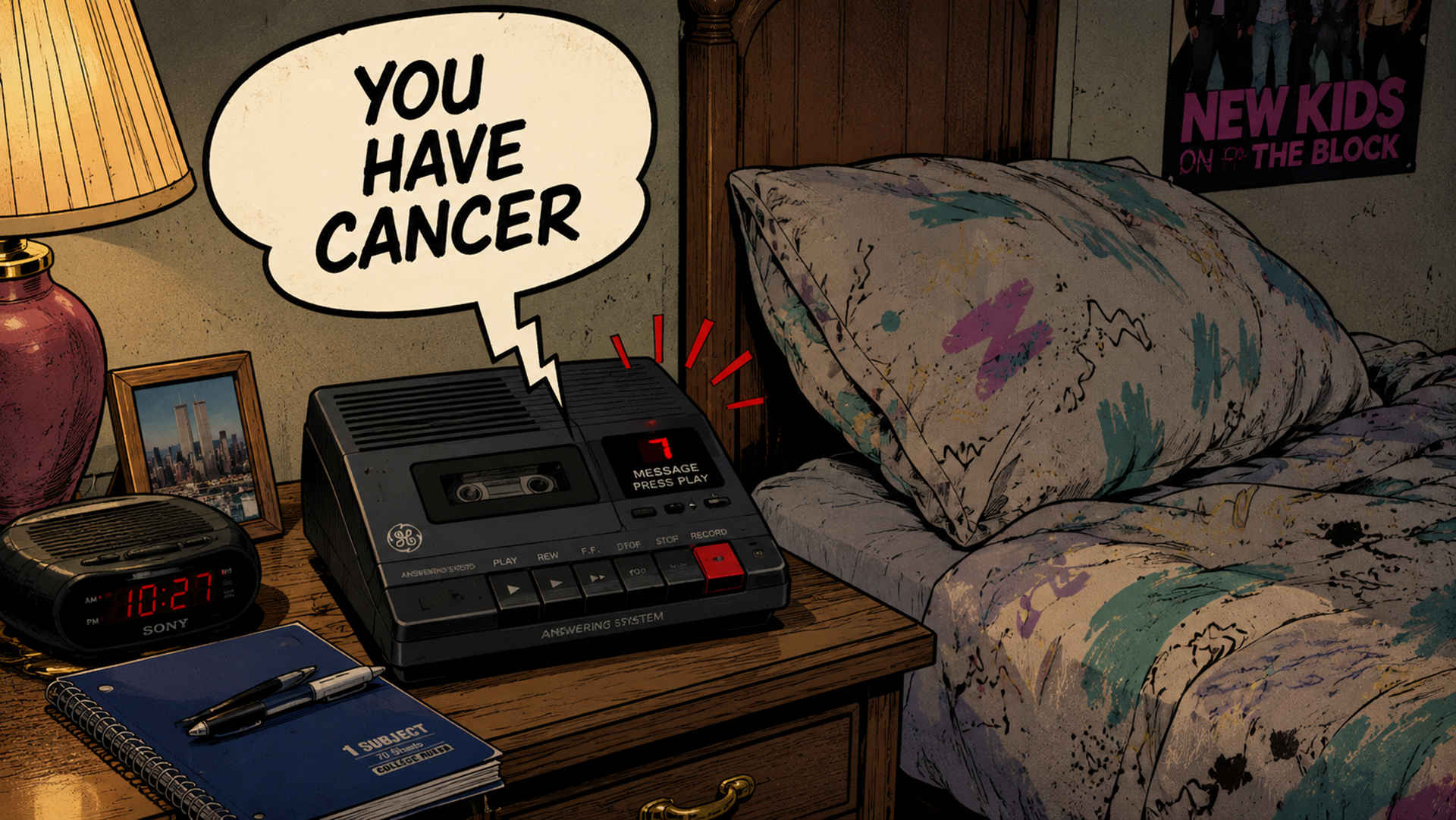
I found out there was something growing in my brain because the answering machine was blinking.
It was December 1995, and I was 21 years old. For months, my left hand had been slowly betraying me in ways that were becoming harder to explain away. This was particularly problematic because I was a musician. I had been playing piano since I was eleven, and by college music had become the thing around which I expected to build my life. Your hands are fairly important to that arrangement.
At first, the changes were subtle. Things I had played thousands of times suddenly became harder. My left hand couldn't arpeggiate properly. Eventually I couldn't hold a pen normally. I somehow managed to play in a pit using only my right hand, which tells you something about the spectacular ability of a 21-year-old male to normalize evidence that something may be seriously wrong with him.
Eventually, I was sent for an MRI. My mother came with me. We had the scan and then went to lunch, because at that point this was still something you could apparently do between medical appointments and the rest of your day. We went home afterward without any great ceremony. Nobody had told us to expect anything catastrophic.
Then we saw the answering machine.
For those who did not experience the technological splendor of the early 1990s, an answering machine was a plastic box connected to your home telephone that recorded messages on a tiny cassette tape. There was no patient portal to refresh, no smartphone in your pocket, no email arriving from the health system. If somebody wanted to reach you while you were out, they called your house and left a message. When you got home, a little light told you that somebody had.
Ours was blinking.
The message was from the doctor's office. They had found something and wanted me to come back.
That was it. Something.
I have thought about that word many times over the last 30 years because of how spectacularly inadequate it was for everything that was about to happen. At that moment, I didn't know I had a brain tumor. I didn't know that surgeons were going to open my skull, that radiation would make me violently ill, that chemotherapy would force me to make decisions about what I was willing to sacrifice for a slightly better chance of staying alive, or that some of the consequences of treatment would remain with me for the rest of my life.
I certainly didn't know that the American healthcare system itself was about to become one of the central subjects of my adulthood.
All I knew was that they had found something.
Looking back, that blinking answering machine is the cleanest dividing line I have between the person I was before cancer and the person I became afterward. There was nothing cinematic about it. Nobody sat me down in a darkened office. There was no dramatic pronouncement. My mother and I had gone to lunch. We came home. There was a message waiting for us. Somewhere between pressing play and hearing that doctor's voice, an ordinary day became the beginning of an entirely different life.
Healthcare has since developed a remarkably sanitized phrase for everything that follows: the patient journey. I have always found that language strange because journeys are things we generally choose to take. You decide where you're going. You make arrangements. You pack. You have some reasonable expectation of what the destination is.
Illness doesn't work that way. Most of us enter healthcare because something interrupts the life we were already living. A pain won't go away. Someone feels a lump. A routine blood test comes back abnormal. A mammogram shows something suspicious. A child wakes up sick and doesn't get better. A physician walks into a room with a different expression on their face. Sometimes an answering machine blinks.
Then, almost immediately, the person on the receiving end is expected to become conversant in an entirely new world. There are diagnoses and prognoses, specialists and second opinions, treatment protocols and side effects. Eventually there may be networks, deductibles, formularies, prior authorizations, claims, appeals, billing codes and explanations of benefits that explain almost nothing.
What has always struck me about this expectation is the timing. We ask people to become sophisticated healthcare navigators at precisely the moment when they are least equipped to do it. They're scared. They're sick. They're worried about their spouse or their child. They're trying to absorb what the doctor said ten minutes ago while simultaneously wondering whether they're going to die. Then we hand them an enormously complicated system and expect them to figure out how it works.
The technology surrounding that moment has changed almost beyond recognition since 1995. Today my answering machine would probably be a patient portal notification. In some ways, that's obviously better. Information moves faster. Patients have more direct access to their medical records and test results. We can research a diagnosis without driving to a library and hoping the medical encyclopedia isn't twenty years out of date.
But the fundamental human experience hasn't changed nearly as much as the technology has.
There is still a moment when you don't know, followed by a moment when you know something you desperately wish you didn't. There is still the disorientation of realizing that your ordinary vocabulary is no longer sufficient for your circumstances. There is still the strange experience of watching everyone else continue with their day while yours has been permanently rearranged.
That is part of why Jen Singer and I wrote We the Patients: Understanding, Navigating, and Surviving America's Healthcare Nightmare. Much of the book is about understanding the system patients suddenly find themselves inside: how American healthcare became what it is, who controls which pieces of it, where the incentives came from, what rights patients actually have, and what people can do when the machinery gets between them and the care they need.
But the book begins much earlier than any of that. It begins with the experience of becoming a patient.
I have spent three decades learning how healthcare works, and one of the strange consequences of doing this professionally is that the system no longer feels foreign to me. I know the vocabulary. I know many of the institutions and incentives. I know where some of the trapdoors are and where some of the ladders are hidden.
The 21-year-old who walked into his parents' house in December 1995 knew none of it.
He just saw a blinking light.
And then he pressed play.
If you've read We the Patients: Understanding, Navigating, and Surviving America's Healthcare Nightmare, I'd genuinely love to know which story stayed with you after you finished it. If you haven't read it yet, 85 five-star Amazon reviews can't all be wrong.