I Could Play: Behind We the Patients | Story 4 of 5
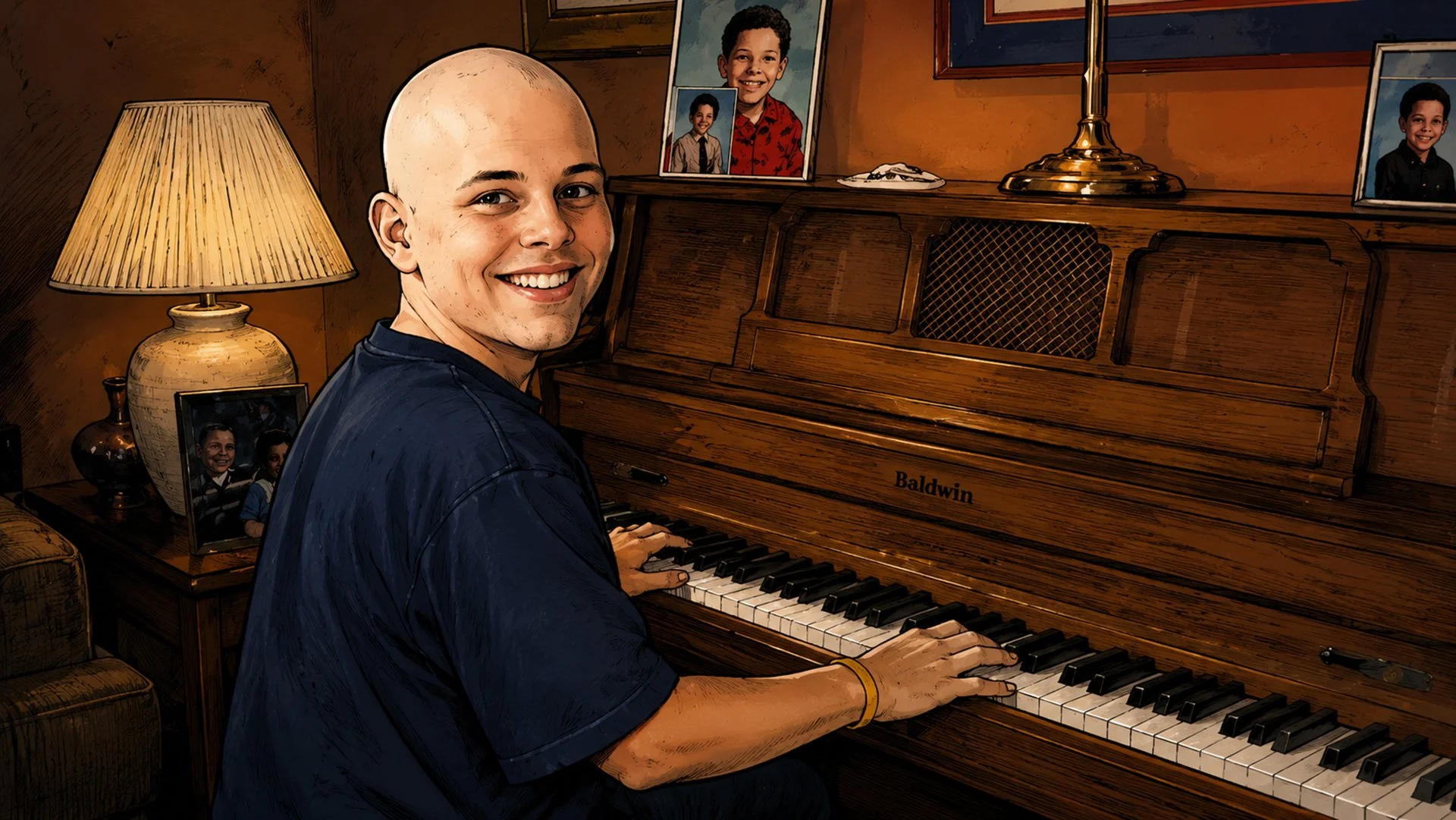
The first thing I wanted to know when I got home from brain surgery was whether I could still play the piano.
This probably requires some explanation, because there were objectively larger matters at hand. I was 21 years old. A tumor had just been removed from my brain. I had cancer. Radiation was ahead of me, chemotherapy was still being discussed, and nobody could tell me with certainty what the next several years of my life were going to look like.
But I had been playing piano since I was eleven, and by college, music had become much more than something I happened to be good at. I was studying it. I was composing. I was performing. It was the career I imagined for myself and, more importantly, one of the ways I understood who I was.
My left hand was also how I first understood that something was wrong.
It hadn't simply stopped working one morning. It had gradually become less reliable, which made the problem surprisingly easy to rationalize. A passage that should have been automatic suddenly wasn't. I couldn't arpeggiate properly. My fingers wouldn't do what I was telling them to do. Eventually I couldn't hold a pen normally.
None of this immediately led me to the conclusion that there was something growing in my brain. I was 21, and young people possess an almost supernatural ability to explain away evidence that their bodies are trying desperately to get their attention. At one point I played a show in the pit using only my right hand, adapting to the problem rather than asking the considerably more useful question of why half my body had apparently resigned from the band.
Eventually there was an MRI. Then the answering machine. Then the diagnosis. Then brain surgery.
When I came home from the hospital, I went to the piano.
I don't remember consciously deciding that this would be some profound test of my future. I wasn't staging a moment for the documentary that thankfully nobody was filming. I needed to know whether my hand worked.
So I sat down and played.
And I could play.
It is difficult to explain the enormity of something so ordinary. I had spent years sitting at that piano. There was nothing remarkable about pressing those keys until suddenly there was. The same left hand that had been disappearing from me before surgery was doing what I asked it to do again.
For that moment, whatever else was happening inside my body became secondary.
I could play.
Thirty years later, I think about that moment differently than I did when I was 21. Back then, it was intensely personal and immediate. Something I thought I might have lost had been returned to me. Today, after three decades spent around patients, clinicians and healthcare, I understand that the piano represented a question medicine doesn't always know to ask.
What does the patient need to be able to do for their life to still feel like their life?
Medicine has very sophisticated ways of determining whether treatment works. We can measure tumor response, surgical margins, blood counts, organ function, recurrence, progression and survival. These measurements matter enormously. I am alive because generations of physicians and scientists learned how to measure them, study them and improve them.
But those measurements cannot completely describe what happens to the person who survives.
A scan cannot tell you whether a pianist can play. A pathology report cannot tell you whether a parent has enough strength to pick up their child. Five-year survival does not tell you whether someone can return to the work that gave their life purpose, taste the food they once loved, hear the people around them, think as clearly as they used to, have children, have sex, walk without pain, sleep through the night, or recognize themselves in the person treatment left behind.
These aren't secondary outcomes simply because they're harder to put into a spreadsheet. For the person living with them, they may become the definition of the outcome.
That distinction became much more important to me as the consequences of my own treatment accumulated. Cancer did not end when the tumor came out. Some of the things done to save my life came home with me and stayed. That is a complicated truth for many survivors because gratitude and loss are perfectly capable of occupying the same body. You can be profoundly grateful to be alive and still mourn what survival cost you.
Healthcare is often uncomfortable with that ambiguity. We prefer clean categories. The treatment succeeded or failed. The patient survived or didn't. The cancer recurred or it didn't. Those distinctions are medically necessary, but human beings don't experience their lives as endpoints in a clinical study.
We experience them on ordinary Tuesday mornings when we discover what our hands can still do.
This is one of the reasons I wrote We the Patients: Understanding, Navigating, and Surviving America's Healthcare Nightmare. The book examines the enormous machinery surrounding American healthcare, but I never wanted the machinery to swallow the person standing inside it. Understanding insurance, hospitals, drug pricing, billing, policy and patient rights matters because all of those systems ultimately converge on somebody's actual body and somebody's actual life.
The goal of healthcare cannot merely be to produce survivors. It has to care about the lives those survivors are being sent home to live.
That requires something deceptively simple from everyone involved in healthcare: ask patients what matters to them before deciding what a successful outcome looks like. Sometimes the answer will be another year. Sometimes it will be avoiding pain. Sometimes it will be seeing a daughter graduate or preserving the ability to work or being able to live independently.
And sometimes it will be sitting down at an old piano after brain surgery and discovering that your left hand has come home too.
I was 21 years old when I sat down and tested mine.
I could play.
I still can.
If you've read We the Patients: Understanding, Navigating, and Surviving America's Healthcare Nightmare, I'd love to know which story stayed with you after you finished it. And if you've lived through serious illness yourself, I'm especially interested in what your version of the piano was. If you haven't read the book yet, 85 five-star Amazon reviews can't all be wrong.