Someone Had To Clear The Road: Eulogizing Dr. Harold Freeman
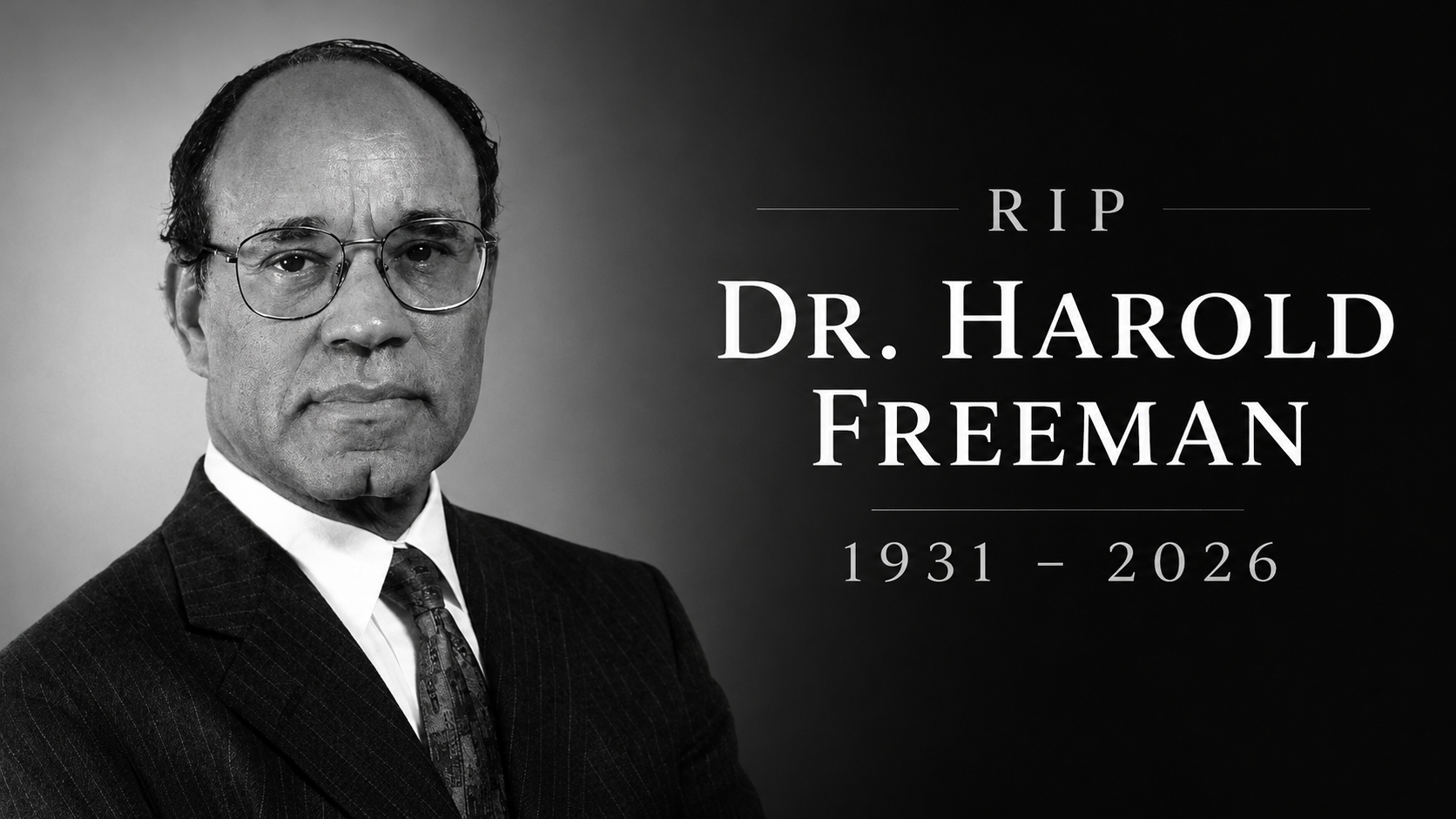
Dr. Harold P. Freeman died this week, and I’ve been thinking about a strange privilege that comes with getting older in a movement: eventually you begin losing the people who built the world you walked into. I wasn’t Harold’s protégé, and I won’t commit the peculiar eulogy sin of promoting myself posthumously into his inner circle. I met him a few times during my earliest years in cancer advocacy, heard him speak at conferences, saw him at ASCO and LIVESTRONG, and mostly watched him from the bleachers with popcorn. But I revered the man. There are people you know personally, and there are people whose work rearranges your understanding of what is possible. Harold was the latter for me.
I fell down the cancer advocacy rabbit hole sometime in the early 2000s, years after my own brain cancer diagnosis, through my first cancer buddy, Craig Lustig. Craig asked me one day whether I’d ever thought about becoming a cancer advocate. I had no idea what he was talking about. “What the hell is a cancer advocate? Why would I advocate FOR cancer? Craig’s explanation was essentially that you try to help the next few people have a less crappier time than you did. I’ve carried that around ever since.
Back then, discovering this world felt like Kansas going color. I was Jack Skellington wandering around singing “What’s This?” There were survivors, activists, physicians, organizers, researchers, and assorted professional pains in the ass who had somehow figured out that experiencing something terrible did not automatically confer wisdom, but it did occasionally provide useful intelligence about what ought to change. After years of believing cancer was something that had happened to me, I discovered there were people who had turned what happened to them, or what they witnessed happening to others, into work.
Harold Freeman belonged to an earlier generation of that tradition, except he came to it as a physician. He arrived at Harlem Hospital in 1967 after training at Memorial Sloan Kettering, intending, as he would later put it, to “cut cancer out of Harlem.” He was a surgeon. Surgery was what he knew how to do. But the Black women arriving with breast cancer at Harlem Hospital were often arriving so late in the course of their disease that the sophistication of the surgery barely mattered. In a study of 606 women treated there during the 22 years ending in 1986, only 6% had Stage 1 disease. Nearly half presented with Stage 3 or Stage 4 cancer, and the 5-year survival rate was 39%. Nearly all of the women were Black, all were poor, and half had no insurance when they arrived.
The easy response would have been to classify this as another depressing disparity, publish the numbers, and return to the operating room. Harold wanted to know why.
That question sounds almost embarrassingly obvious now, which is one of the recurring jokes in the history of healthcare. Many of our great innovations consist of someone noticing that the human being attached to the tumor is experiencing circumstances outside the tumor. Harold listened to what poverty actually did to cancer care. A woman could find a lump, make her way to the emergency room, wait for hours, and eventually be told she was in the wrong place. Without insurance, she could then face another bureaucracy, another office, another lost day of work, another transportation problem. She might have children, a job she couldn’t leave, and 15 other emergencies competing for attention. The lump didn’t hurt. The process did. Medicine could then record that she had “presented late,” a wonderfully antiseptic phrase that made the outcome sound almost meteorological. Harold understood that the delay itself had causes, and those causes could be attacked.
The era in which Harold began this work cannot be understated.
Across Black communities, the Black Panther Party was establishing free health clinics and community health programs because access to medicine had already become inseparable from the broader struggle for civil rights. Harold’s work was distinct from theirs, but he confronted the same underlying fact from inside medicine: the existence of healthcare does not guarantee access to it. Access to healthcare was not simply a question of whether a hospital existed. It was a question of whether people could realistically get through its doors, navigate its rules, trust its institutions, understand what was happening, and remain connected to care long enough for medical progress to mean anything. A miracle therapy located behind an impenetrable bureaucracy is still an impenetrable bureaucracy.
Harold eventually gave one answer to that problem a name: patient navigation. While serving as national president of the American Cancer Society, Harold led hearings in 7 American cities in 1989 about cancer among poor Americans. The following year, he established the first patient navigation program at Harlem Hospital.
The concept was almost comically sensible. If cancer care had become so fragmented and complicated that vulnerable people were getting lost between screening, diagnosis, treatment, insurance, transportation, and follow-up, perhaps somebody should help them get through it. Navigators helped remove barriers between an abnormal finding and a diagnosis, between a diagnosis and treatment, between the existence of medicine and a person’s actual ability to receive it. Combined with expanded screening, the Harlem program was associated with dramatically earlier diagnosis and a 5-year breast cancer survival rate that reached 70% in a later cohort. Harold didn’t discover a molecule or invent a machine. He changed what happened between the medicine, and people lived.
And this is why Harold had to be part of The Cancer Mavericks: A History of Survivorship.
During the pandemic, I partnered with the National Cancer Institute to produce a documentary podcast series marking the 50th anniversary of the 1971 National Cancer Act and telling the history beneath the history most people already knew. | We know the War on Cancer through chemotherapy, radiation, clinical trials, and the scientists whose discoveries changed treatment. I wanted to document the other lineage: Mary Lasker forcing cancer onto the national agenda; Rose Kushner challenging the barbaric paternalism surrounding breast cancer surgery; Ellen Stovall helping turn survivorship into a political constituency; and Harold Freeman recognizing that a cure means very little to someone structurally prevented from reaching it. My producers desperately tried to interview Harold. But this was COVID, he was ill, and despite communicating with his family, there was simply no way to make it happen. I hated that then, and I hate it more today. There was no intellectually honest way to tell 50 years of modern cancer history and leave Harold Freeman out simply because we couldn’t get him on Zoom.
So we told his story anyway.
What fascinates me now is how completely his idea succeeded in becoming ordinary. We have patient navigators, nurse navigators, financial navigators, clinical-trial navigators, survivorship navigators. Navigation has become part of the vocabulary and infrastructure of contemporary cancer care. Most patients who encounter a navigator will never know Harold Freeman’s name, and I don’t think that is an injustice. I think it may be the highest compliment advocacy can receive. If you do this work correctly, eventually people take the victory for granted.
The accommodation becomes normal. The once-radical proposition becomes a job description. Nobody should have to know the historiography of patient navigation while sitting in an oncology waiting room wondering whether they’re going to die. They should simply get help. Harold made cancer suck less for people he would never meet, in places he would never see.
The older and creakier I get, the more I understand that movements are built this way. Someone has to take the machete into the jungle first. They clear enough brush for another person to follow, and eventually enough people walk the same path that it becomes a road. Someone paves it. Somebody else puts up signs. A generation later, people drive on it and complain about the traffic, blissfully unaware that there was ever a jungle there. Harold Freeman was one of the people with the machete. So was Ellen Stovall. So were many of the people I discovered when Craig Lustig first asked me if I wanted to become a cancer advocate and my entire understanding of what I could do with my life changed.
They taught me that you don’t wait for someone to certify you as the person authorized to notice the problem. If something needs doing and nobody is doing it, sometimes that’s the job description.
So Harold’s death feels personal to me despite the fact that our relationship wasn’t particularly personal. I was fortunate enough to encounter him when I was young enough in advocacy to still be figuring out what the word meant. I heard him speak. I watched how he thought. I learned the history of what he had seen in Harlem and what he chose to do about it. He was extraordinarily articulate, deeply empathetic, and possessed of that rare form of vision that looks obvious only after someone else has had it. He invented something that should have been there on day 1 and wasn’t. Then he spent his life making sure it was there for the people who came next.
We use the phrase “standing on the shoulders of giants” so often that it has been sanded into motivational cat posters on sale at a Successories store in a 1990s SkyMall catalog. But occasionally one of those shoulders disappears, and you’re reminded there was a person underneath you all along. Harold Freeman was one of the original pillars of modern cancer advocacy and cancer care. He saw human beings where systems saw late-stage disease. He understood that access was not an abstraction, that empathy could be operationalized, and that advocacy was not something adjacent to medicine. Sometimes advocacy was the thing that allowed medicine to work.
Rest in peace, Harold. I was proud to stand in your shadow, and I’m even prouder to stand on the road you cleared.