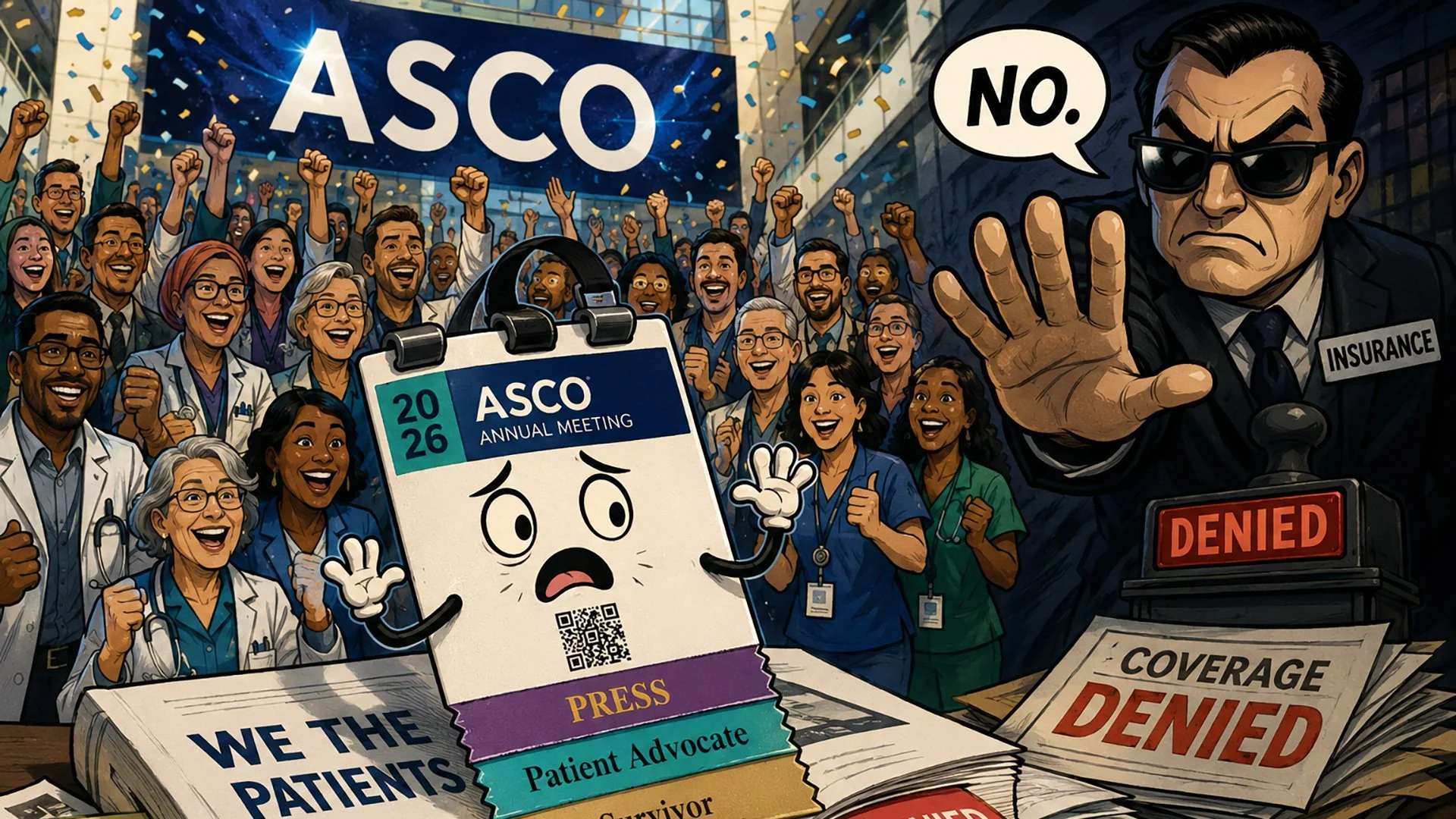
Every year, ASCO offers a glimpse of the future.
More than 40,000 oncologists, researchers, pharmaceutical executives, investors, regulators, nonprofit leaders, journalists, and patient advocates descend on Chicago to discuss where cancer care is headed next. For a few days, the entire oncology world occupies the same space. New discoveries take center stage. Companies unveil products. Researchers present data. Partnerships form. Careers advance. Deals get done. Hope gets measured in hazard ratios and survival curves.
By every conventional measure, ASCO 2026 was a success.
The conference featured some of the most promising science in recent memory. The standing ovation for a major pancreatic cancer breakthrough represented one of those rare moments when an entire room understood the significance of what it had just witnessed. Pancreatic cancer remains one of the deadliest diseases in medicine. Researchers have spent decades chasing meaningful progress. Thousands of patients enrolled in clinical trials knowing they might never personally benefit from the results. Many never did. When the data finally delivered, the applause reflected something deeper than excitement. It reflected relief.
For a few minutes, everybody focused on the same thing.
Science worked.
Yet the conversation that followed throughout the rest of the week had very little to do with science.
I attend ASCO as credentialed press because I am interested in what happens after the presentations end. The official program tells one story. The hallways tell another. After nearly 30 years as a brain cancer survivor, I have learned that the most revealing conversations rarely happen under spotlights. They happen over coffee. They happen during breakfast meetings. They happen while people wait for elevators. They happen when someone glances over both shoulders before saying what they actually think.
This year, I kept hearing the same thing.
A physician would stop me after a session about a promising therapy and spend the next 10 minutes talking about insurance denials.
An advocate would describe an extraordinary advance in treatment and then pivot immediately to transportation barriers, copays, and patients who could not get to appointments.
A nonprofit leader would talk about rising demand for services while quietly wondering how long those services could survive if funding continues to shrink.
A researcher would celebrate a breakthrough and then express frustration that many patients may never reach it.
Nobody coordinated these conversations.
They all arrived at the same place on their own.
The most revealing moment of the conference happened when a physician I had never met stopped me in a hallway, pointed at the copy of We the Patients sticking out of my bag, and said, “Thank you for saying what we cannot.”
That conversation repeated itself all week.
People asked me to sign books in the middle of crowded aisles. Others pulled me aside between sessions. Several thanked me for putting words around something they had struggled to articulate themselves. What struck me was not that they had read the book. What struck me was why they connected with it.
They were not talking about cancer.
They were talking about the system surrounding cancer.
Walking through the exhibit hall felt like walking through the future. Massive displays promoted precision medicine, artificial intelligence, advanced diagnostics, targeted therapies, and technologies that would have sounded impossible when I was diagnosed in 1996. The amount of talent, investment, and intellectual horsepower concentrated in one place was staggering. Nobody can walk through ASCO and conclude we have a shortage of innovation.
At the same time, nobody seemed particularly eager to discuss the obstacles standing between patients and that innovation.
Somewhere between the giant video walls and the espresso bars, it occurred to me that nobody had built a booth dedicated to explaining prior authorization.
That observation sounds sarcastic because it is.
It is also true.
The oncology community has become remarkably effective at developing new ways to extend life. The patient experience remains remarkably inconsistent when it comes to accessing those advances. Throughout the conference, conversations about clinical trial enrollment became conversations about transportation. Discussions about treatment advances became discussions about insurance approvals. Meetings focused on innovation eventually circled back to affordability, navigation, and access.
Different conversations kept arriving at the same destination.
The challenge facing many cancer patients no longer begins with finding the right treatment.
The challenge begins after finding it.
One breakfast conversation captured the shift particularly well. My longtime friend Dr. Eric Rubenstein, founder of CancerX Ventures and advisor to both the Cancer Moonshot and the Biden Cancer Initiative, had recently finished reading We the Patients. He described it as the foundation for a bipartisan patient protection movement. The observation stayed with me because it reflected what I was hearing throughout the conference. Increasingly, people across healthcare seem to recognize that many of the biggest problems facing patients no longer originate in laboratories.
They originate in systems.
For years, healthcare debates revolved around assigning blame. Insurers blamed providers. Providers blamed insurers. Pharmaceutical companies blamed pharmacy benefit managers. Employers blamed rising costs. Politicians blamed one another. Every stakeholder arrived with evidence explaining why somebody else created the problem.
At ASCO 2026, I heard something different.
I heard broad agreement that patients increasingly struggle to access care in a system that has never been better at creating it.
That may be the most important healthcare development nobody is talking about.
One of the biggest mistakes people make when discussing healthcare is assuming the system is broken. Most of the time it works exactly as designed. Insurance companies attempt to control spending. Hospitals attempt to maximize revenue. Drug companies pursue growth. Employers try to manage costs. Investors seek returns. Politicians respond to budgets and elections. Every participant reacts rationally to the incentives in front of them.
The problem is that patients experience the combined effect.
They experience the denied scan. The delayed approval. The surprise bill. The out of network specialist. The endless paperwork. The hours spent on hold. Institutions divide these experiences into categories. Patients experience them as a single journey.
Prior authorization offers a useful example. Insurers defend it as a tool for controlling unnecessary spending. There is logic behind that argument. Healthcare costs continue to rise, and every payer faces pressure to manage resources responsibly. The problem emerges when friction itself creates value. If enough patients abandon appeals, miss deadlines, become exhausted, or simply give up, delays generate savings. Nobody needs bad intentions for bad outcomes to emerge. The incentive structure handles that work on its own.
The same dynamic appears in debates surrounding Medicaid, Affordable Care Act subsidies, and 340B. Policymakers often discuss these programs through the language of budgets and spending. Patients experience them through the language of consequences. Coverage determines access. Access influences treatment. Treatment affects outcomes. The chain is neither complicated nor controversial.
What continues to surprise me is how often healthcare discussions drift away from patients entirely. Conversations become debates about process, reimbursement, margins, utilization, and market dynamics. Those issues matter. They are also means to an end. At some point, the conversation stops being about patients and starts being about defending the system.
That is why I keep returning to patient protection.
Not because it sounds good politically.
Because it addresses a problem hiding in plain sight.
We regulate financial markets because consumers need protection. We regulate transportation because passengers need protection. We regulate food and pharmaceuticals because the public needs protection. Yet we routinely expect cancer patients and their families to navigate one of the most complex systems in modern society while confronting one of the most frightening experiences of their lives.
The industry often treats patient navigation as a support service. I increasingly view it as essential infrastructure. Navigation determines whether people understand their options, access financial assistance, secure second opinions, coordinate care, appeal denials, and stay connected to treatment. Helping patients navigate the system is not simply compassionate. It is economically rational. Better navigation reduces delays. Better access improves adherence. Better outcomes reduce avoidable costs.
The standing ovation for pancreatic cancer deserved every second of applause it received. The science presented at ASCO 2026 genuinely moved the field forward. Yet the conversations I remember most happened after the applause ended.
The most important story at ASCO 2026 was not the science.
It was the growing recognition that nearly everyone inside the cancer ecosystem now understands the same problem. The question is whether that shared understanding finally produces action, or whether next year’s breakthroughs will arrive accompanied by the same hold music.