My Father Wrote Everything Down: Behind We the Patients | Story 5 of 5
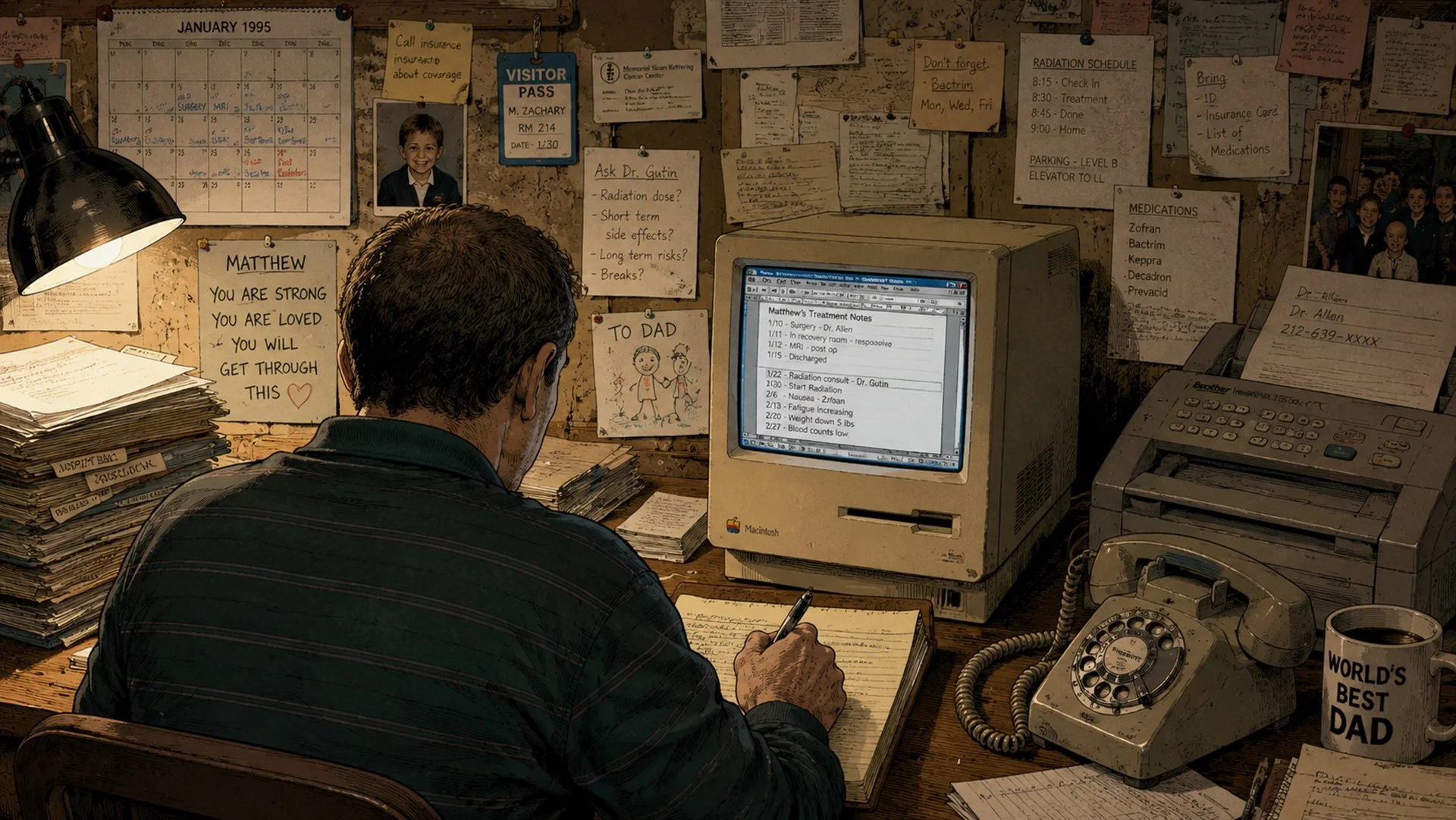
When I was 21 and going through treatment for brain cancer, my father kept a journal.
Calling it a journal may give it more literary ambition than Dad intended. He wasn't sitting beside a fireplace reflecting on the fragility of life. He was documenting things. Doctors, appointments, medications, radiation treatments, conversations, weather, parking, how I was feeling, what I was eating and occasionally where I had thrown up.
One of my favorites comes from radiation.
I was nauseated constantly during treatment, and on one particular day I threw up on the street at Third Avenue and 39th Street in Manhattan. My father dutifully recorded the location for posterity. He also noted that he cleaned my shoes afterward and needed to teach me better technique for keeping them clean while vomiting.
Apparently even brain cancer could not exempt me from constructive parental feedback.
At 21, I don't think I understood why he wrote all of this down. It was just another strange feature of the strange new world my family had entered. Dad took notes. Dad remembered things. Dad drove me places. Dad asked questions. Dad kept track of what happened.
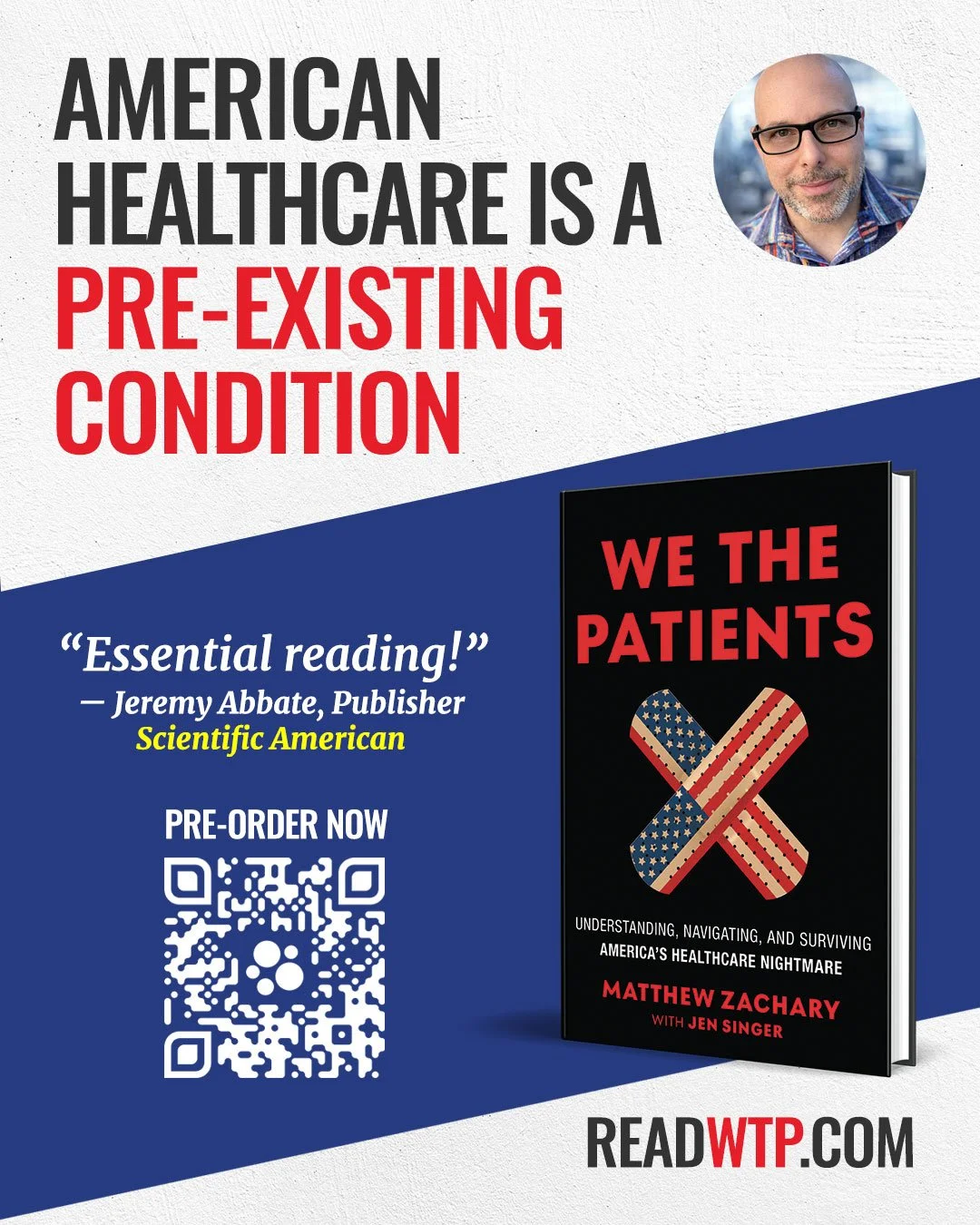
Years later, when Jen Singer and I were writing We the Patients: Understanding, Navigating, and Surviving America's Healthcare Nightmare, I went back through those records.
Reading them as a father myself was a very different experience.
I could finally see what the 21-year-old version of me couldn't.
My father was terrified.
There is an enormous amount of helplessness involved in watching someone you love become seriously ill, but there is something particularly cruel about being a parent in that situation. For most of your child's life, your job has been to fix things. They fall down, you pick them up. They get lost, you find them. Something breaks, you repair it. There is an almost contractual understanding between parent and child that you are the person who knows what to do.
Then somebody tells you your kid has cancer.
Suddenly there are surgeons and oncologists and radiation machines and statistics you don't understand. Other people are making decisions about your child's body. You are surrounded by expertise and still unable to answer the only question that actually matters to you.
Is my kid going to be okay?
My father couldn't answer that question.
So he wrote everything down.
The more I read his journal, the more I began to see the notes differently. The details weren't incidental to the story. The details were how he survived the story.
If you can't control the cancer, you can control the appointment schedule. If you can't guarantee that radiation will work, you can remember what the doctor said about it. If you can't stop your son from vomiting, you can clean his shoes afterward. You can write down where it happened. You can make sure he gets home.
You can do the next thing.
Eventually, even that stopped being enough.
As radiation accumulated, I became increasingly sick. My father watched the treatment that was supposed to save me reduce me physically in front of him, and at one point he began pleading with my doctors to give me a break because he was afraid the treatment itself was killing me.
That passage in his journal lands very differently now.
I knew what radiation felt like from inside my body. I had never really considered what it looked like from the chair next to me.
We talk about caregivers constantly in healthcare, and the word is so familiar that I think we've managed to drain some of the humanity out of it. "Caregiver" sounds almost occupational, as though somebody has been assigned a defined set of responsibilities and provided with instructions.
That is not what happened to my father.
He was a dad whose son got brain cancer.
Nobody trained him for the job. Nobody gave him a manual explaining how much to write down, which questions to ask, when to challenge the doctors, how frightened he was allowed to be, or what to do with himself when there was nothing left to do.
He figured it out while I was figuring it out.
Families across America are doing some version of this every day. They become schedulers, drivers, note takers, medication managers, insurance negotiators, amateur clinicians, financial administrators, advocates and translators. They learn the names of drugs they never wanted to know existed and memorize phone extensions to departments they didn't know existed six months earlier. They rearrange jobs and marriages and bank accounts and childcare because illness rarely confines itself to the person whose name appears on the medical chart.
And much of that labor remains nearly invisible to the healthcare system.
The patient has the diagnosis. The caregiver inherits the consequences.
That realization became another important part of We the Patients. Jen and I wrote a book about navigating American healthcare, but there is an assumption buried inside the very word "navigating" that deserves more scrutiny. Navigation requires somebody with enough time, energy, knowledge and persistence to do it.
Sometimes that's the patient.
Very often it isn't.
Sometimes it's the spouse sitting beside the hospital bed with a notebook. It's the adult daughter calling the insurance company during her lunch break. It's the friend organizing meals. It's the sibling researching specialists at two in the morning. It's the parent who has become the unofficial archivist of a disease because somebody needs to remember what everybody said.
Thirty years later, I have very few memories of the administrative details of my cancer treatment. I remember fear. I remember being sick. I remember the people. I remember the piano.
My father remembered the rest for me.
He even remembered Third Avenue and 39th Street.
There is something wonderfully ridiculous about knowing the precise Manhattan intersection where your 21-year-old self threw up three decades ago. But I'm grateful Dad wrote it down, because buried among all those appointments, medications, parking problems and bodily functions is a record of something much larger than my cancer.
It's a record of how my father loved me when there was almost nothing he could control.
He took notes.
He drove the car.
He challenged the doctors.
He cleaned my shoes.
And when I went back through those pages 30 years later to write a book about surviving American healthcare, I discovered that Dad had been writing part of it all along.
This is the fifth and final essay in this series of personal stories behind We the Patients: Understanding, Navigating, and Surviving America's Healthcare Nightmare. If you've read the book, I'd love to know which of these stories stayed with you, or which one I haven't written about yet that you think deserves its own essay. And if you haven't read it yet, 85 five-star Amazon reviews can't all be wrong.