America’s Newest Healthcare Industry Is Protecting Us From American Healthcare
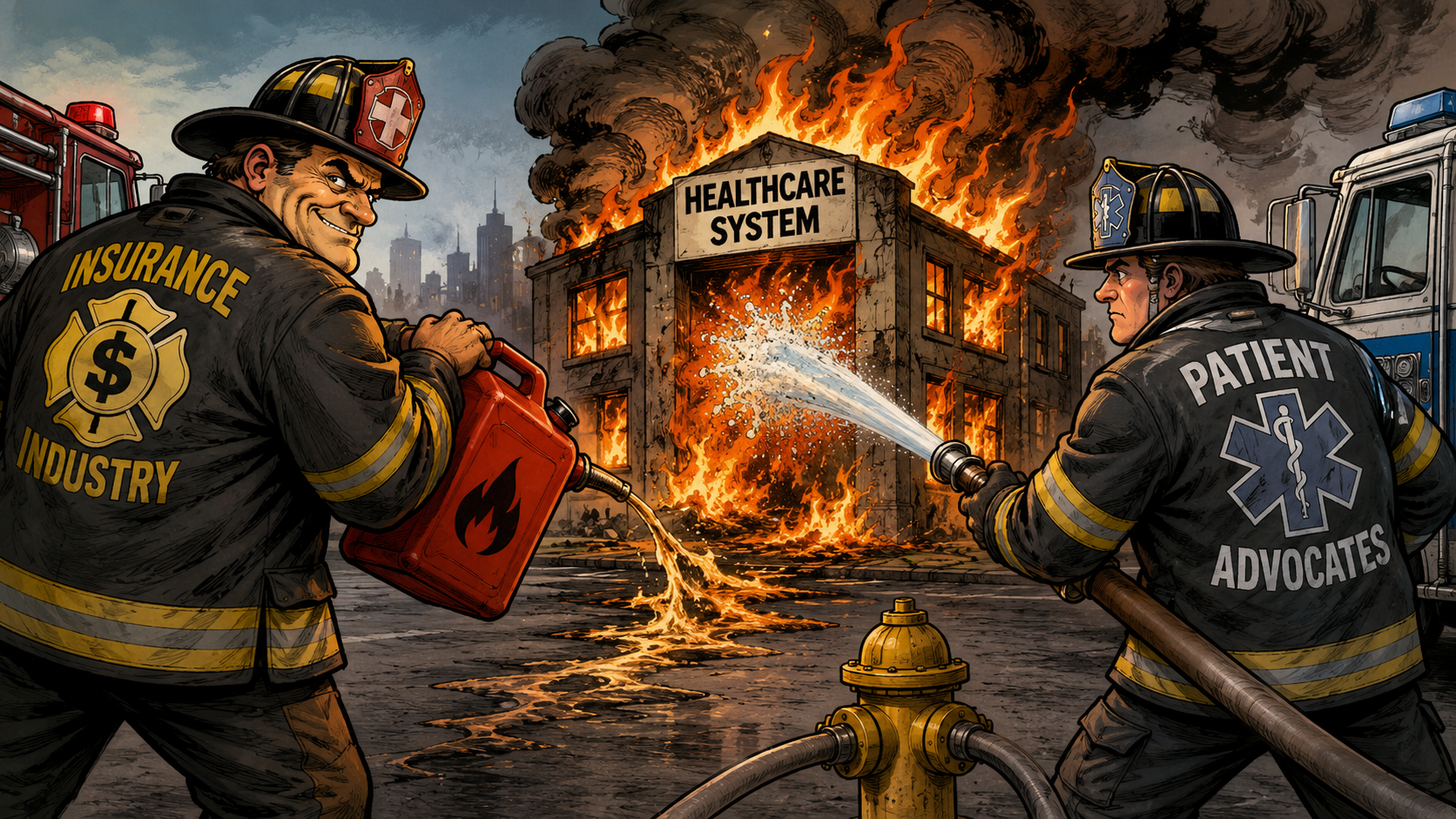
At some point, American healthcare became so difficult to use that helping people use American healthcare became an industry.
Not a hotline. Not a nonprofit niche. Not a few retired nurses helping families decipher medical bills at the kitchen table. An actual industry, complete with startups, venture capital, enterprise contracts, technology platforms, private advocates, benefits navigators, billing specialists, care coordinators, second-opinion services and concierge companies whose basic value proposition is remarkably simple: American healthcare is incredibly complicated. Pay us and we will help you survive it.
I recently confronted this absurdity while finishing the Patient Survival Guide on my website, a collection of 21 practical guides for people trying to navigate the everyday machinery of American healthcare. One of them explains private patient advocacy and concierge healthcare navigation, including services that help people find specialists, schedule appointments, obtain medical records, coordinate second opinions, manage complex treatment, deal with insurance problems, review medical bills and communicate across institutions.
Reading through the final version, I had one of those palm-surgically-attached-to-forehead moments.
Holy shit.
We have created an entire secondary economy to protect people from the primary economy.
Welcome to the Healthcare Countermeasures Economy
There is nothing imaginary about the market. Grand View Research estimates that the U.S. healthcare navigation platform market generated nearly $3.9 billion in revenue in 2023 and projects it will reach approximately $6.4 billion by 2030. Globally, the same firm estimates healthcare navigation platforms will become a $17.7 billion market by the end of the decade. The exact numbers depend heavily on what researchers include under the increasingly broad umbrella of “healthcare navigation,” so I would not pretend there is one perfect figure. The important part is that we are no longer talking about a cottage industry. We are talking about billions of dollars being spent helping human beings figure out how to obtain and pay for healthcare. (Grand View Research)
And then there is Solace Health, a patient advocacy company founded in 2022. In February, Solace raised $130 million in venture capital at a reported valuation of $1 billion. Its advocates help people schedule appointments, interpret treatment plans and understand medical bills. The company was born partly from its founder’s experience watching his physician mother struggle to navigate the healthcare system while being treated for pancreatic cancer. (Solace)
A billion-dollar valuation for helping Americans navigate American healthcare.
You really cannot improve upon that sentence.
What makes this phenomenon so interesting is that these businesses are not selling some exotic new medical technology. They are frequently selling comprehension, coordination, persistence and administrative competence. They help people understand what their insurance covers, locate appropriate care, untangle bills, manage appointments, coordinate specialists and deal with the enormous amount of clerical labor that now accompanies being sick in America.
My own Patient Survival Guide describes situations where private advocacy may be useful: repeated insurance denials, authorization problems, complicated billing disputes, care spread across multiple institutions, transitions between facilities and families simply overwhelmed by the administrative workload of serious illness. These are not obscure edge cases. They are recognizable features of the American patient experience.
That is what makes the whole thing so magnificently ridiculous.
The People Solving the Problem Are Not the Problem
There is an important distinction here, because otherwise this becomes another lazy healthcare rant about startups making money.
I have no problem with patient advocates making money. I have no problem with healthcare navigation companies making money. If somebody can help a frightened family coordinate five specialists, find an appropriate second opinion, understand an incomprehensible medical bill or get an insurer to reconsider a denial, that person has created real value. A skilled advocate can save time, money and sanity precisely when a patient or caregiver has very little of any of those things to spare.
The problem is not that somebody built a business helping cancer patients fight insurance denials. The problem is that America generates enough insurance denials to support the business.
That distinction matters.
For 30 years, I have watched patients receive an involuntary second occupation the moment they become seriously ill. You thought you had cancer? Congratulations. You are now also a project manager. Please coordinate your physicians, pharmacy, insurer, hospital, laboratory, imaging center and benefits department while simultaneously undergoing treatment, working if you still can, caring for your family and trying not to die.
We have normalized an astonishing amount of unpaid administrative labor performed by sick people and their families. The emergence of professional navigation is, in one sense, the market finally assigning economic value to work patients have been forced to perform themselves for decades.
There is something encouraging about that. There is also something deeply damning about why the demand exists in the first place.
When Dysfunction Becomes Economically Productive
Markets are extremely good at discovering unmet needs, and American healthcare manufactures unmet needs at industrial scale. Every additional layer of complexity creates another problem somebody can potentially get paid to solve.
Insurance benefits become too complicated to understand, so employers buy benefits navigation. Provider networks become difficult to navigate, so companies help employees find physicians. Prescription drug pricing becomes opaque, so another company helps people locate cheaper medications. Medical bills become incomprehensible, so specialists emerge to review and negotiate them. Care becomes fragmented among institutions, so somebody gets paid to coordinate it.
None of these services exists solely because somebody woke up one morning and decided healthcare needed another middleman. Many exist because something upstream became sufficiently confusing, fragmented, expensive or adversarial that fixing the resulting problem acquired market value. That is a remarkable economic phenomenon when you think about it. American healthcare dysfunction is no longer merely expensive. It has become economically productive.
We have created markets around mitigating the consequences of other markets.
This does not mean every dollar spent on navigation represents waste. Far from it. Healthcare is inherently complicated, serious illness can require coordination even in well-functioning systems, and people will always benefit from expertise when making difficult medical decisions. The absurdity appears when we examine how much of the demand comes not from medicine itself, but from the administrative architecture surrounding medicine.
Cancer is complicated because cancer is complicated. Getting six specialists to share information should not require the organizational skills of an air traffic controller. Chemotherapy is complicated because chemotherapy is complicated. Determining whether your insurer has decided you tried enough cheaper drugs first is complicated because we chose to make it complicated.
Those are different kinds of complexity, and American healthcare has spent decades casually blending them together.
Employers Are Starting to Pay for the Complexity Twice
The employer market makes this even stranger.
Employers already finance a substantial portion of American healthcare through employer-sponsored coverage. They hire brokers and consultants, select plans, negotiate benefits and spend enormous sums providing insurance to workers. Employees contribute through payroll deductions, deductibles, copayments and coinsurance. Then, increasingly, employers purchase navigation platforms because employees struggle to use the benefits everyone just spent all that money buying.
The market research itself acknowledges this dynamic. Grand View Research identifies large enterprises as the largest end-user segment for healthcare navigation platforms and describes employers investing in these tools to help workers navigate the healthcare system, access appropriate care and manage healthcare spending. (Grand View Research)
Think about the circularity of that for a moment. An employer pays for healthcare. The employer pays for health insurance. The employer may pay advisers to help design the health benefit. Then the employer pays another company to help employees understand and successfully use the benefit. At some point, perhaps we should ask whether the user interface for American healthcare has become the world’s most expensive escape room. The answer from the market appears to be yes, except now there is a thriving business selling clues.
This Is What Markets Do When Systems Stop Working for Humans
There is an instinct in healthcare policy to view administrative complexity primarily as waste, and certainly there is plenty of it. But I think that framing misses something increasingly important. Complexity does not simply consume money. Once complexity becomes sufficiently entrenched, businesses organize around it. Careers form around it. Technology gets built around it. Investors finance solutions to it. Employers create budgets for managing it.
The dysfunction develops its own economic ecosystem.
That creates an uncomfortable question about what happens when the system eventually tries to simplify itself. Every unnecessary complication may be somebody else’s revenue stream. Every layer we theoretically want to eliminate may have companies, contracts, employees and investors attached to managing it.
That does not make reform impossible. It does mean the economic anatomy of American healthcare is even stranger than the usual diagrams showing insurers, hospitals, pharmaceutical companies, employers and patients. There is now another expanding layer whose purpose is helping everybody cope with the interactions among all the other layers.
We should be grateful that these services exist. People need them right now. I recommend patient advocates because I have seen what competent advocacy can accomplish, and my own guide tells patients how to evaluate private advocates, understand their fees, check their qualifications and decide whether paying for help makes sense. A good advocate can make an impossibly complicated situation manageable.
But gratitude for the solution should not make us incurious about the problem.
There is something profoundly American about responding to a dysfunctional market by creating another market to protect people from it. It is entrepreneurial, adaptive and, in its own strange way, impressive. Human beings encountered a system that routinely overwhelms sick people and said, fine, we’ll build companies to help them through it.
Thank God they did.
But perhaps the more important question is why we needed them to.
American healthcare has become sufficiently difficult to navigate that navigating American healthcare is now itself a multibillion-dollar business. Investors can finance it. Employers can purchase it. Startups can scale it. Entrepreneurs can build billion-dollar companies around it. And patients can finally hire somebody to help them survive the administrative system surrounding the medical system that is supposed to help them survive their illness.
If that doesn’t make you put your palm through your forehead, I don’t know what will