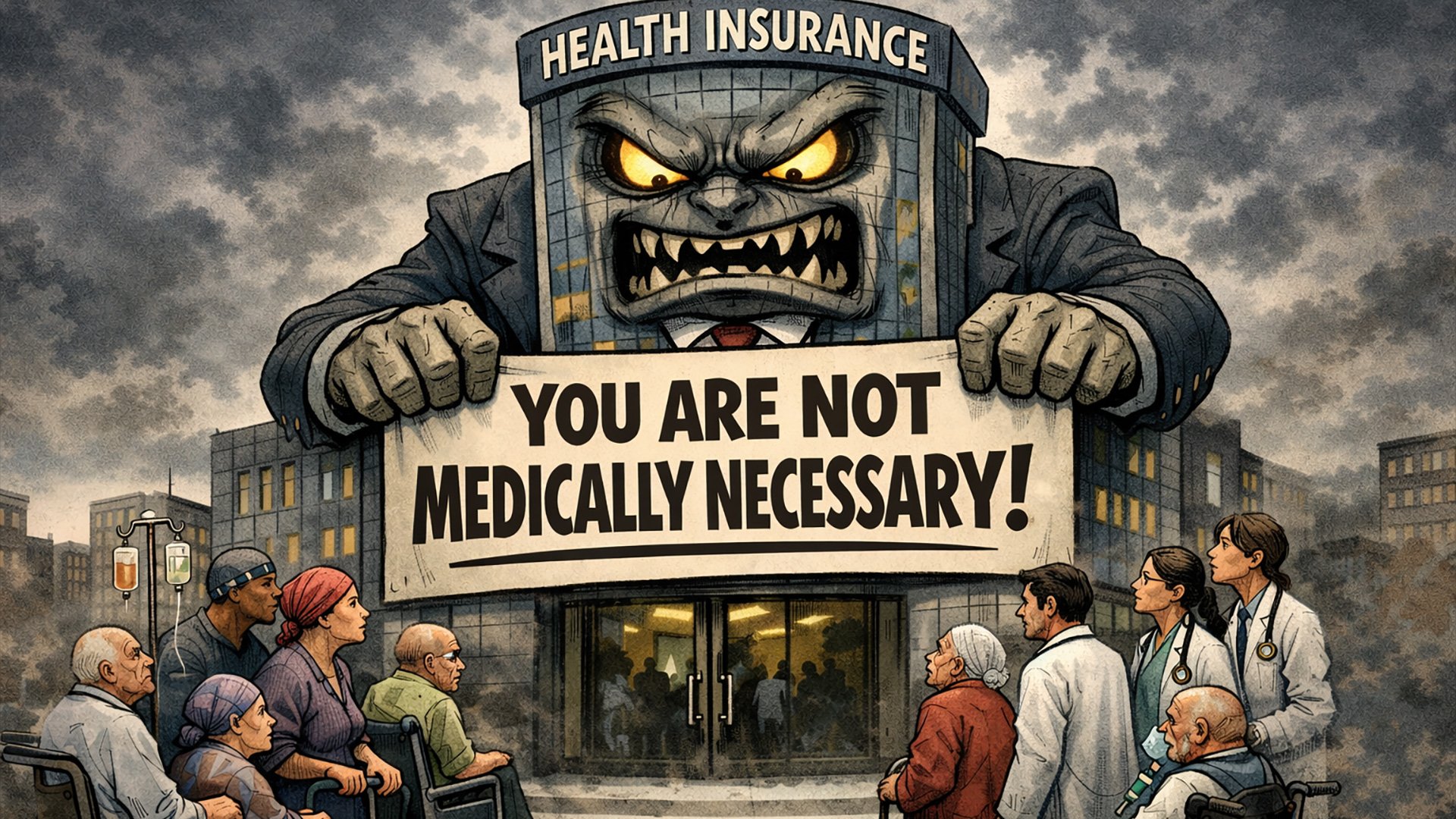
You Are NOT Medically Necessary
DISCLAIMER
If you are a clinician reading this, especially a nurse practitioner, family practitioner, or anyone providing care day to day, this piece stands with you. The critique below targets insurance companies and the denial systems they designed. The people practicing medicine are dealing with the consequences, not causing them.
———————————————
Insurance companies did not invent the phrase medically necessary. They took it, hollowed it out, and rebuilt it as a financial gate.
Wendell Potter and Ron Howrigon laid this out in plain language, without theatrics and without euphemism. Once you see it clearly, it becomes hard to unsee. A clinical term that once lived between a patient and their clinician now lives inside coverage policies, internal reviews, and profit calculations that never involve the patient at all.
When a doctor, nurse practitioner, or family practitioner says medically necessary, they mean something grounded and human. They mean the test, drug, procedure, or treatment that gives the patient in front of them the best chance of relief, stability, or survival. That judgment comes from training, experience, pattern recognition, and actual contact with a living person.
When an insurer uses the same words, they mean something entirely different. They mean whatever their plan document allows. They mean whatever their coverage policy says this quarter. They mean whatever interpretation benefits the company after internal review by someone they employ, whose incentives align with financial performance, not patient outcomes.
This distinction gets blurred on purpose.
The public conversation often collapses all medical decision making into a single bucket, as if clinicians and insurers operate with the same goals and authority. They do not. Clinicians practice medicine. Insurance companies manage risk and revenue. One exists to care for people. The other exists to protect margins.
The harm begins when insurance companies present their decisions as medical judgment.
ProPublica exposed how far this has gone. They found that Cigna medical directors approved denials at a rate of once every 1.2 seconds. That pace alone tells you everything you need to know. No one practices careful clinical review every 1.2 seconds. That is not medicine. That is throughput.
Those denials do not float in abstraction. They land on real people. Patients receive letters full of unfamiliar language. Treatments get delayed. Symptoms worsen. Anxiety spikes. Then the next wave hits clinicians.
Nurse practitioners and family practitioners field the calls. They explain decisions they did not make. They resubmit paperwork. They argue with people who never saw the patient. They burn hours chasing approvals instead of practicing care. They absorb anger that belongs somewhere else.
Doctors do the same. Specialists do the same. The entire clinical workforce becomes the shock absorber for insurer behavior.
And still the narrative persists that this is a disagreement among professionals, a gray area of judgment, a necessary tension in a complex system. That framing protects the wrong actors.
Insurance companies created coverage policies that vary plan to plan and change without notice. They maintain libraries of contradictory rules that no single clinician could reasonably track. Even when a patient appears covered on paper, a medical director can override the policy anyway. The policy becomes a suggestion, not a guarantee.
Ask yourself a basic question. Why should the care someone receives depend on the insurance card in their wallet instead of their clinical situation. There is only one honest answer. That arrangement benefits insurance companies.
This structure did not happen by accident. It persists because it works for shareholders.
The people harmed by it lack leverage individually. Patients navigate illness while learning a second language of denials and appeals. Clinicians juggle care delivery with administrative warfare. Everyone stays busy. Accountability stays diffuse.
Potter and Howrigon point to solutions that expose how artificial this complexity really is.
The first involves coverage standards. Medicine already has structures that evaluate care across specialties. The Relative Value Scale Update Committee represents every specialty through hundreds of physician advisors. That body already reviews services and evidence. There is no technical barrier to creating universal clinical coverage guidelines that apply across insurers.
If such standards existed, clinicians would know what qualifies. Patients would know what to expect. Insurance companies would lose the ability to hide behind bespoke policies designed to confuse. Variation would narrow. Appeals would drop. Care would become predictable again.
The second solution cuts closer to the nerve. Treat denials as the practice of medicine.
If an insurance company wants to deny care, require that denial to carry real clinical accountability. The person signing it should hold an active license in the patient’s state. They should practice within the relevant specialty. They should document their reasoning in the patient’s chart. They should carry malpractice liability if harm results.
Watch how quickly denial rates change when the risk shifts.
Right now medical directors deny care from behind corporate shields. Their decisions rarely touch patient records. Their names rarely appear. Their exposure remains limited. That insulation enables speed and volume. Remove it and the entire denial economy changes.
None of this indicts clinicians. In fact, it restores their authority.
Under such a system, a specialist could still disagree with another specialist. That happens in real medicine. The difference lies in transparency, accountability, and proximity to the patient. Real disagreements belong in charts, not in call centers.
Take the current GLP 1 coverage mess. A universal guideline could clarify eligibility. Prescribers would operate within known parameters. Patients would not need to guess. Denials would become rare exceptions rather than default outcomes.
Or consider oncology decisions near end of life. A licensed oncologist reviewing a case, documenting clinical reasoning, and standing behind that judgment operates inside medicine. A nameless denial stamped in seconds operates outside it.
These changes remain absent for one reason. They threaten profit.
Insurance companies generate returns by limiting payouts. Every delay saves money. Every denial shifts cost. Stock prices respond accordingly. That incentive structure explains more than any public statement ever will.
Patients pay the price. Clinicians carry the weight. Insurance companies collect the upside.
I have lived inside this system long enough to recognize the pattern. I have watched language shift. I have watched responsibility blur. I have watched good clinicians apologize for decisions they did not make. I have watched patients internalize blame that never belonged to them.
This piece exists to pull the curtain back again and again until the mechanics become undeniable.
If you are a patient, this explains why your care feels arbitrary.
If you are a clinician, this names the forces undermining your judgment.
If you work inside policy or media, this shows where accountability actually sits.
The full reporting and analysis live in the original work. Read it. Share it. Use it to push conversations out of abstraction and into consequence.
Silence keeps this machine running. Clarity slows it down.
SOURCE ➡️ https://healthcareuncovered.substack.com/p/what-is-medically-necessary