UnitedHealthcare Invited Journalists to Headquarters to Prove They’re the Good Guys. Then the CEO Called Wrongful Death Lawsuits “One-Offs.”
Last week, UnitedHealthcare invited journalists and influencers to its Minnesota headquarters for a carefully staged show of transparency. There was no major product announcement. No meaningful policy reform. No public reckoning with the company’s growing pile of controversies. Instead, reporters were treated to a day of AI demos, tech presentations, and human-interest anecdotes about call centers, all wrapped in the kind of polished corporate hospitality designed to produce one thing: better press.
It was less a news event than a reputation laundering exercise.
The most revealing moment came when MedCity News reporter Katie Adams asked UnitedHealthcare CEO Tim Noel a question that any serious journalist should ask the leader of the country’s largest health insurer: how can the company present itself as a credible messenger when it is facing lawsuits from dead patients’ families, whistleblower employees, state attorneys general, and health systems across the country?
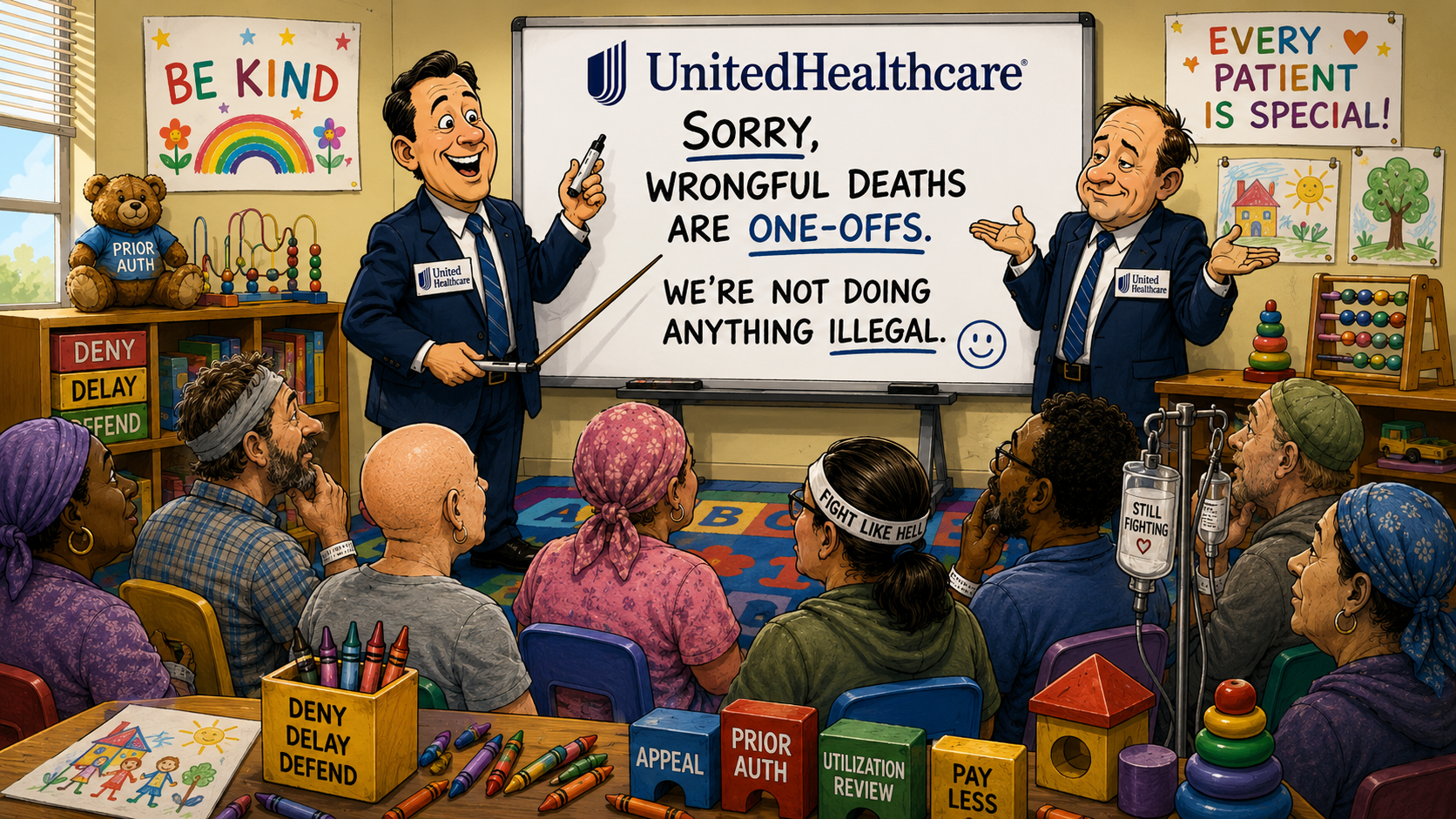
Noel’s answer was stunning in its casualness. He characterized the wrongful death lawsuits as “commercial disagreements.” He called them “one-offs.”
One-offs.
That phrase deserves to be sat with for a minute, because it reveals far more than the company likely intended. It is the language of institutional minimization. It is how a corporation tries to shrink a pattern into an anecdote, to turn systemic harm into a handful of regrettable but isolated misunderstandings. If every denial, every delay, every catastrophic outcome can be reframed as its own little “one-off,” then no one ever has to confront the larger machine producing them.
That is the real trick here. Not denial in the narrow insurance sense, but denial in the public-relations sense. Denial that there is a pattern. Denial that the lawsuits, whistleblower allegations, reimbursement fights, and patient horror stories all point to the same underlying structure. Denial that the business model itself deserves scrutiny.
When Noel was pressed on bipartisan calls from senators to break up the vertical consolidation of “big medicine,” he responded that politicians simply do not like the rules, while UnitedHealthcare plays by them. That line should also sound familiar. Before he was killed, former UnitedHealthcare executive Brian Thompson reportedly said something strikingly similar: “But nothing we do is illegal.”
And that is exactly the point.
The defense of modern health insurance is no longer moral. It is procedural. These companies do not claim that what they do is humane, compassionate, or even good for patients. They claim it is legal. They claim they are following the rules. The problem is that the rules were written to protect the game, not the people trapped inside it.
That distinction matters. A system can be functioning exactly as designed and still be monstrous. It can comply with regulation, satisfy shareholders, and produce devastating human consequences all at the same time. In fact, that is precisely what many patients experience every day. Care is delayed. Appeals drag on. treatments are denied. Families spend months or years fighting over bills, prior authorizations, formularies, and utilization review decisions while the clock keeps ticking on actual illness. The suffering is real, even when the paperwork is technically in order.
So when UnitedHealthcare says these cases are “one-offs,” what patients hear is something else entirely: your story does not count as evidence. Your dead spouse, your denied chemo, your delayed surgery, your bankruptcy, your grief, your exhaustion navigating a maze of call centers and algorithms, all of it gets filed away as an exception. A tragic outlier. A sad but statistically insignificant blip on a quarterly earnings chart.
That is why this headquarters media day landed so badly. It was supposed to humanize the company. Instead, it exposed the moral vacuum at the center of the message. You cannot charm your way out of accountability with AI demos and polished presentations while waving away wrongful death lawsuits as isolated misunderstandings. You cannot present yourself as a victim of bad optics when the core criticism is that patients are being harmed by a system that treats delay and denial as standard operating procedure.
MedCity News gave UnitedHealthcare an A+ for initiative and a C for moral leadership. I would have failed them on both.
Initiative is not the same as integrity. And moral leadership does not begin with inviting reporters to headquarters. It begins with telling the truth about what the system is doing to people and what your company’s role in that system has been. Until that happens, this is not transparency. It is theater.
And patients have seen enough theater.