How Do You Create Demand for Something Nobody Wants?
For 20 years, I’ve been building healthcare brands for markets that shouldn’t exist. I only recently realized they all work the same way.
Nobody asked for Stupid Cancer. There was no focus group, market research, consumer segmentation study, or brand agency charging me $175,000 to discover that our archetype was the Courageous Disruptor while a room full of consultants moved Post-it notes around a wall and somebody named Chad explained millennials to me. There wasn’t even a market in the conventional sense.
There were young adults with cancer, obviously. I was one of them. But nobody was sitting around demanding a national young adult cancer movement because most of us didn’t know such a thing could exist. We were scattered across diagnoses, hospitals, geographies, nonprofits, and whatever primitive internet message boards we could find while waiting for our AOL modems to stop screaming.
That presents a very strange marketing problem, one I have apparently spent most of my adult life trying to solve without realizing I was solving it: How do you create demand for something nobody wants to need?
I have always been fascinated by disruption as a marketing idea, particularly Jean-Marie Dru’s concept of breaking conventions by doing the thing the category isn’t supposed to do. Consumer history is full of moments when somebody looks at an established market and decides the assumptions surrounding it are more interesting than the product itself.
Toilet paper becomes bathroom tissue, and suddenly Mr. Whipple is begging an entire nation not to squeeze the Charmin because apparently wiping your ass needed aspirational branding. Coca-Cola launches Diet Coke and deliberately competes with Coca-Cola, which sounds perfectly reasonable now but was fairly radical when Tab was already sitting there in all its metallic saccharine glory. The genius wasn’t merely making something new. It was violating an expectation everyone else had mistaken for a rule.
Cancer had plenty of those rules. When I was diagnosed at 21, cancer culture came wrapped in reverence. Everything was inspirational. Everything was courageous. There were journeys, warriors, hope, ribbons, miracles, and an unspoken expectation that if cancer tried to kill you, the least you could do afterward was develop an uplifting personality about it.
I found the whole thing exhausting. I didn’t want cancer to teach me anything. I didn’t want to climb a mountain or become a better person. I wanted my old life back, preferably with my original cerebellum and significantly less neuropathy. Cancer was stupid, so I called it Stupid Cancer.
At the time, that name violated almost everything the category expected. It was childish, irreverent, mildly inappropriate, and sounded more like something you would mutter after hanging up on your insurance company and throwing a cordless phone across the room. That was precisely why it worked. It didn’t ask young adults to admire cancer, conquer cancer, find meaning in cancer, or perform cancer correctly for everyone watching. It gave people permission to say what they were already thinking, and once they realized other people were thinking it too, they recognized each other.
The psychology of an unwanted market works backward. In a normal consumer market, you want something, discover somebody selling it, buy it, and then spend the next 6 months unsubscribing from their emails. In an unwanted market, something happens to you first. You get cancer. Your kid gets sick. Your mother needs care. Your insurance company denies something. You discover medical debt. You get introduced to prior authorization, a phrase no functioning civilization should require ordinary people to understand.
Then, usually while exhausted and terrified, you discover that the thing you needed either doesn’t exist or existed somewhere you couldn’t find it. And eventually you think: If only this had been there when I needed it.
Once you finally find the people, information, community, language, or support that should have been there earlier, you start wanting it to exist for the next person. You cannot undo what happened to you, but you can make sure the next version of you doesn’t walk into the same buzz saw alone. The thing you never asked to need becomes something you feel ownership over precisely because you understand the cost of its absence.
I think of that as reciprocal psychography. Your shitty experience becomes somebody else’s warning label. The thing you wish had existed for you becomes the thing you help preserve for someone you will probably never meet. Nobody had to convince you to care about that stranger because, psychologically, they aren’t entirely a stranger. They’re you, 5 minutes before the piano falls out the window.
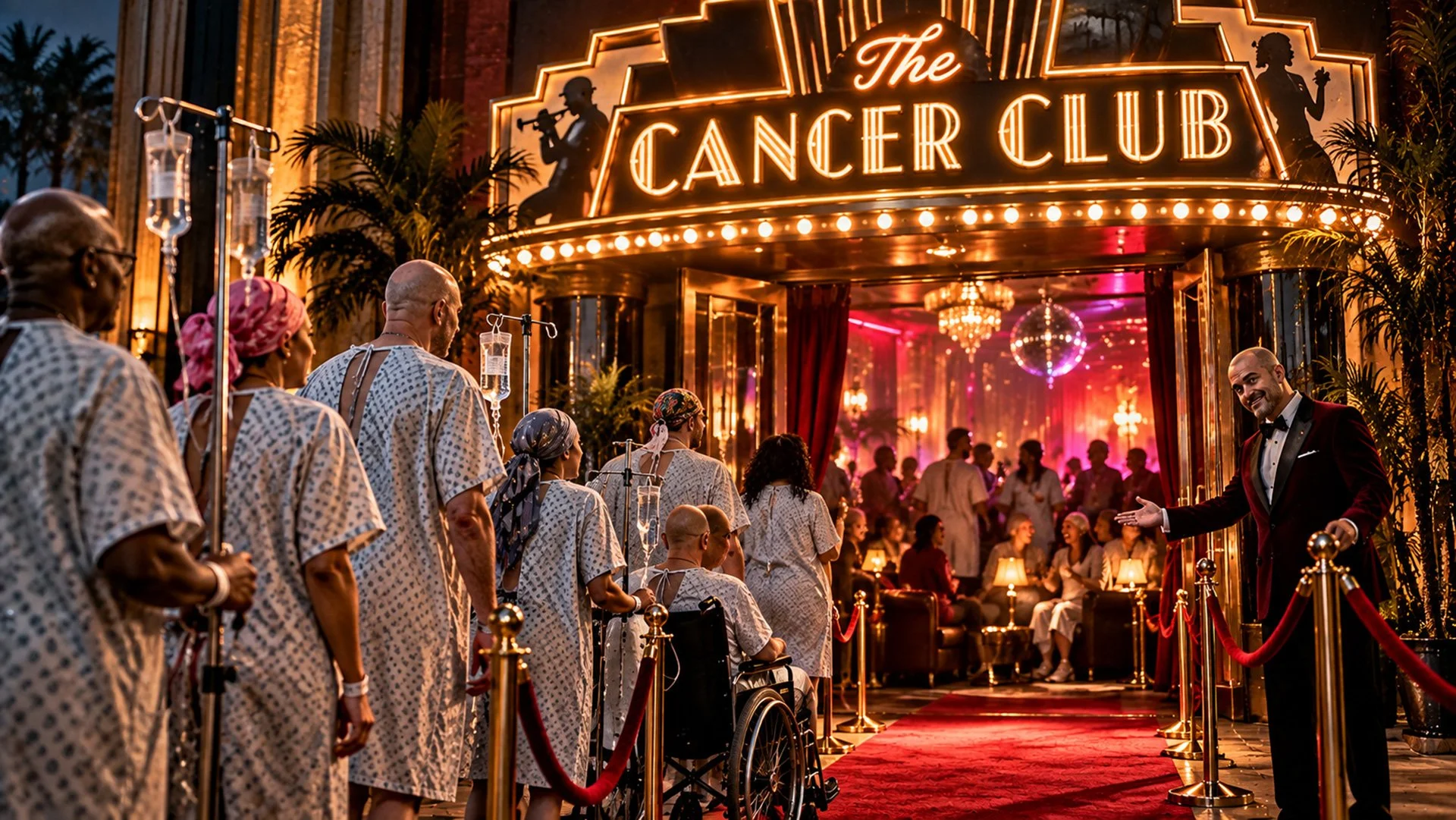
Years later, we created CancerCon, which remains one of the stranger manifestations of this idea. Take the word associated with chemotherapy, mortality, scanxiety, infertility, neuropathy, medical bankruptcy, and your mother crying in a hospital hallway, attach it to the cultural architecture of Comic-Con, and invite thousands of people to come celebrate. On paper, this sounds like something invented during a fever dream after watching The Breakfast Club on morphine.
But people came, and they came back. They weren’t celebrating cancer. They were celebrating finding each other. They could walk into a room where nobody required the first 45 minutes of their story explained, where the gallows humor didn’t need translation, where everybody understood the weird emotional math of being grateful to be alive while also occasionally furious about what being alive now required. CancerCon took an identity nobody wanted and turned it into a place people wanted to return to, because you don’t have to love the reason you belong somewhere to love belonging there.
Out of Patients came from the same instinct. The joke was sitting there in plain English: I had spent decades surrounded by patients while becoming increasingly out of patience with the machinery surrounding them. Again, the name didn’t really describe a product. It described a state of mind. If you understood it, you were probably already in on the joke, which is one of the most useful things a brand can accomplish. It tells somebody, before they’ve heard the pitch, that whoever built this might understand them.
And now there is We the Patients.
I did not spend 20 years secretly constructing some grand brand architecture culminating in a national patient constituency. If I possessed that kind of foresight, I would have bought Apple stock instead of DVDs. But looking backward, I can see the same instinct operating again and again. Stupid Cancer gave people permission to reject the expected emotional vocabulary of cancer. CancerCon gave people a physical place to belong to the club they never wanted to join. Out of Patients gave me a platform for saying the things people living inside American healthcare were already muttering under their breath.
We the Patients now asks whether that same psychological machinery can work at national scale, because “patient” may be the ultimate unwanted identity. Nobody puts PATIENT on a vision board. There are no guidance counselors telling promising high school students they really have the temperament for a career in being denied an MRI. Patienthood arrives involuntarily, often temporarily, sometimes catastrophically, and almost always with terrible timing.
You can be a Republican, Democrat, CEO, bartender, oncologist, plumber, lobbyist, teacher, billionaire, socialist, libertarian, vegan, carnivore, Swiftie, Deadhead, Yankees fan, or somebody who still thinks Facebook is going to make a comeback. Eventually, you wind up on the other side of the reception desk.
And then something fascinating happens. The institutions surrounding you know exactly who they are. Insurers organize around insurer interests. Hospitals organize around hospital interests. Pharmaceutical companies organize around pharmaceutical interests. Employers, PBMs, investors, professional societies, trade associations, lobbyists, consultants, and government agencies all have infrastructure for understanding and advancing their interests. The person sitting in the gown that ties in the back mostly has a clipboard.
For decades, we have tried to solve this through advocacy, storytelling, awareness, education, empowerment, engagement, and every other word healthcare has successfully beaten into a flavorless paste. Those things matter. I spent much of my career doing them. But increasingly I wonder whether we have been trying to create demand for the wrong thing.
Maybe people don’t want more patient engagement. Maybe they want recognition: a way to understand that the anger they carry isn’t uniquely theirs, the bureaucratic humiliation they experienced wasn’t some personal failure to understand the system, and the next person getting pulverized by the same machinery looks suspiciously familiar.
That was the hidden mechanism inside Stupid Cancer. The brand never created young adults with cancer. They were already there. It didn’t create their frustration, isolation, dark humor, or anger either. Those were already there too. What the name did was make something previously scattered recognizable. It gave an existing population language for itself, and language gave people permission to find one another.
That may be what I have actually been branding for 20 years: not products, organizations, conferences, podcasts, or movements, but recognition.
Which brings me back to the problem of demand. Conventional marketing teaches us to identify a need and satisfy it. Healthcare occasionally hands you a more perverse assignment: identify a need your customer desperately wishes they did not have, then build something valuable enough that they become grateful it exists while simultaneously wishing they had never heard of you.
That sounds commercially insane because it is. Welcome to healthcare.
But unwanted markets contain a form of energy ordinary consumer markets rarely possess. When someone discovers the thing they needed too late, something changes. The person who once thought, If only this had existed when I needed it, starts thinking about whoever comes next. You stop asking only why it wasn’t there for you and start asking how the hell you make sure it’s there for them.
That is the experiment now. Can “patient,” an identity almost nobody wants, become something people willingly claim when their interests require it? Can millions of disconnected experiences become recognizable enough that people begin to see themselves in one another? Can the person who says, “If only this had existed when I needed it,” become the person who makes sure it exists for whoever comes next?
I don’t know. For once, that’s the point.
But after 20 years of building things for people who wished they never needed them, I have learned one thing about markets that shouldn’t exist.
Sometimes the demand was there all along. Nobody had given it a name.