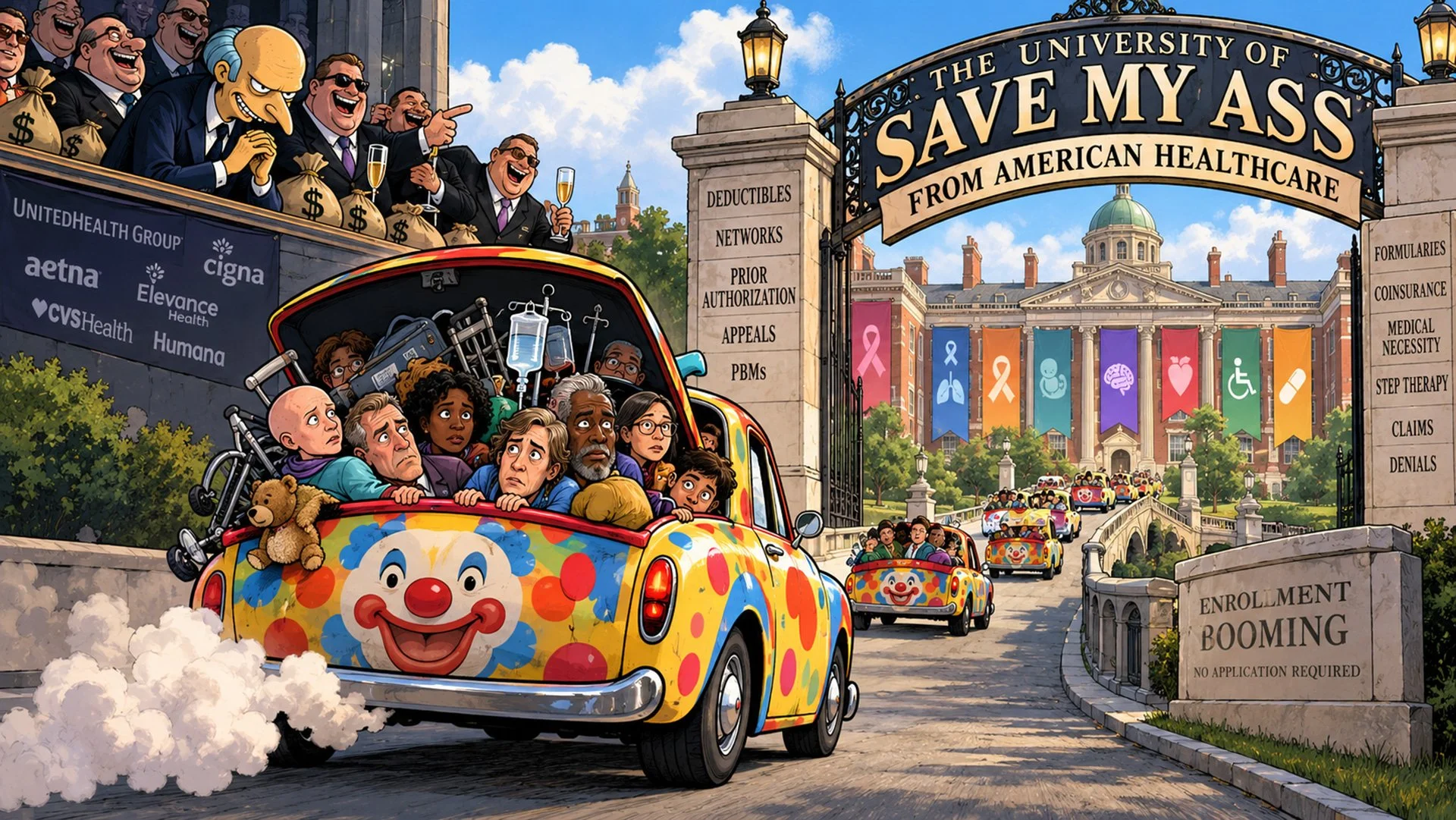
The University of Save My Ass From American Healthcare
For years, I’ve joked that nobody goes to Cancer University until they have to. I certainly didn’t. I was forcibly enrolled at 21 and have apparently been auditing classes ever since.
Turns out cancer is just one department.
The actual institution is The University of Save My Ass From American Healthcare, and enrollment is booming.
Nobody applies. There are no prerequisites. You’re admitted when something goes wrong. Cancer was my major. Yours might be MS, asthma, diabetes, pregnancy, a sick kid, an aging parent, a $900 prescription, or the mysterious pain your insurance company has determined isn’t medically necessary. Whatever gets you admitted, everyone eventually takes the same core curriculum: Deductibles, Networks, Prior Authorization, Advanced Appeals, Introduction to Pharmacy Benefit Managers, and the extremely popular capstone seminar Who the Fuck Do I Call Now?
Also, tuition may bankrupt you.
I’ve spent 30 years in this university, which makes something I’ve recently discovered mildly embarrassing. I wrote an entire book about American healthcare. I’ve spent most of my adult life working in and around it. I understand what happens when people get sick, insurance says no, the drug costs too much, the bill makes no sense, the appeal disappears into a fax machine in Nebraska, and somebody tells you to call the number on the back of your card as if you’ve just been handed the cheat code to Contra.
But lately I’ve wandered into parts of healthcare I somehow managed not to visit for 3 decades, particularly the strange and exotic land of employer benefits. Here live employers, brokers, consultants, insurers, pharmacy benefit managers, third-party administrators, fiduciaries, lawyers, and people who can use the phrase “self-funded plan” 11 times before I’ve finished my coffee.
And I realized I’ve been studying the car from inside the fucking engine.
The people I’m meeting understand who bought the car, who financed it, who negotiated the tires, who insures the driver, who paved the road, and why replacing the transmission may somehow generate a rebate for a company whose name isn’t anywhere on the vehicle.
Patients understand something else. We know what it feels like to be locked under the hood while the car is moving.
That distinction matters because American healthcare has spent decades responding to people getting crushed by the machinery by teaching them to become better mechanics. Be an informed patient. Know your benefits. Ask questions. Shop around. Understand your deductible and coinsurance. Check the formulary. Appeal the denial. Call HR. Call the insurer. Call the pharmacy. Call your doctor. Call the insurer again. Ask for a supervisor.
Have you tried turning your cancer off and back on?
I recently spoke with someone who understands this machinery far better than most patients ever could. She needed an expensive infusion and did exactly what we tell empowered healthcare consumers to do. She investigated the cost, asked questions, shopped around and found another facility that could provide her treatment for dramatically less money. She was potentially going to save her employer’s health plan tens of thousands of dollars.
The system essentially said no.
She knew the rules. She did the homework. She found the cheaper option. She tried to save everyone money and still couldn’t make the machinery behave rationally.
Apparently even graduating from Save My Ass University with honors doesn’t guarantee you can save your ass.
That gets to something much larger than one infusion. Somewhere along the way, we normalized the idea that healthcare literacy is an acceptable substitute for functional healthcare infrastructure. If people are getting screwed, apparently the answer is to teach them more about the thing screwing them.
I’ve given versions of that advice myself for years. Some of it is useful, even necessary. Patients absolutely benefit from understanding the systems governing their care. But there is an enormous difference between giving people knowledge and transferring the burden of systemic dysfunction onto them.
Nobody wants to understand prior authorization. Nobody dreams of becoming exceptionally proficient at medical billing appeals. Nobody wants to discover that their employer may actually be paying their medical claims while the insurance company whose logo is on the card is performing a considerably more complicated role. We learn because somebody we love is sick, something got denied, a drug became unaffordable, or a bill arrived that looked like the GDP of Luxembourg.
We learn because the hood slammed shut.
I opened We the Patients with a dedication to people who didn’t live long enough to see the system change. People buried in paperwork instead of peace. Families who mortgaged their futures to buy another month. Parents who watered down baby food to pay for chemo. People still fighting for care they never should have had to earn.
Those are the people under the hood.
Cancer doesn’t own this story. Neither does any disease. What connects these people isn’t what happened to their bodies. It’s what happened next. They collided with the same machinery and discovered that survival had somehow become a transaction they were expected to understand while it was happening.
Which leaves me with a question I somehow never thought to ask during my 30-year education.
What happens if the people under the hood realize they’re not down there alone?
Maybe “patient” isn’t an identity people want. Maybe we will always retreat to cancer, MS, asthma, diabetes and thousands of other communities where people recognize themselves. Maybe there is no larger we. I’m interested in finding that out rather than declaring another healthcare revolution into existence, because God knows we have enough of those.
But if there is a we, the question changes.
I’ve spent 30 years learning how to survive inside the engine.
I’m finally getting curious about who has the damn keys.