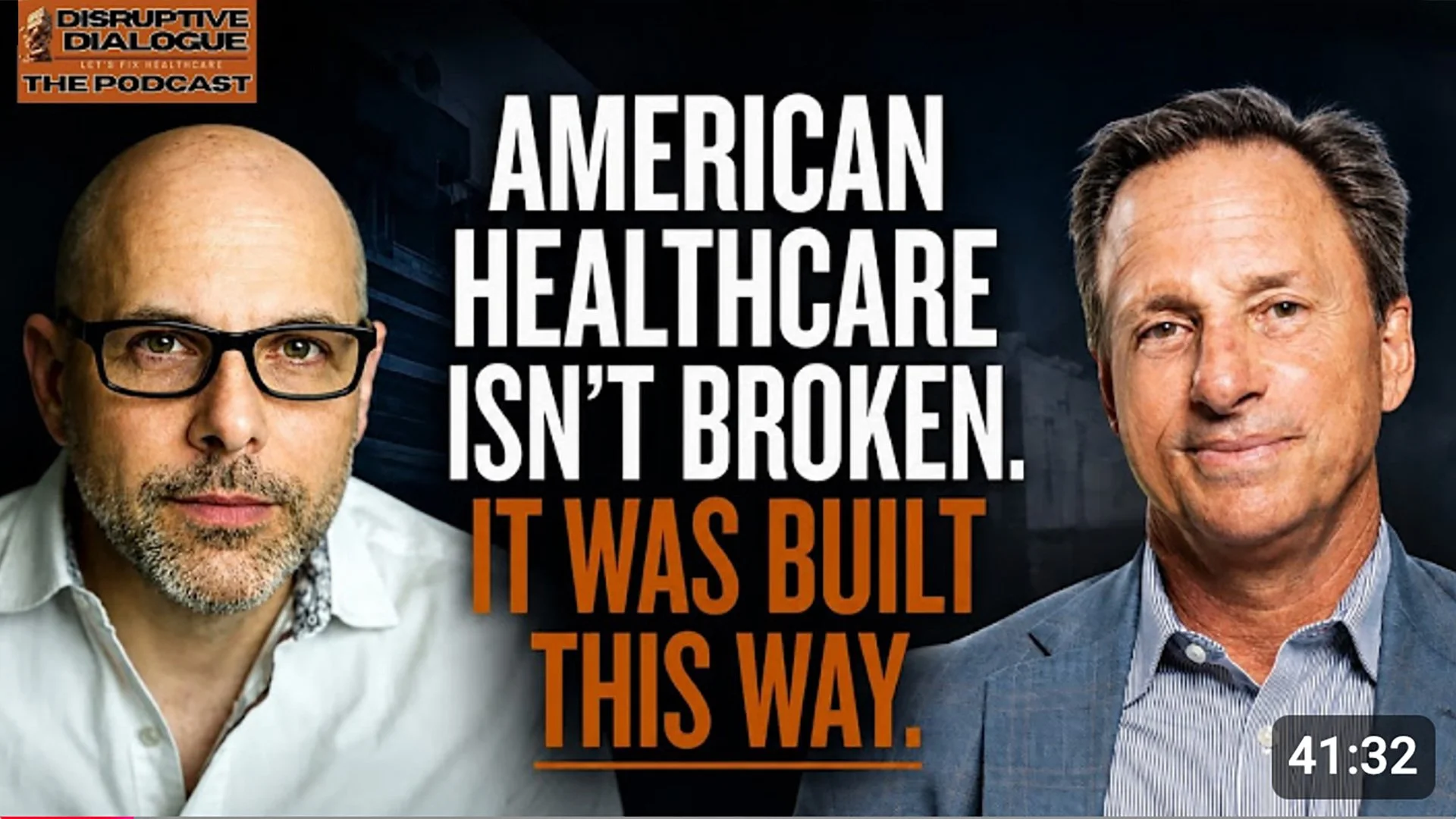
Apparently I’m A Healthcare Policy Guy Now: My Appearance on Disruptive Dialogue with Chuck Melendi
Something strange has been happening since We the Patients: Understanding, Navigating, and Surviving America’s Healthcare Nightmare came out.
People keep taking me seriously.
After nearly 30 years of working in patient advocacy, building Stupid Cancer, organizing communities, podcasting, making documentaries, working with industry, working against industry, and generally spending an unreasonable percentage of my adult life inside the American healthcare terrarium, I seem to have crossed some invisible professional border.
I joked about this recently with Chuck Melendi on his podcast, Disruptive Dialogue. Most people write a book and then build a career around it. I apparently built the career first and then wrote the book that made everyone decide the previous 30 years counted. The book, I told him, is my Zelda key.
There was something different about this particular conversation, though, and not simply because Chuck and I share an appreciation for profanity and institutional bullshit. Chuck spent 35 years inside healthcare, including more than 25 years at Johnson & Johnson, with experience spanning pharmaceuticals, medical devices, health plans, PBMs, market access, and eventually healthcare policy and advocacy. He retired and started Disruptive Dialogue specifically because what he saw during those decades convinced him the system needed fundamental change.
That made for a very different kind of interview. I wasn’t there primarily as a cancer survivor explaining what happened to me, or even as a patient advocate explaining why navigating healthcare is so difficult. Chuck already understands the machinery. He has been inside it. So we were able to spend most of the conversation talking about the thing that has increasingly consumed me over the past several years: not how patients survive this system, but what it would actually take to change the incentives that make surviving it so unnecessarily difficult in the first place.
For decades, patient advocacy has largely existed downstream. Someone gets sick, insurance denies something, a bill arrives that nobody can decipher, treatment gets delayed, a family starts hemorrhaging money, and an enormous ecosystem of advocates, navigators, nonprofits, social workers, clinicians, employers, benefits companies and increasingly entire new industries mobilizes to help that person survive the problem. We desperately need all of them. But after watching this happen for most of my adult life, I’ve become increasingly interested in why we tolerate the upstream conditions that keep manufacturing the same problems.
During the conversation, I described it using an analogy that has become central to how I think about all of this: Ralph Nader and the seatbelt.
We didn’t ultimately make automobiles safer by teaching every American how to become better at surviving a car crash. We changed the car. We created consumer protections that operated before the crash happened. The seatbelt became part of the infrastructure rather than something consumers had to invent for themselves while hurtling toward a telephone pole.
So what is the seatbelt for a cancer patient?
What intervention could prevent some of the extraordinary downstream waste created by delays, denials, appeals, administrative warfare and financial toxicity before it begins? What would it mean to create an upstream dam instead of continually financing better rescue operations downstream? Those were the questions Chuck and I started kicking around, and they quickly led somewhere considerably more interesting than another conversation about “fixing healthcare.”
The basic protections themselves aren’t particularly radical. Your treating physician should have meaningful authority over your care. You shouldn’t experience unreasonable delays or denials because an insurer has discovered that saying no can be profitable. You shouldn’t go bankrupt because you happened to get cancer. In the conversation, I boiled the policy version of the seatbelt down to something even simpler: no one gets improperly denied, no one gets unnecessarily delayed, the doctor in the clinic gets the final say, and no one goes bankrupt.
The more difficult question is how any of that actually becomes law. And this is where my own work has taken a turn I didn’t entirely anticipate when I started writing the book. For most of modern patient advocacy, we have organized ourselves according to biology. Cancer patients organize around cancer. Diabetes patients organize around diabetes. Rare disease communities organize around rare diseases. Alzheimer’s families organize around Alzheimer’s. Those organizations have accomplished extraordinary things, and I have spent my entire career as part of that world.
But insurance companies don’t screw us according to diagnosis.
A prior authorization doesn’t care which ribbon you wear. A hospital bill doesn’t ask whether you’re Republican or Democrat. A PBM doesn’t check your ideology before deciding how much friction can be inserted between you and a drug. The shared experience isn’t necessarily the disease. Increasingly, the shared experience is being a patient in America.
That distinction has become enormously important to me because it suggests that patients may represent something we have never really attempted to organize at scale: a political constituency.
Not another coalition of organizations. Not another awareness campaign. Not another annual lobby day where everyone puts on matching T-shirts, takes photographs with congressional staffers and goes home hoping someone remembers the talking points.
A constituency.
Chuck and I spent a substantial part of the conversation talking about what that could mean politically, particularly at the state level. He knows this territory from his own years working in policy and advocacy, and he made the point that states have historically served as incubators for what eventually reaches Washington. We talked about efforts already underway around PBMs and insurance regulation, the enormous lobbying power standing in the way, and the possibility that meaningful healthcare consumer protection may have a better chance of being proven in one state before anyone imagines doing it nationally.
That is increasingly where my head is.
I don’t know whether this works. In fact, I’m deeply suspicious of anyone in healthcare who confidently tells you they know exactly how to fix healthcare. There is a warehouse somewhere filled with the remains of those PowerPoints.
But I do think there is something worth testing here.
Can patients organize around their shared economic and civic interests rather than only their diagnoses? Can enough people in one legislative district make healthcare consumer protection politically valuable? Can enough districts make it dangerous for a legislator to ignore? Can one state demonstrate that protecting patients upstream doesn’t merely prevent suffering, but also saves enough money to make the economic argument impossible to dismiss?
That is the experiment.
And it also explains why conversations like this one with Chuck feel different to me now. The book has unexpectedly opened doors into rooms where the conversation isn’t about my cancer story or the history of Stupid Cancer. It’s about incentives, economics, legislation, regulatory capture, political organizing and power. I seem to have wandered from patient advocacy into healthcare policy without noticing exactly where the border crossing occurred. Perhaps there wasn’t one. Maybe this is simply where 30 years of watching the same things happen to people eventually leads. At some point, helping everyone become better swimmers stops being enough, and you start wondering who keeps throwing them into the fucking river.
Near the end of the episode, Chuck talked about calling legislators, and I told him something I’ve learned that still surprises people: it doesn’t necessarily take thousands of constituents to get a state representative’s attention. Many state legislators operate with tiny staffs and limited constituent engagement. A handful of calls about the same issue can register. Enough calls can become a genuine political problem.
Scale that idea. That’s the part I’m interested in now. For most of my career, I’ve been trying to make patients louder inside healthcare. I’m increasingly interested in what happens when they become louder inside democracy.
So yes, apparently I’m a healthcare policy guy now.
DC, I’ll see you soon.