Out of Patients EP440:Not Today, Jesus: Janine Durso
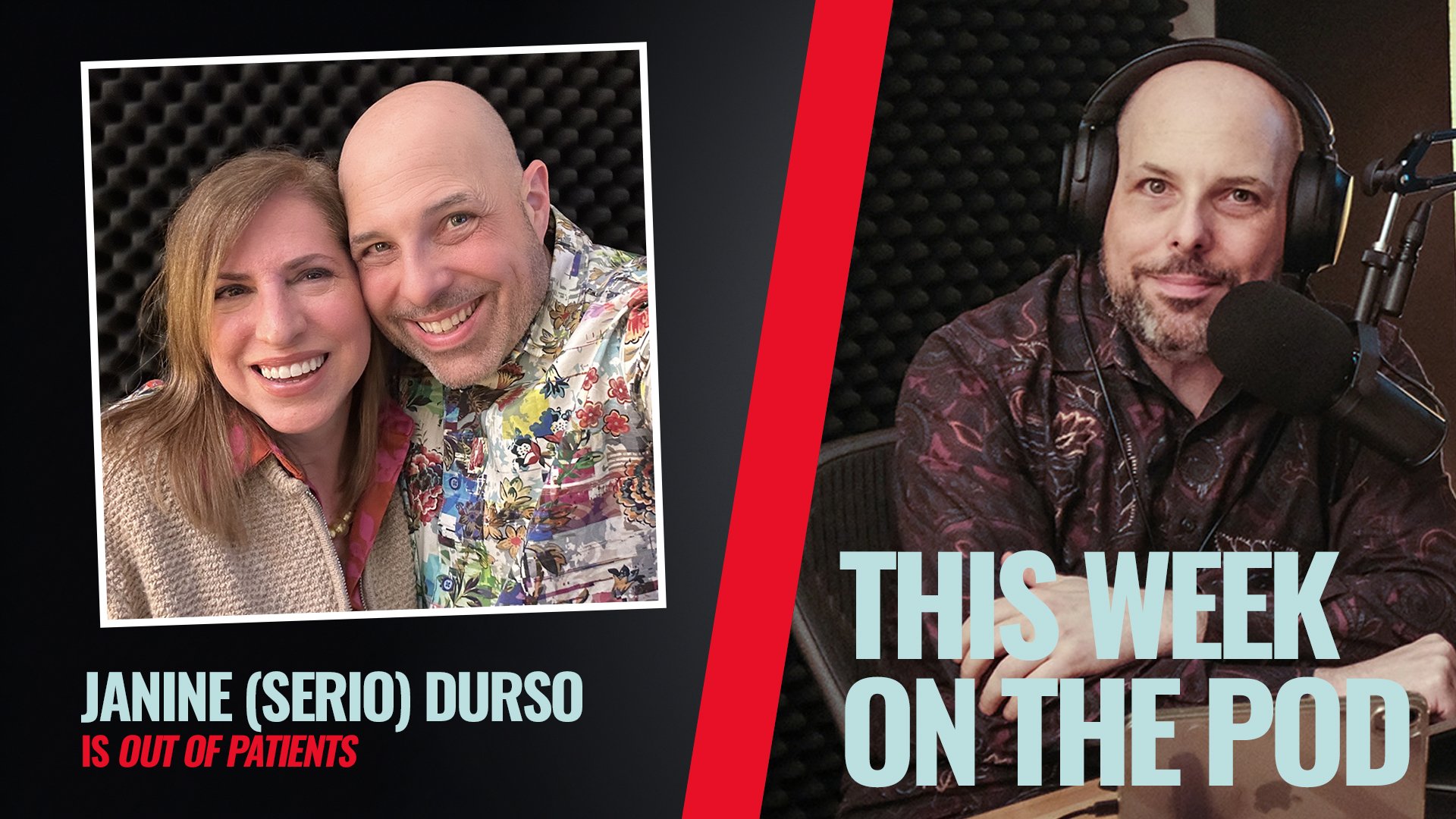
In November 2024 a 54 year old woman felt a violent pain in the right side of her head while coaching a client over Zoom. She told her husband something broke in my brain. Within hours surgeons at White Plains Hospital opened her skull and coiled a ruptured aneurysm that had begun to bleed. She spent 5 weeks in intensive care. She spent another 10 days in inpatient rehabilitation relearning how to walk and calculate basic change. She survived because 1 person took her seriously, 1 ambulance arrived quickly, and 1 hospital had the neurosurgical capacity to intervene.
Her name is Janine Durso. For 30 years she worked inside pharmaceutical advertising shaping how health gets marketed to patients and clinicians. She built campaigns that translated risk and benefit into persuasive language. Then she became the body on the table.
Her story demands attention now for a reason that extends beyond individual resilience. She survived an acute event that medicine knows how to treat when it moves fast. She now faces a second unruptured aneurysm that clinicians monitor through periodic angiograms. She also faces a structural barrier that blocks her 11 year old daughter from obtaining preventive screening because current insurance rules in many states require 2 direct relatives with aneurysms before covering imaging. The logic runs backward. The system requires evidence of harm before paying to prevent it.
The clinical facts deserve clarity. A ruptured brain aneurysm often presents as a sudden severe headache accompanied by nausea, disorientation, or loss of consciousness. Physicians describe the bleed as a subarachnoid hemorrhage. Mortality rates for ruptured aneurysms remain high. Studies estimate that roughly 10 to 15 percent of patients die before reaching a hospital. Of those who reach care, many face long term neurological deficits. Rapid imaging, neurosurgical intervention, and intensive monitoring improve survival dramatically. Timing determines outcome.
Durso experienced what neurologists call a thunderclap headache. She could speak but soon lost motor control. Her husband called 911 without delay. Emergency responders transported her first to a nearby facility, then transferred her to a hospital with neurosurgical capability. Surgeons coiled the ruptured aneurysm and later placed a flow diverting stent. She does not remember the ambulance ride. She does not remember the first days in intensive care. She does remember staring at 4 quarters in a rehabilitation unit and realizing she could not calculate 75 cents in change.
The healthcare system performed exactly as designed in that moment. Emergency medicine triaged her appropriately. Neurosurgery intervened with skill. Intensive care units monitored complications that often follow subarachnoid hemorrhage, including vasospasm and hydrocephalus. Physical therapists and speech therapists addressed motor and cognitive deficits. She regained speech fluency, driving capacity, and the ability to manage multiple conversations in a crowded room. Many patients do not.
That performance reflects decades of scientific investment. In 1996 when I survived brain cancer at 21, imaging technology lacked the speed and precision that hospitals now deploy as standard practice. In the early nineties surgeons still opened skulls for conditions that interventional radiology now treats through a catheter inserted in the leg. Medicine has advanced. Survival curves show it.

Yet the same system that excels in crisis often fails in prevention. Durso now participates in advocacy with the Brain Aneurysm Foundation to address insurance rules that restrict screening coverage. Current policies in many plans require 2 first degree relatives with aneurysms before covering magnetic resonance angiography. Insurers justify this threshold by citing cost effectiveness models. Widespread screening for low prevalence conditions increases imaging volume and downstream procedures. Health economists calculate incremental cost per quality adjusted life year and draw lines.
Those models embed assumptions. They assume stable risk stratification. They assume uniform access to emergency care. They assume that preventing 1 catastrophic bleed carries the same economic weight as preventing 1 elective orthopedic surgery. They assume that a family can absorb uncertainty until a second relative suffers a rupture. None of those assumptions appear in the denial letter.
The financial incentive structure shapes these decisions. Private insurers collect premiums based on actuarial risk pools. They manage medical loss ratios by controlling utilization. Screening tests represent near term costs. Avoided catastrophic events represent probabilistic future savings that may accrue to a different payer if a patient changes jobs or insurance carriers. Short term budget cycles favor denial of preventive imaging unless risk reaches a threshold defined by data that lag real world experience.
Durso’s case highlights the asymmetry. A ruptured aneurysm triggered immediate high cost intervention. Five weeks in intensive care, neurosurgery, rehabilitation, follow up angiograms, and stent placement represent significant expenditures. Medicare reimbursement rates for subarachnoid hemorrhage and complex neurosurgery can exceed $50,000 for the index hospitalization alone, depending on complications and length of stay. Private insurance payments often exceed that figure. The system will pay for catastrophe. It hesitates to pay for a scan that might prevent it.
Clinicians often defend these thresholds by citing limited evidence for population wide screening. They argue that most aneurysms never rupture and that incidental findings can lead to overtreatment. They note that imaging carries cost and potential anxiety. Those concerns deserve acknowledgment. Overdiagnosis exists. False positives occur. Risk stratification requires nuance.
But the current policy does not reflect nuanced shared decision making. It reflects a blunt administrative rule. It does not allow a family with 1 documented rupture to weigh their tolerance for risk and request imaging coverage. It does not consider that modern noninvasive magnetic resonance angiography carries minimal physical risk compared with invasive procedures. It places the burden of proof on the patient after harm has already occurred.
The system also relies on patient literacy that few possess. Durso knew something felt wrong because the pain differed from prior headaches. Many patients do not recognize the difference. Public awareness of stroke signs improved over the past 2 decades through campaigns that teach facial droop, arm weakness, speech difficulty, and time to call 911. Awareness of aneurysm rupture lags behind. Patients who dismiss severe headaches as stress or migraine may lose the narrow window for intervention.
Durso now raises funds through 5K events and travels to Washington to advocate for legislative change. That effort reflects a pattern I have witnessed for nearly 3 decades. The system fails a patient or nearly fails a patient. The survivor becomes the unpaid educator, fundraiser, and policy advocate. Institutions benefit from their labor while preserving the underlying incentive structure. Gratitude toward clinicians coexists with frustration toward payers.
White Plains Hospital and Dr Jared Cooper provided exemplary care. Durso speaks about them with justified appreciation. That appreciation does not obligate silence about insurance barriers. We can acknowledge excellence in acute care while interrogating structural shortcomings in preventive policy. Both statements can hold simultaneously.
The healthcare industry often celebrates stories of survival as proof of system success. Hospitals highlight surgical outcomes. Foundations showcase resilience. Insurers emphasize coverage of high cost interventions. These narratives obscure the distribution of risk. Patients in regions without neurosurgical capacity may not survive transfer. Patients without insurance may delay seeking care due to cost concerns. Families without transportation may lose precious time. Data show disparities in stroke and aneurysm outcomes along socioeconomic and racial lines. Structural inequities compound biological risk.
Durso’s husband called 911 immediately and responders arrived quickly. Many families hesitate due to fear of surprise bills. Emergency transport can generate charges exceeding $1,000 depending on geography and insurance status. The No Surprises Act addresses some balance billing practices but does not eliminate cost anxiety. The system cannot claim universality while relying on patient courage to override financial fear.
The broader lesson extends beyond aneurysms. Healthcare financing in the United States prioritizes treatment over prevention when prevention requires up front investment without guaranteed short term return. Employers change insurers. Patients change jobs. Payers operate within annual contracts. Catastrophic events generate visible claims that justify premium increases. Prevented events remain invisible.
Policy change requires recalibrating incentives. Legislatures can mandate coverage of screening for first degree relatives of patients with documented aneurysm rupture. Insurers can adjust medical policy criteria to incorporate individual risk discussions rather than rigid family history counts. Researchers can refine risk prediction models that integrate genetic markers, hypertension history, and demographic factors. Hospitals can partner with advocacy groups to expand community education about warning signs. None of these steps require technological breakthroughs. They require administrative will.
Some will argue that expanding screening opens floodgates of imaging and incidental findings. That argument assumes clinicians cannot practice restraint. Medicine already manages incidentalomas across imaging modalities. Shared decision making frameworks exist. Professional societies publish guidelines for surveillance of small unruptured aneurysms. Complexity does not justify inaction.
Others will argue that rare events cannot drive coverage expansion. Yet rare events that carry high mortality and morbidity deserve proportional attention. Public health routinely balances low incidence against high severity. We vaccinate against diseases with incidence lower than aneurysm rupture because consequences justify prevention.
The system currently sends a message that prevention remains optional until harm multiplies. That message contradicts decades of rhetoric about value based care. Value based care claims to reward outcomes rather than volume. True value would incorporate avoided catastrophe into reimbursement logic. It would not require a second family member to suffer before imaging receives approval.
Durso describes her recovery as a slow return of cognitive bandwidth. She could not follow conversations in crowded rooms until months after discharge. She could not process multiple stimuli without feeling overwhelmed. These deficits do not appear in hospital discharge summaries beyond check boxes. They affect employment, parenting, and identity. Acute survival does not end consequence.
We often praise American medicine for its technological prowess. That praise carries merit. Interventional neuroradiology that snakes a catheter from the femoral artery to the brain represents a triumph of engineering and training. Intensive care protocols for vasospasm reflect disciplined research. Rehabilitation science restores function once deemed permanently lost. These achievements warrant recognition.
Recognition does not absolve structural flaws. The same system that can deploy coils and stents within hours can deny a preventive scan for a child of a survivor. The same insurers that will reimburse $100,000 for acute neurosurgical care may refuse $1,500 for imaging that could avert rupture. The same policymakers who celebrate innovation may resist adjusting coverage criteria due to budget projections.
We must separate gratitude from complacency. Patients can thank surgeons while demanding reform. Clinicians can deliver lifesaving care while advocating for coverage policies that align with evidence and ethics. Insurers can protect solvency while recalibrating thresholds that currently externalize risk onto families.
Continuing the status quo carries measurable cost. Each preventable rupture imposes not only hospital expenses but long term disability payments, lost productivity, caregiver burden, and psychological trauma. Economic models that focus narrowly on imaging utilization ignore these downstream costs. Comprehensive cost analyses often reveal that prevention yields savings over time when we account for societal impact rather than single payer budgets.
Change will require coordinated action. Legislatures must review insurance coverage mandates for aneurysm screening. Insurers must update medical policy criteria in light of evolving evidence. Professional societies must publish clear guidance that supports individualized risk discussions. Advocacy organizations must continue educating the public about warning signs and coverage barriers. Media must report on structural incentives rather than solely on survival narratives.
The system currently excels at crisis response for those who reach it in time. It falters at equitably distributing preventive opportunity. Durso survived because a chain of events aligned. We should design policy so survival depends less on alignment and more on intention.
If we continue to treat prevention as optional and catastrophe as inevitable, we will keep funding intensive care units while neglecting imaging suites. We will keep celebrating surgical skill while ignoring administrative rigidity. We will keep asking survivors to carry advocacy burdens that institutions could shoulder.
The choice does not lie between fiscal responsibility and patient safety. The choice lies between short term accounting and long term value. The system knows how to save a life in the operating room. It must now decide whether it values preventing the next rupture enough to pay for a scan before the bleed begins.