They Gave Every Medical Student My Book. Then We Talked About the Storm They’re Inheriting.
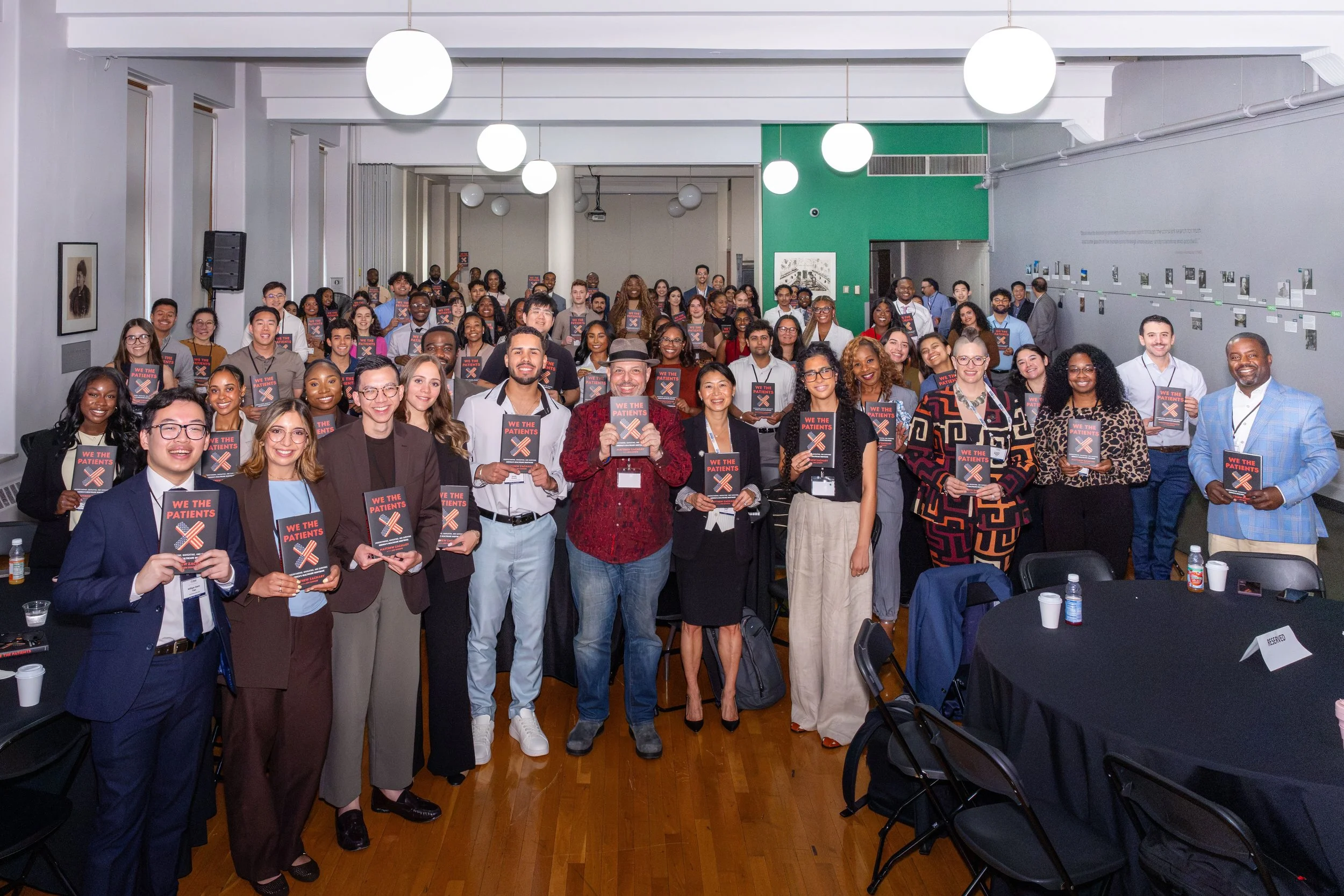
What made this week in Chicago extraordinary was not simply the prestige of the invitation, though there was plenty of that. It was the fact that a major academic medical institution decided that a room full of future physicians should not only hear from a patient, but should actually wrestle with what healthcare feels like from the patient side of the bed rail. The 2026 Robert A. Winn Clinical Investigator Symposium, under the leadership of Dr. Joy Jones, invited me to keynote for an extraordinary and deeply diverse group of 2nd and 3rd year medical students, then did something that struck me as even more meaningful than the speaking slot itself: they bought hundreds of copies of We the Patients: Understanding, Navigating, and Surviving America’s Healthcare Nightmare so that every student would go home with the book, and they created a post-event survey to measure whether it changed how those students understand patient experience.
That last part matters more than almost anything else.
I have spent enough years in and around American healthcare to know the difference between being invited in as a decorative patient voice and being invited in because an institution is serious about education. One is a panel slot. The other is pedagogy. One says, “Come tell your story and inspire the room.” The other says, “We believe future physicians need to understand something that traditional training still does not fully teach, and we are willing to build it into the educational experience.” Chicago felt like the latter. It felt like an institution saying, out loud and on purpose, that learning anatomy, physiology, diagnostics, treatment pathways, and research methods is not enough if students are never taught what healthcare actually feels like to the people trapped inside it.
The whole thing began, improbably enough, with a Chicago river cruise. On paper it was the kind of opening-night networking event that sounds polished and civilized, a little breeze off the water, a skyline doing its usual peacocking, a chance to meet students and faculty before the formal program began. Instead, the sky opened up and absolutely drenched us. Not a cute drizzle. Not a light inconvenience. A full-on, “everybody on this boat is now participating in a weather event” rainstorm that left us soaked and laughing and scrambling in equal measure. I have to admit, once I stopped wringing out my clothes, it felt almost absurdly perfect as a metaphor for the entire week. There we were, a boat full of people preparing to talk about medicine, research, mentorship, equity, and the future of care, getting walloped by an unexpected storm in a city where I was about to stand in front of future doctors and talk about the storm they are all walking into whether they realize it yet or not.
Because the storm in American healthcare is not just disease. It is not just the diagnosis, the tumor, the scan, the surgery, the pathology report, or the treatment plan. The storm is the system itself. It is the administrative burden that colonizes every spare minute of a patient’s life. It is the bureaucracy that asks sick people and their families to become project managers, insurance clerks, medication historians, billing detectives, and unpaid care coordinators in the middle of the worst days of their lives. It is the fragmentation that forces patients to stitch together their own care across portals, departments, phone trees, prior authorizations, denials, and contradictory instructions. It is the emotional violence of trying to stay alive while also trying to understand whether the medication is covered, whether the bill is real, whether the records made it to the next office, whether anyone has actually called in the order, and whether the treatment plan that looks so elegant in the chart is functionally impossible to carry out in real life.
That is what I wanted these students to hear. Not as an abstraction, not as a policy talking point, and not as a sentimental plea to be “more compassionate,” but as a professional challenge. The patient experience is not a soft skill. It is not an elective. It is not a garnish sprinkled on top of the “real” curriculum once the hard science is done. It is one of the central realities of American healthcare, and if we continue to train clinicians without teaching them how illness is actually lived inside the machinery of this system, then we are training them for a fantasy version of medicine that their patients will never have the privilege of receiving.
What moved me so deeply about the Winn Symposium was that they seemed to understand this. They did not treat We the Patients as a nice conference giveaway or a bit of extracurricular enrichment. They put the book in students’ hands because they wanted it to be part of the conversation about what kind of physicians these young people are becoming. They wanted them to hear from someone who has spent nearly 30 years living with the long tail of cancer survivorship, but they also wanted them to think about navigation, financial toxicity, caregiver burden, prior authorization, administrative burden, and the vast gulf between “receiving care” and actually trying to live inside the healthcare system. And they did not stop there. They built a survey to ask whether the book changed anything about how these students understand patient experience. That is not a vanity exercise. That is a statement of intent. It says that the patient perspective is not being invited in merely to emote. It is being invited in to teach, to challenge, to unsettle, and ideally to leave a mark.
I kept coming back, both in my keynote and in conversation afterward, to the idea that patients do not experience healthcare in departments. They do not experience it as a set of cleanly organized specialties or tidy workflows. They experience it as one continuous disruption to their lives. They experience it as fear, confusion, dependency, logistics, waiting, paperwork, money, uncertainty, and the constant pressure to become competent in a language and a bureaucracy they never asked to learn. The chart may separate the surgery from the follow-up, the follow-up from the imaging, the imaging from the billing issue, and the billing issue from the prior authorization battle, but the patient does not. To the patient, it is all one thing. It is all “my cancer,” “my child’s illness,” “my mother’s decline,” “my body falling apart,” or “my life being rearranged by forces I do not control.” If we are serious about educating physicians, then we have to be serious about teaching them to see that continuity of burden, not just the continuity of care.
And the truth is, these students are not immune to the storm either. One of the reasons I felt so strongly about speaking honestly in this setting is that the future physicians sitting in that room are walking into a profession that is itself under siege. They are not merely being trained to diagnose and treat. They are being drafted into a healthcare ecosystem shaped by documentation overload, throughput pressure, insurance interference, staffing shortages, institutional bureaucracy, moral distress, and burnout so normalized that it is often treated as a personal resilience problem rather than a systems failure. Whether they go into academic medicine, private practice, research, hospital medicine, surgery, primary care, or something none of us can predict yet, they will feel the weather. They will experience the collision between the ideals that brought them into medicine and the machinery that too often drains those ideals of oxygen. They will discover, if no one warns them, that the danger is not just exhaustion. It is acclimation. It is the slow normalization of things that should still horrify them.
That is why I did not want to offer them a tidy survivor’s tale tied up with a ribbon. I wanted to tell them the truth about what it means to become a patient at 21 and to spend the rest of your life understanding healthcare from the horizontal position. I wanted to tell them that a medically sound plan can still be a humanly impossible one. I wanted to tell them that the hidden labor of illness is not peripheral to care; it is often the difference between whether care succeeds or collapses. I wanted to tell them that administrative burden is not a nuisance layered on top of medicine but part of the harm itself. I wanted to tell them that confusion is too often treated like a patient problem when it is actually a systems problem. Most of all, I wanted to tell them that they have more power than they think, even before they have institutional authority, because they can decide whether they will notice the burden, whether they will explain what happens next, whether they will close the loop, whether they will respect the caregiver, whether they will pay attention to the real-life obstacles that determine whether a treatment plan is survivable, and whether they will resist the seduction of thinking that what is not in the chart is somehow not real.
The survey that followed matters precisely because it takes those questions seriously. It asks, in effect, whether We the Patients and the conversation around it exposed blind spots in medical education. It asks whether students feel their training adequately prepares them to understand nonclinical burdens like navigation challenges, insurance barriers, financial toxicity, and the emotional toll of interacting with the healthcare system. It asks what aspect of patient experience they think medical education still does not prepare them to understand well enough. It asks what they hope to do differently as future physicians because of what they heard. In other words, it does something that American healthcare should do much more often: it measures whether patient perspective actually changes professional formation.
I left Chicago feeling profoundly honored, not in the self-congratulatory sense of “look where I got invited to speak,” but in the deeper sense of having been entrusted with something important. There is real significance in being asked to speak to the next generation of physicians before the culture calcifies around them, before the habits of institutional life dull their moral reflexes, before the language of “that’s just how it works” settles in like dust. There is real significance in being able to say to them, while there is still time, that the people they care for will not experience medicine as a sequence of elegant decisions. They will experience it as a vulnerable, messy, often frightening attempt to survive not just disease but the system built around it. There is real significance in asking those students to think now, before the machinery hardens, about what they will refuse to normalize.
So yes, I got soaked on a boat in Chicago. And yes, it now feels impossible not to see that storm as the opening scene of the week. But what I will remember most is not the rain. It is the room full of future physicians holding copies of We the Patients: Understanding, Navigating, and Surviving America’s Healthcare Nightmare, listening hard, asking serious questions, and participating in an institution that was willing to say that patient experience belongs in the center of medical education, not at the margins. If that idea takes root in enough places, if enough schools and programs decide that future clinicians must be taught what healthcare feels like from the inside, then maybe we begin to produce not just smarter doctors, but wiser ones. Not just more clinically competent physicians, but professionals better equipped to recognize suffering before the chart captures it, to understand the hidden labor patients perform in silence, and to practice medicine in a way that requires less heroism from the people already in crisis.
That is the hope I carried out of Chicago.
Not that one keynote changes everything, because it won’t. But that a room full of future doctors was told early enough, and seriously enough, that the patient experience is not a side story to medicine. It is one of the main stories. And if they learn to read it now, while they are still becoming who they are, it might just change the kind of healthcare they go on to build.