Today My Book Comes Out! It's Already In Its Second Printing. That Never Happens.
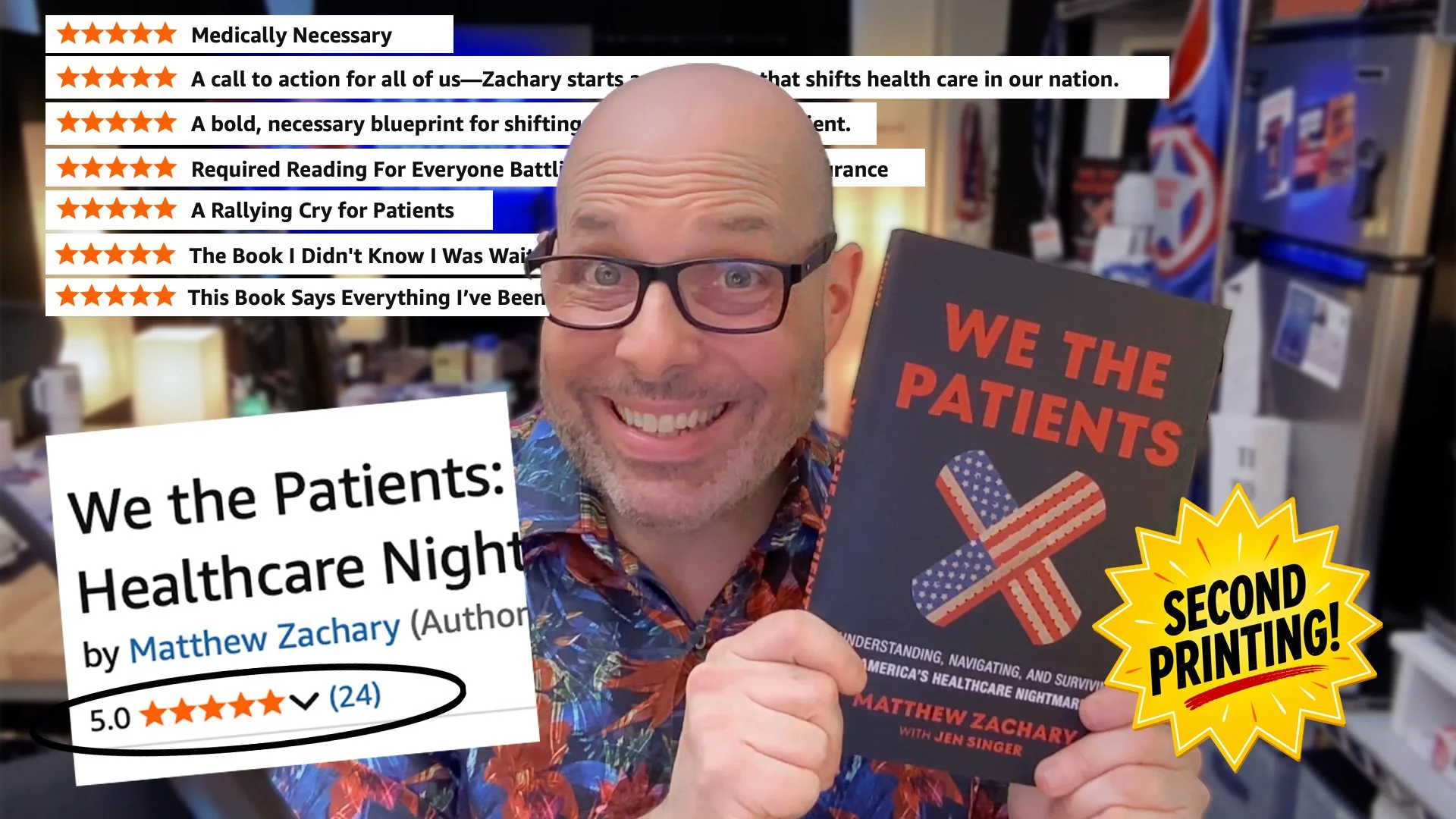
TODAY MY BOOK COMES OUT. IT’S ALREADY IN ITS SECOND PRINTING. THAT NEVER HAPPENS.
We the Patients: Understanding, Navigating, and Surviving America’s Healthcare Nightmare officially enters the world today, and before release day even arrived, Wiley ordered a second printing. Every publishing person I speak with says the same thing: that almost never happens for a first time author, especially one writing about healthcare policy, insurance abuse, institutional failure, and the human cost of surviving modern medicine in America.
I think I understand why people are responding to it.
For years, patients have lived inside a system that constantly makes them feel isolated, stupid, dramatic, expensive, difficult, or disposable. People know something feels deeply wrong, but most cannot articulate why because the machinery stays intentionally fragmented. You only see your tiny piece of the catastrophe. The denied scan. The prior authorization. The surprise bill. The pharmacy rejection. The impossible deductible. The endless phone tree. The disability paperwork. The ambulance claim. The out of network specialist nobody warned you about while you were trying not to die.
Then one day you realize every person you know has their own version of the same story.
That realization changes people.
The response to this book has honestly floored me because readers are recognizing themselves in it immediately. A 20 year oncology policy advocate called it “the book I wish I could have handed to every lawmaker.” A rare disease patient told me it instantly became her “personal patient guidebook.” Medical school faculty said it should be required reading for providers, patients, and activists. A former CDC division director said I “pulled back the curtain like the Wizard of Oz.” One reviewer simply wrote: “This book changed me.”
I have spent three decades living inside this healthcare system as both patient and professional. I watched hospitals celebrate survivorship with balloons and ringing bells while survivors quietly walked into parking lots carrying medical debt, PTSD, cognitive damage, employment problems, insurance chaos, and a lifetime of bureaucratic exhaustion nobody prepared them for. I watched insurance companies build trillion dollar business models around attrition, delay, confusion, and the statistical probability that sick people eventually become too tired to keep fighting. I watched patients internalize shame because they believed they somehow failed to navigate a system specifically engineered to exhaust them.
The most dangerous lie American healthcare ever sold people is the idea that these outcomes are accidental.
They are not accidental.
The system behaves exactly as designed.
Every incentive points toward revenue extraction, administrative complexity, utilization control, and risk management long before human dignity enters the conversation. Hospitals optimize reimbursement. Insurers optimize denials and utilization management. PBMs optimize opacity. Pharmaceutical companies optimize shareholder obligations. Employers purchase healthcare products they barely understand because they are trapped too. Everyone inside the machine responds rationally to the incentives surrounding them while patients absorb the consequences.
That is why this book exists.
I did not write it as therapy. I did not write it to complain. I did not write it because outrage performs well online. I wrote it because patients deserve fluency. They deserve context. They deserve to understand the architecture surrounding them so they stop blaming themselves every time the system behaves exactly as it was financially designed to behave.
Most importantly, I wrote it because isolated patients stay overwhelmed, but connected patients become dangerous to institutions that depend on confusion and silence.
That shift already started.
You can feel it happening across the country right now. Patients are organizing. Caregivers are speaking publicly. Survivors are comparing notes. Doctors are burning out in plain sight. Employers are finally realizing healthcare costs are swallowing entire businesses. Even people who once avoided these conversations entirely are beginning to understand that healthcare now shapes nearly every aspect of American life, from bankruptcy to employment to mental health to politics to whether people trust institutions at all.
That collective awakening carries consequences.
Which brings me back to the surreal part.
The second printing.
Before launch day.
I genuinely cannot wrap my head around it.
But maybe the timing finally makes sense. Americans are exhausted. They are tired of feeling powerless. They are tired of being patronized by systems that demand endless resilience while offering diminishing humanity in return. They are tired of being told to become better self advocates while trapped inside bureaucracies specifically engineered to outlast them.
People want language for what they have lived through.
People want receipts.
People want names.
People want clarity.
And maybe, after decades of quietly absorbing this abuse one family at a time, patients are finally ready to stop whispering about it.
2026 is the year of the patient.
The revolution already started.
And if you are still wondering whether this book is for you, then let me say it the only appropriate way possible:
Taste the soup.
Just like Eddie Murphy in Coming to America.
Where’s the spoon?
Taste the soup.
Available now wherever books are sold.