How I’d Spend $1 Billion to Fix Healthcare Alongside Mark Cuban
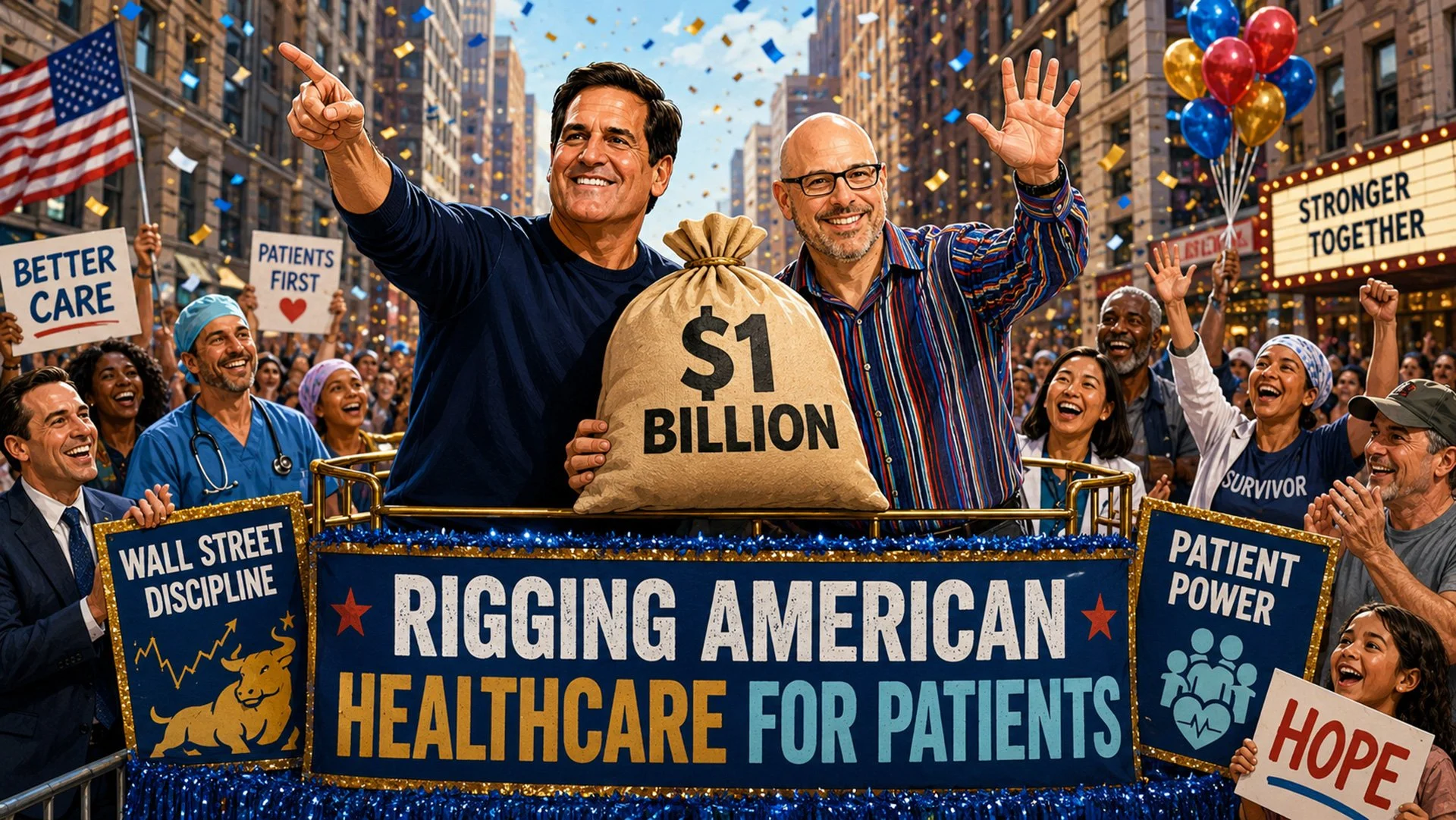
Mark Cuban and I would probably agree on the central premise immediately, which already places us in a very small category inside American healthcare. The system behaves rationally according to the incentives embedded within it. Hospitals optimize reimbursement. Insurers optimize utilization management. PBMs optimize spread economics and formulary leverage. Pharmaceutical manufacturers optimize market exclusivity and pricing power. Employers attempt to control labor related healthcare expense without fully understanding the products they purchase. Investors reward predictable margin and scalable revenue extraction. None of that behavior surprises me anymore because the system consistently produces exactly what it financially rewards.
Where patients enter this equation is where the distortion becomes impossible to ignore.
Cuban approached healthcare through pricing mechanics because he recognized that pharmacy economics contain layers of opacity that would never survive scrutiny in a functioning consumer market. His solution through Cost Plus Drugs reflects the instincts of an operator who sees unnecessary friction, hidden pricing structures, and middlemen extracting value without creating proportional utility. He exposed acquisition cost, added a transparent markup, and demonstrated that enormous portions of pharmaceutical pricing often derive from contractual complexity rather than intrinsic value creation. The fact that he calculated the Dallas Mavericks spent roughly $169,000 on generic drugs that could have cost approximately $19,000 through Cost Plus was not merely a clever anecdote. It represented evidence that institutional healthcare purchasing has normalized levels of waste and opacity that sophisticated business operators would reject almost immediately in any other industry.
What makes Cuban interesting to me is not that he attacks healthcare pricing. Plenty of people do that. What makes him interesting is that he understands incentive structures deeply enough to recognize that the PBM conversation alone misses the larger architecture surrounding vertically integrated insurance conglomerates. In his Healthcare Brew interview, he acknowledged that he originally focused too heavily on PBMs in isolation before recognizing how insurance companies positioned PBMs to absorb public criticism while preserving broader financial control throughout the system. That evolution demonstrates intellectual maturity because it reflects a willingness to revise the diagnosis after deeper operational exposure.
Most healthcare commentary collapses into tribal performance before it reaches that level of systems thinking. One side blames corporations generically. Another side blames regulation generically. Everyone selects villains that flatter their existing worldview. Meanwhile the actual machinery producing patient harm continues operating exactly as designed because very few people bother interrogating how incentives interact across reimbursement, contracting, utilization management, employer purchasing, and capital allocation simultaneously.
That is where my perspective begins to diverge from Cuban’s, though not in opposition to it.
Cuban attacks healthcare dysfunction primarily through transactional reform. He focuses on pricing transparency, formulary control, direct purchasing pathways, generic manufacturing, and structural separation between insurers and PBMs. Those interventions matter enormously because they target mechanisms that directly inflate cost and distort competition. His framework asks how markets can operate more rationally once opacity and artificial leverage lose protection.
My framework starts from a different operational reality. Patients do not experience healthcare as isolated transactions. Patients experience healthcare as prolonged exposure to institutional power during moments of physical, financial, and psychological vulnerability.
That distinction changes the entire strategic approach.
A patient with cancer does not merely purchase medication. That patient enters a sequence of dependency involving diagnosis, referrals, imaging approvals, pathology review, network status disputes, treatment authorization, disability paperwork, survivorship planning, financial toxicity, employment instability, transportation logistics, and long term administrative management that often extends years beyond active treatment. Every institutional participant along that pathway possesses specialized infrastructure protecting its interests. Hospitals employ reimbursement specialists. Insurers employ utilization management teams. Pharmaceutical companies maintain market access divisions. Employers retain consultants and brokers. Patients often navigate the most economically destabilizing period of their lives armed with Google searches, portal passwords, and hold music that sounds like it escaped from a cable access infomercial in 1988.
That imbalance represents the central healthcare infrastructure failure I would target with $1 billion.
If Cuban uses capital to reduce extraction inside the healthcare transaction, I would use capital to reduce patient vulnerability inside the healthcare experience itself. Those strategies reinforce one another rather than compete.
INVESTMENT ONE
The first major investment I would make involves building a national patient navigation infrastructure operating across all 50 states with professionally trained navigators capable of assisting patients through insurance appeals, prior authorization disputes, disability systems, clinical trial access, billing conflicts, employer protections, survivorship transitions, and financial toxicity management. Healthcare leaders consistently underestimate how much modern clinical outcome now depends upon administrative literacy. Two patients with identical diagnoses can experience radically different treatment trajectories depending upon who understands reimbursement pathways, network exceptions, appeals language, and documentation requirements more effectively. Administrative complexity increasingly functions as a hidden clinical determinant.
That reality creates enormous downstream economic inefficiency in addition to human harm. Patients who abandon treatment because they cannot navigate insurance systems often reenter the system later with more advanced disease and dramatically higher costs. Patients who fail to appeal inappropriate denials may lose access to medically necessary care while institutions record the outcome as ordinary nonadherence. Delayed treatment frequently masquerades as patient behavior when administrative dysfunction actually drove the delay.
INVESTMENT TWO
The second investment I would make involves constructing the largest independent healthcare accountability database in the country. Cuban correctly focuses on exposing pharmaceutical pricing distortion and PBM leverage. I would expand that transparency model across the full continuum of patient experience by tracking denials, prior authorization delays, network inadequacy failures, employer plan behavior, medical debt accumulation, appeals outcomes, coverage interruptions, and delayed diagnoses associated with administrative barriers. Healthcare currently protects itself through fragmentation because every institution sees only a portion of the aggregate damage while patients absorb the cumulative effect across years.
Opacity preserves revenue because opacity prevents pattern recognition.
Once patterns become measurable, employers can negotiate differently, regulators can enforce differently, journalists can investigate differently, litigators can challenge differently, and policymakers can no longer pretend isolated anecdotes explain systemic outcomes. Transparency alone never fixes institutions, but transparency changes the cost of maintaining abusive incentives.
INVESTMENT THREE
The third investment would focus heavily on independent healthcare journalism and public education because healthcare media ecosystems frequently depend financially upon the same institutions they nominally scrutinize. That financial structure does not require explicit corruption to produce caution. It merely creates incentives toward softer framing, narrower inquiry, and performative consensus language that obscures the actual mechanics driving patient harm. Patients require clear explanations around insurance design, employer purchasing, PBM economics, disability systems, medical debt, and patient rights because citizens cannot meaningfully challenge structures they do not understand. Public literacy represents infrastructure.
INVESTMENT FOUR
The fourth investment would create legal and policy infrastructure specifically designed to enforce patient protection at scale. Cuban supports separating insurers and PBMs because concentrated ownership distorts incentives and weakens market discipline. I agree entirely. I would extend that logic toward enforceable legal protections when denials become systemic patterns, when network inadequacy disrupts continuity of care, when administrative burden creates economic harm, and when employer purchased plans expose workers to structurally avoidable financial risk. Markets respond to enforceable consequence more consistently than they respond to moral argument.
INVESTMENT FIVE
The fifth investment would build durable civic organization around healthcare because every major institutional stakeholder currently operates with coordinated influence while patients remain fragmented despite representing the largest affected population in the system. Hospitals organize aggressively. Insurers organize aggressively. Pharmaceutical companies organize aggressively. PBMs organize aggressively. Employers organize aggressively. Patients experience suffering individually and episodically. That fragmentation protects incumbents far more effectively than any individual law or lobbyist ever could.
What interests me about Cuban’s work is that it demonstrates how a focused intervention inside one distorted healthcare market can expose far larger structural problems. Cost Plus Drugs operates as both a business and a systems level proof point. It reveals how much pricing dysfunction survives primarily because complexity conceals it from purchasers who lack time, expertise, or negotiating leverage. My instinct would be to build the missing patient side infrastructure capable of converting that transparency into sustained civic, legal, operational, and economic pressure throughout the broader healthcare ecosystem.
That is why I do not see Cuban’s model and my model as competing visions. I see them as different entry points into the same structural diagnosis.
He reduces extraction.
I would reduce vulnerability.
He disciplines pricing distortion through transparency and market pressure.
I would discipline institutional asymmetry through infrastructure, accountability, legal enforcement, and patient organization.
Together, those approaches begin shifting leverage toward the people who currently possess the least of it despite carrying the greatest exposure to system failure.
The most important point here is that neither framework requires hostility toward markets themselves. Functional markets depend upon transparency, informed participants, enforceable rules, and relatively balanced negotiating power. American healthcare routinely denies those conditions to patients while preserving them for institutions sophisticated enough to exploit complexity economically. That imbalance produces enormous waste disguised as inevitability.
Healthcare insiders frequently frame patient protection and economic efficiency as competing goals because the current system profits from separating them conceptually. In reality, aligned incentives frequently produce both simultaneously. Better navigation reduces avoidable utilization. Better employer purchasing lowers waste. Better transparency improves contracting discipline. Better continuity reduces downstream crisis expense. Better legal enforcement discourages abusive administrative behavior. Better patient literacy improves adherence and earlier intervention.
The current system externalizes enormous operational burden onto patients and families while distributing institutional leverage upward toward entities sophisticated enough to monetize complexity consistently.
That arrangement can change.
Cuban has already demonstrated that one disciplined intervention can expose massive structural inefficiency inside pharmaceutical pricing. If I had $1 billion, I would spend it building the patient infrastructure layer capable of translating transparency into durable leverage throughout the rest of healthcare. The future of meaningful reform probably depends less on choosing between those strategies than on recognizing how powerfully they could reinforce one another if deployed together.