When Patients Stop Trusting Dermatology

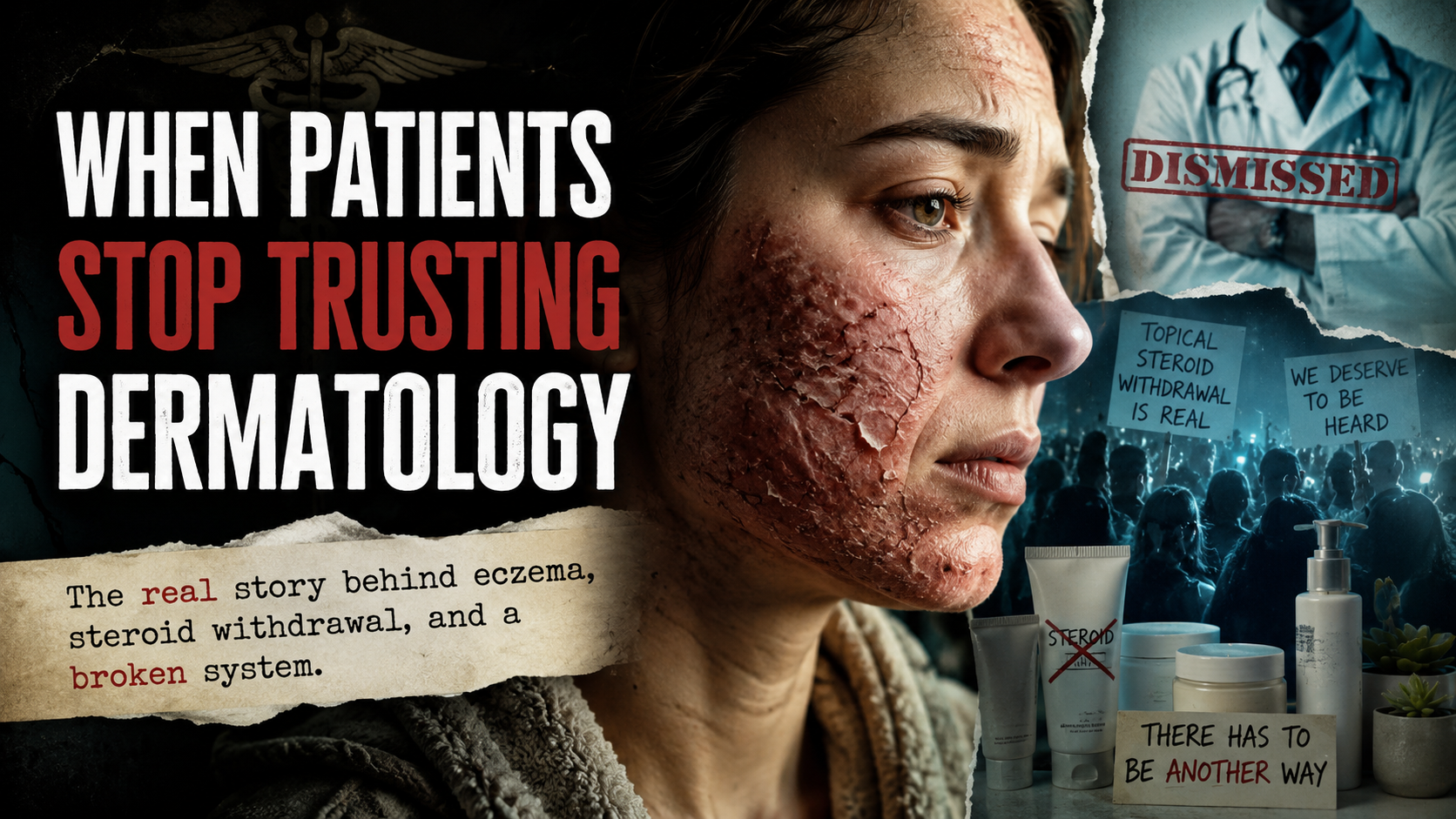
Patients with severe eczema increasingly distrust the very treatments medicine tells them to rely on. That reality carries consequences far beyond dermatology. Once patients conclude that the healthcare system either cannot recognize harm or refuses to acknowledge it, they begin searching for answers elsewhere. They move into online communities, private support groups, documentaries, Reddit threads, and algorithm driven ecosystems where lived experience often carries more authority than institutional guidance. Healthcare leaders continue acting surprised when this happens. They should not. The American healthcare system trained patients to behave this way.
I arrived at this issue through an unexpected doorway. Over the last several months I have worked with Codex Labs as a brand ambassador tied initially to oncology and survivorship audiences. The original focus centered on compromised skin during and after cancer treatment, an issue I understand personally after surviving aggressive brain cancer treatment in the 1990s. Radiation damaged my skin badly enough that the recovery plan effectively amounted to petroleum jelly and luck. Nobody discussed barrier function, microbiome science, long term inflammatory consequences, or cumulative dermal damage. The system treated skin breakdown as collateral damage inside a larger treatment pathway. Back then the medical equivalent of aftercare often sounded like “walk it off” delivered with the confidence of a gym teacher from 1987.
Over time, the conversation around Codex Labs evolved beyond oncology supportive care and deeper into eczema, chronic inflammation, skin barrier science, and microbiome research. That shift led me into the rapidly growing and deeply fractured world surrounding eczema, topical steroid withdrawal, chronic inflammatory disease, and patient distrust in dermatologic care. What I found looked disturbingly familiar to anyone who has spent decades watching institutions struggle to keep pace with lived experience.
The numbers alone demand attention. More than 31 million Americans live with eczema. The global eczema therapeutics market already exceeds $20 billion annually and continues growing as specialty biologics and targeted therapies enter the market. The condition generates enormous downstream costs through physician visits, prescriptions, sleep disruption, mental health deterioration, caregiver exhaustion, school absenteeism, lost productivity, and escalating pharmaceutical utilization. Beneath the economic scale sits a parallel patient narrative that mainstream medicine still struggles to address directly.
Thousands of patients now identify with a condition known as topical steroid withdrawal, often abbreviated as TSW. Patients describe severe symptoms after prolonged use and discontinuation of topical corticosteroids prescribed for eczema and other inflammatory conditions. Reports include burning skin, nerve pain, temperature dysregulation, insomnia, anxiety, depression, shedding skin, social isolation, and recovery periods measured in years rather than weeks. Documentary projects and online patient communities contain extensive firsthand accounts from people who believe the standard treatment path itself became a source of injury.
At the same time, many dermatologists dispute the prevalence, characterization, or even existence of TSW as patients describe it. Evidence remains incomplete. Diagnostic standards remain inconsistent. The medical literature continues evolving. Serious physicians debate causality, misuse patterns, underlying disease progression, and the extent to which withdrawal phenomena differ from uncontrolled eczema itself. That nuance deserves respect. Healthcare systems, however, consistently misunderstand one critical point. Patients experience scientific uncertainty as institutional dismissal.
Most patients do not expect medicine to possess perfect answers. Patients understand complexity far better than institutions often assume. What patients struggle to tolerate is the perception that their suffering gets minimized while professional organizations protect existing treatment frameworks pending further evidence. Once people believe the healthcare system no longer recognizes their lived reality, they stop trusting the system itself.
The documentaries surrounding TSW reveal a recurring pattern that appears across many chronic illnesses. Patients describe years of escalating prescriptions, worsening symptoms, repeated medical visits, psychological deterioration, financial strain, and growing desperation. Many describe feeling dismissed once their experiences no longer fit conventional treatment expectations. Eventually they begin conducting their own research because they conclude nobody else will investigate aggressively on their behalf.
The same pattern has emerged repeatedly across healthcare over the last 30 years across autoimmune disease, menopause medicine, Long COVID, psychiatric medication withdrawal, and cancer survivorship communities where supportive care consistently lagged behind lived reality. The details differ. The institutional behavior often looks remarkably similar. A patient reports harm. The healthcare system demands higher evidence thresholds. The patient becomes harder to categorize. Institutions defend standard practice while awaiting definitive consensus. Patients organize independently in the vacuum that follows.
Markets eventually respond to distrust because distrust creates opportunity. That dynamic partially explains why investors and healthcare companies increasingly pay attention to eczema innovation. Millions of patients remain dissatisfied despite enormous spending across existing treatment pathways. Some seek steroid sparing approaches. Some seek microbiome focused therapies. Some seek barrier restoration strategies. Others simply want acknowledgment that their experiences deserve investigation rather than reflexive dismissal.
Trust now functions as infrastructure inside healthcare markets. Once patients lose it, every downstream interaction becomes more expensive, slower, and less effective. Patients disengage from care. Adherence declines. Alternative ecosystems emerge. Misinformation spreads more rapidly. Clinician frustration increases. Regulators face pressure. New market entrants position themselves against incumbents who failed to maintain credibility.
Healthcare institutions continue treating distrust primarily as a communications problem. In reality, distrust reflects a systems design problem. The eczema story exposes how deeply the healthcare system remains optimized around symptom suppression and intervention throughput rather than long horizon restoration. Reimbursement models reward prescriptions, procedures, specialty escalation, and measurable short term intervention far more efficiently than they reward extended investigation into cumulative inflammatory burden, environmental exposure, barrier dysfunction, or longitudinal harm patterns.
Nobody designed the system maliciously. The incentives simply evolved this way over time. That distinction matters because outrage alone solves nothing. Real reform requires incentive realignment. If healthcare organizations want patients to trust them again, they must create financial and regulatory environments where investigating treatment related complications becomes economically viable rather than reputationally threatening.
The dermatology community now faces a challenge larger than eczema itself. The challenge centers on whether modern medicine can acknowledge uncertainty without collapsing institutional authority. Historically, healthcare organizations often treated acknowledgment of uncertainty as weakness. The internet destroyed that strategy. Patients now compare experiences globally in real time. Institutions no longer control the narrative monopoly surrounding treatment outcomes. When healthcare systems fail to engage transparently with emerging patient concerns, patients build parallel validation systems outside formal medicine. Some of those parallel ecosystems eventually become commercially powerful precisely because institutional medicine failed to maintain credibility with the patients seeking answers.
That reality explains why I continue supporting Barbara Paldus and Codex Labs as they expand deeper into eczema, skin barrier science, microbiome research, and chronic inflammatory disease. I respect companies willing to engage difficult questions early, especially inside categories where patients already feel dismissed, exhausted, or distrustful. Trust cannot function as a marketing slogan inside healthcare. Companies earn trust slowly through transparency, scientific rigor, responsiveness, and a willingness to listen when patients describe outcomes that formal systems still struggle to categorize cleanly.
That question sits at the center of the work I continue to do through my upcoming book, We the Patients: Understanding, Navigating, and Surviving America’s Healthcare Nightmare. Over 30 years inside survivorship and advocacy communities, I have watched the same structural pattern repeat itself across cancer, chronic illness, mental health, autoimmune disease, and now dermatology. Patients report patterns before institutions feel comfortable validating them. Communities organize before systems respond. Markets eventually move toward whoever takes patient experience seriously first.
The future of healthcare will belong to institutions capable of integrating lived experience with rigorous science rather than forcing patients to choose between them. Chronic disease management requires that alignment now. The cost of continuing the current trajectory will appear in rising distrust, fragmented care, worsening misinformation ecosystems, and millions of patients who increasingly believe they must navigate complex inflammatory disease largely on their own.