The Missing Constituency: What Comes Next for Patient Advocacy
For most of my adult life, I have been known for cancer. This is understandable. I was diagnosed with brain cancer at 21, survived it, and eventually founded Stupid Cancer because the young adult cancer community I needed did not exist. That work became a career I never planned on having, followed by nearly two decades of broadcasting, advocacy, entrepreneurship, media, policy work, and eventually writing We the Patients: Understanding, Navigating, and Surviving America’s Healthcare Nightmare.
There is a fairly straight line connecting all of it. Something terrible happened to me. I survived it. I discovered that millions of other people were struggling with versions of the same institutional failures I had encountered, and I became increasingly interested in why those failures existed in the first place.
For 30 years, I have been learning American healthcare from the least prestigious possible credential: being a patient inside it. That education has changed the questions I am asking.
This week, The Hill published an essay of mine called “The Missing Constituency.” It may be the most important thing I have written in quite some time, not because I have discovered how to “fix healthcare,” a phrase I have come to dislike, but because I no longer believe fixing it adequately describes the challenge. American healthcare did not accidentally become enormously expensive, administratively hostile, fragmented, opaque, and governed by competing financial interests. Much of what patients experience as dysfunction is the predictable result of how the system was designed and how its incentives evolved.
It ain’t broken. It was built this way.
The question I find much more interesting now is what patients can build in response.
Thirty Years of Patient Advocacy
The modern patient advocacy movement has accomplished extraordinary things. Organizations representing diseases, disabilities, caregivers, seniors, families, and specific patient populations have funded research, changed laws, expanded access to treatment, created communities, educated policymakers, protected public programs, and forced institutions to acknowledge experiences they once routinely ignored.
I have spent most of my adult life as part of that history. Stupid Cancer emerged because young adults with cancer were falling through gaps created by a healthcare culture organized largely around pediatric and older adult populations. We did not invent young adults with cancer. We gave an existing population a name, a community, and eventually an identity strong enough to demand recognition from the institutions that had overlooked it. That experience taught me something I did not fully appreciate at the time: identity can be infrastructure.
Once people recognize that an experience they considered personal is actually shared, their relationship to that experience changes. Isolation becomes community, community creates expectations, and eventually those expectations become demands.
Patient advocacy has replicated versions of this process remarkably well across thousands of communities. The result is an enormous ecosystem of organizations, advocates, experts, coalitions, researchers, clinicians, caregivers, and patients fighting for important things. But there is a structural problem embedded in its success.
We have organized patients primarily according to the categories that distinguish them from one another. Cancer patients organize around cancer. People with Parkinson’s organize around Parkinson’s. Rare disease communities organize around individual diseases or the broader challenges of rare disease. Seniors organize around Medicare. Families organize around Medicaid. Other communities organize around medical debt, disability, mental health, reproductive care, access to medications, or dozens of other legitimate priorities.
Meanwhile, the industries that shape American healthcare rarely approach Washington with that degree of fragmentation.
Insurers understand themselves as an industry. Hospitals understand themselves as an industry. Pharmaceutical companies understand themselves as an industry. Employers, benefits companies, pharmacy benefit managers, medical device manufacturers, and countless other commercial interests understand the value of organizing around shared economic and political interests even when they compete vigorously among themselves. Patients have never possessed an equivalent organizing identity at national scale.
The Problem Is No Longer Awareness
For decades, one of the essential functions of patient advocacy has been making harm visible. We tell stories because stories reveal what statistics cannot. We collect data because individual stories can be dismissed as exceptions. We organize Hill Days because policymakers need to encounter the human consequences of decisions that otherwise exist as language buried inside legislation and regulation. All of that work remains necessary. But I have become increasingly skeptical that awareness is the primary obstacle standing between patients and structural change.
Americans know healthcare is a problem.
They know it is expensive. They know insurance can be incomprehensible. They know medical bills can destroy household finances. They know prior authorization can interfere with care. They know that getting sick can transform an ordinary person into an unpaid expert in networks, deductibles, formularies, appeals, billing codes, coverage determinations, and government programs. We have established that American healthcare is fucked up with sufficient peer review.
Yet the political consequences of that dissatisfaction remain strangely limited compared with its prevalence. Millions of people can experience the same frustrations without understanding themselves as members of the same group. Their anger remains personal, even when the forces producing it are systemic. That is the contradiction I have been thinking about for several years. The missing ingredient may not be another issue. It may be identity.
The Patient as a Political Identity
A cancer survivor fighting an insurance denial in Phoenix, a caregiver coordinating care for a parent in Pittsburgh, and a retiree trying to understand a Medicare notice in Tampa may appear to have little in common. Their diagnoses may be different. Their incomes may be different. Their ages, cultures, professions, and political beliefs may be different.
But each has experienced what happens when a human being becomes dependent on American healthcare.
That experience crosses virtually every demographic and ideological boundary we spend so much time discussing. Illness does not ask how someone voted before introducing them to an insurance company. Caregiving does not observe party registration. Medical debt is not particularly ideological. There is a potentially enormous constituency embedded in that shared experience, but we have rarely asked people to understand themselves that way.
Patients have always had the numbers. What they have never had is a shared identity capable of becoming political power.
I do not mean partisan identity. The distinction matters enormously. A patient constituency should not exist to deliver votes to Democrats or Republicans, nor should healthcare become another cultural sorting mechanism through which Americans decide which tribe they belong to.
I mean political identity in the more fundamental sense: a population that recognizes a set of common interests and understands that it possesses collective leverage capable of protecting them.
This is the difference between patient voice and patient power.
Healthcare institutions have become very comfortable with the language of patient voice. Patients sit on advisory boards. They participate in panels. Organizations conduct listening sessions and surveys. Companies hire patient engagement teams. Policymakers invite people to testify. Some of these efforts are meaningful and have produced genuine improvements.
But being heard is not the same thing as possessing leverage. A constituency does not depend entirely on the willingness of powerful institutions to listen. It creates consequences for failing to listen.
From Personal Experience to Civic Power
This is where my own thinking has changed most dramatically. For years, much of my work focused on helping people navigate healthcare, understand their rights, find community, and become better equipped to advocate for themselves. We the Patients grew directly out of that history. I wanted ordinary Americans to understand the machinery surrounding them because knowledge creates agency, and American healthcare has traditionally benefited from patients not knowing how the machinery works.
But individual agency has a ceiling.
A person can learn how to appeal an insurance denial. That does not explain why so many people need to become skilled at appeals. A family can learn how to challenge an incomprehensible hospital bill. That does not change the incentives producing incomprehensible bills. A patient can become an exceptionally effective advocate for herself while leaving the underlying machinery untouched for the person who arrives tomorrow.
Navigation helps people survive systems. Political power changes the conditions they are being asked to survive.
I increasingly believe those two ideas belong together. The knowledge required to navigate American healthcare also teaches people to recognize patterns. Once someone understands that the obstacle confronting them was not simply bad luck, incompetence, or an unusually terrible Tuesday, an individual problem begins to reveal an institutional structure. When millions of people recognize the same structure, navigation can become something more consequential: civic power.
What Comes Next
None of this requires dismantling the patient advocacy movement or asking organizations to abandon the communities they have spent decades building. Quite the opposite. Those organizations have already created much of the infrastructure a broader constituency would need: trusted relationships, policy expertise, communications networks, community leadership, institutional knowledge, and millions of people who already understand the consequences of healthcare policy in their own lives.
The opportunity is connective.
A person can remain a cancer advocate while understanding that an insurance denial connects her to people outside cancer. A rare disease organization can continue fighting for research and treatment while recognizing that its members share certain interests with Medicare beneficiaries, caregivers, people living with chronic illness, and families struggling with medical debt. Nobody needs to surrender the identity that brought them into advocacy.
They need an additional one.
Patient.
That word is so ordinary that its political potential has been easy to overlook. The constituency does not need to be invented. The people are already here. They are in hospitals and infusion centers, pharmacies and waiting rooms, kitchens covered in medical bills, employer benefits portals, insurance appeals, caregiving groups, disease communities, and millions of households where healthcare stopped being an abstract policy debate a long time ago. The work now is helping those people understand that the experience they thought belonged only to them connects them to one of the largest untapped constituencies in American life.
Thirty years after brain cancer introduced me to this system, that is where I find myself.
I did not come out of Washington, and I have no interest in pretending otherwise. Everything I understand about healthcare began with being sick, needing care, surviving, and eventually listening to thousands of other people describe what happened when they needed the same system. That perspective once led me to build a community around young adults with cancer. It later led me to write a book about understanding and surviving American healthcare. Now it has led me somewhere larger.
I am no longer particularly interested in merely documenting what American healthcare does to people. I want to understand what becomes possible when the people it happens to recognize one another.
For decades, patient advocacy has worked extraordinarily hard to make Washington hear the patient voice.
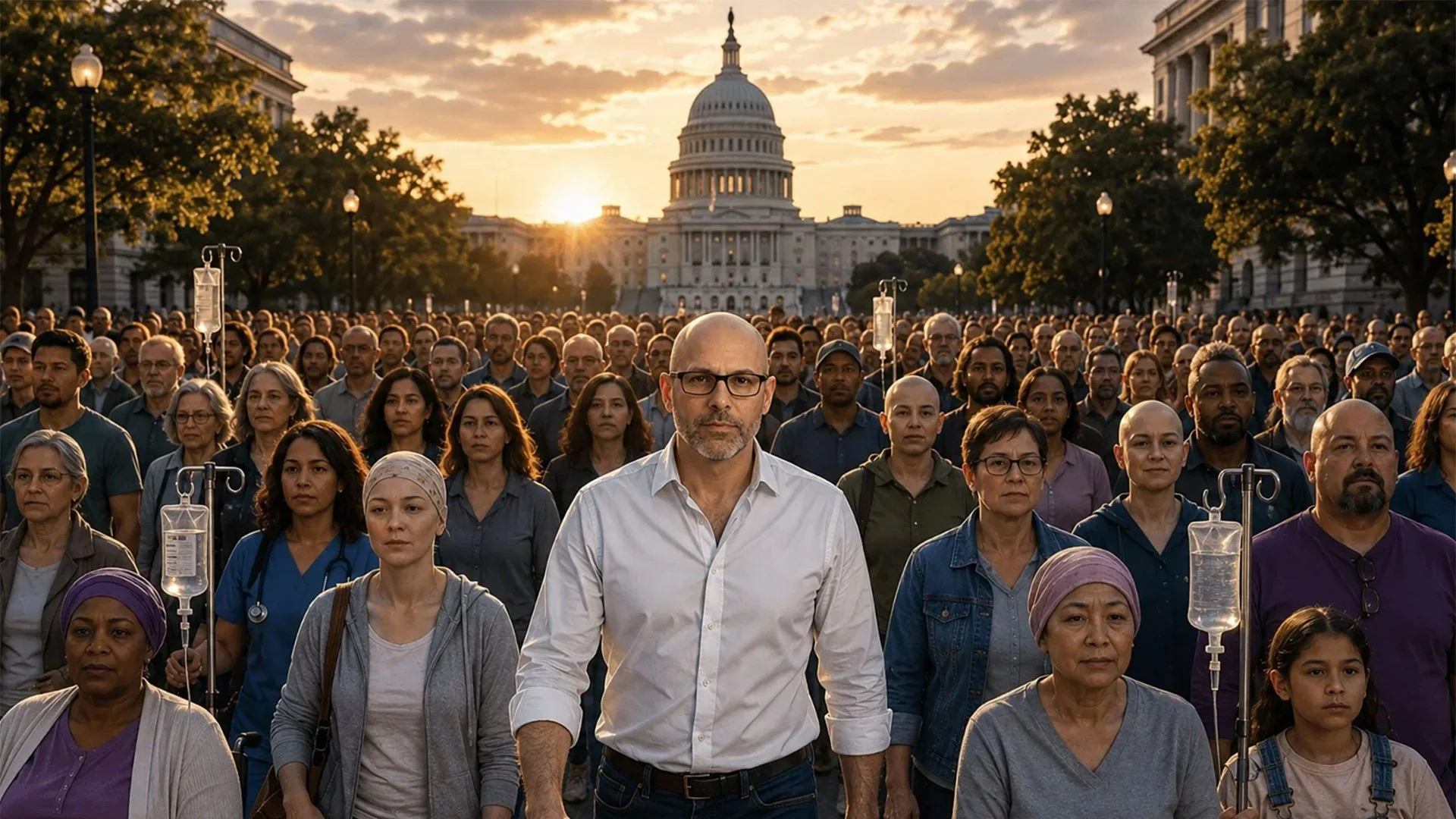
The next chapter may be about something more consequential: helping patients understand that they have been a constituency all along.
Thank you for coming to my TED Talk.