The Healthcare System Works Exactly as Designed. Cancer Patients Pay the Price.
Every healthcare system rations care. America just hides the rationing behind paperwork, billing codes, provider networks, and monthly premiums large enough to qualify as second mortgages.
That reality upset a surprising number of readers after MarketWatch published my recent essay about the financial cost of surviving cancer in the United States. Some readers thanked me for saying publicly what millions of families experience privately. Others accused me of exaggeration, partisanship, or advocating for “free healthcare.” One commenter compared preexisting condition protections to buying fire insurance after your house already burned down. Another suggested I start a GoFundMe if cancer treatment costs so much.
The reactions interested me less than the assumptions underneath them.
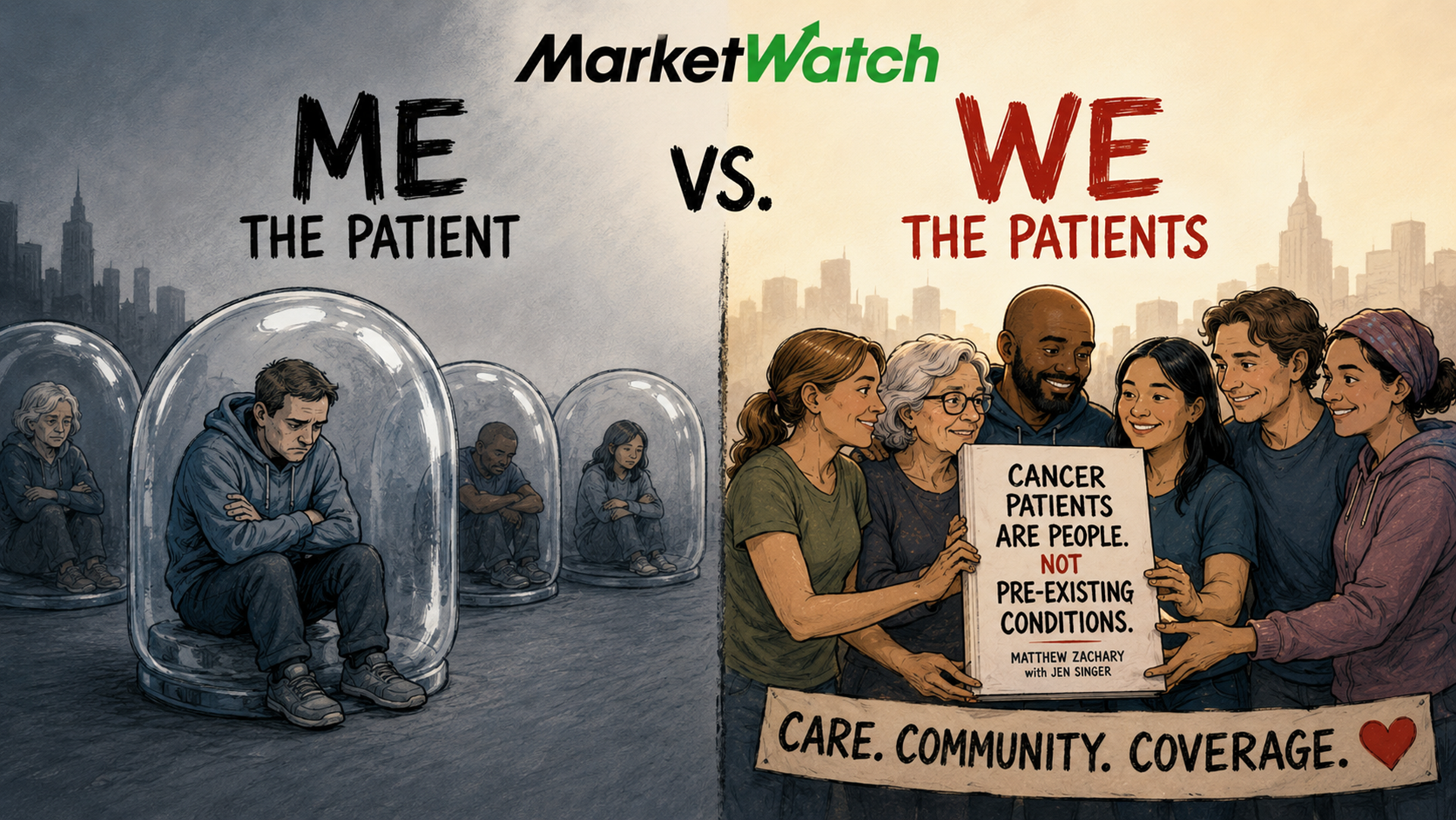
Most Americans still frame healthcare as an individual consumer problem until they become patients themselves. Before diagnosis, healthcare feels theoretical. After diagnosis, healthcare becomes logistics, invoices, network restrictions, lost income, pharmacy denials, prior authorizations, transportation costs, and risk calculations made by strangers who never sit in the exam room.
Cancer strips abstraction from policy discussions very quickly.
In 1996, I was 21 years old when doctors diagnosed me with medulloblastoma, an aggressive brain cancer that can kill within months. My parents worked as public school teachers. Their union insurance refused to cover treatment at Memorial Sloan Kettering. My father bought catastrophic coverage that reimbursed only $285 of each $1,650 radiation session. I underwent 33 treatments. My parents spent more than $50,000 out of pocket to keep me alive, roughly $100,000 adjusted for inflation today.
People sometimes hear stories like mine and assume failure occurred somewhere inside the system. The harder truth sits elsewhere. The system behaved exactly as designed.
Insurance companies manage financial risk. Employers manage labor costs. Hospitals optimize reimbursement. Pharmaceutical companies maximize shareholder return on intellectual property. Private equity firms seek margin expansion across fragmented healthcare sectors. None of those incentives naturally prioritize long term patient financial stability unless regulation, competition, or market pressure forces alignment.
That distinction matters because outrage alone explains very little.
America built a healthcare financing structure where patients absorb enormous financial exposure precisely when they lose the greatest amount of negotiating leverage. Illness reduces income, limits employment flexibility, increases dependency on coverage, and creates urgency that weakens consumer choice. A healthy person comparison shops. A person with glioblastoma signs whatever forms appear before surgery.
Healthcare economists often describe this dynamic as market failure. That description understates the problem. The market functions efficiently for many of the institutions inside it. Publicly traded insurers consistently produce strong earnings. Large health systems continue aggressive acquisition strategies. Pharmacy benefit managers retain extraordinary pricing influence. Investors continue pouring capital into sectors tied to chronic disease management because demand remains durable.
The instability concentrates primarily at the patient level.
That instability carries enormous downstream economic consequences that extend far beyond healthcare politics. Delayed diagnoses increase treatment complexity and expense. Medical debt suppresses consumer spending and damages credit access. Employer tied insurance discourages entrepreneurship and workforce mobility. Financial toxicity contributes to treatment noncompliance, mental health deterioration, and avoidable hospitalizations. Families drain retirement savings to preserve survival odds that wealthier households purchase more easily.
None of that improves market efficiency.
Many defenders of the current system argue that innovation requires high healthcare spending. They often point correctly to American leadership in biotechnology, oncology research, medical devices, and pharmaceutical development. The United States drives enormous portions of global medical innovation. Investors deserve returns for assuming research risk. Drug development remains expensive, failure prone, and heavily regulated.
But innovation and patient protection do not operate as mutually exclusive concepts.
Markets require rules to function sustainably. Securities markets prohibit insider trading because trust sustains participation. Aviation regulations exist because passengers rarely possess the expertise to evaluate aircraft safety personally. Food manufacturers cannot legally sell contaminated products because public health protections support stable commerce.
Healthcare operates under weaker consumer protections despite far greater information asymmetry and far higher personal stakes.
Patients rarely know actual prices before treatment. Insurance contracts remain incomprehensible to most consumers. Consolidation reduces competitive pressure across hospital markets. Employer based coverage limits portability. Prior authorization systems reward delay as a cost containment strategy. Billing complexity creates administrative overhead so enormous that entire industries now exist solely to navigate the inefficiencies of other healthcare industries.
At some point, people stop defending markets and start defending toll booths.
The Affordable Care Act attempted partial correction by prohibiting discrimination against preexisting conditions and expanding coverage access. Critics often describe the ACA as government overreach. Supporters often portray it as salvation. Both positions oversimplify reality.
The ACA addressed several catastrophic vulnerabilities while leaving underlying cost structures largely intact. It expanded access while preserving a fragmented reimbursement architecture that still incentivizes volume, administrative complexity, and profit extraction. It reduced some forms of financial risk while failing to control many of the underlying price drivers aggressively enough.
Even so, preexisting condition protections remain economically rational policy.
Without them, insurers gain incentive to avoid expensive populations rather than compete on operational efficiency, quality outcomes, or preventive care management. That dynamic destabilizes risk pools and increases long term uncompensated care costs that taxpayers eventually absorb anyway through emergency systems, disability programs, and hospital losses.
Cancer patients understand this intuitively because we experience the math personally.
A diagnosis instantly transforms someone from profitable customer into expensive liability. The question becomes whether society structures rules that prevent institutions from shifting unsustainable levels of risk onto people least capable of carrying it.
That debate often devolves into tribal political theater because healthcare discussions trigger deep American instincts around individual responsibility, taxation, and government distrust. But incentives remain more important than ideology.
Most executives inside healthcare do not wake up plotting patient harm like villains from RoboCop or Wall Street. Most clinicians genuinely want to help people. Most insurers employ many decent professionals attempting to balance difficult actuarial realities. Most policymakers understand at least portions of the problem.
But systems produce outcomes according to incentives, not intentions.
If insurers increase earnings by restricting utilization, utilization restrictions will expand. If hospitals generate higher reimbursement through procedural volume than prevention, procedural volume will dominate investment priorities. If employers remain primary insurance sponsors, labor market dependency will continue shaping healthcare access. If private equity can increase returns through staffing reductions, staffing reductions will occur until regulation or public pressure intervenes.
Healthcare behaves rationally within the architecture policymakers and markets created.
That architecture now collides with demographic reality. America continues aging. Chronic disease prevalence continues rising. Cancer survivorship continues increasing because treatment improves. The National Cancer Institute estimates roughly 26 million cancer survivors by 2040. Survivorship creates economic complexity because living longer often requires extended monitoring, expensive maintenance therapies, rehabilitation services, fertility preservation, mental health support, and management of treatment related complications.
The healthcare system still largely finances survivorship like an acute event instead of a long horizon economic condition.
That mismatch creates political vulnerability neither party fully acknowledges. Millions of Americans who previously viewed healthcare as ideological abstraction now navigate prior authorizations, network exclusions, pharmacy denials, or unaffordable premiums personally. The distance between voter and patient continues shrinking.
That explains why public polling consistently shows broad support for preexisting condition protections across party lines. People may dislike government programs abstractly while simultaneously supporting the specific protections those programs provide. The contradiction reflects lived experience colliding with political branding.
The comments under my MarketWatch essay ultimately reinforced the central point more than they weakened it.
Some readers argued that patients should simply accept whatever care insurance covers locally rather than pursue elite institutions like Sloan Kettering. That position sounds rational until someone they love develops a rare or aggressive disease requiring specialized expertise. Suddenly network adequacy feels very different.
Others insisted personal responsibility should dominate healthcare financing. Personal responsibility absolutely matters. Smoking increases risk. Obesity affects outcomes. Preventive behavior reduces costs. But medulloblastoma does not care whether your credit score looks strong. Leukemia does not pause for open enrollment season.
Risk pooling exists because catastrophic events exceed individual planning capacity.
America already accepts that principle across nearly every functioning sector. We socialize fire response. We subsidize flood insurance. We maintain public roads through collective taxation. We stabilize banks during financial crises because systemic collapse threatens broader economic health.
Yet healthcare still triggers uniquely punitive rhetoric despite its universal inevitability. Every healthy person eventually becomes an aging person if they remain lucky enough to stay alive.
That reality leaves the United States facing a choice rooted less in morality than economic design.
The country can continue shifting rising healthcare costs and administrative complexity onto individuals until financial instability suppresses broader economic productivity further. Or policymakers, employers, insurers, providers, and patients can begin aligning incentives around earlier intervention, portable coverage, price transparency, administrative simplification, preventive investment, and long term patient stability.
Markets adapt when incentives change.
The question never centered on whether America can afford stronger patient protections. America already spends more than any developed nation on healthcare. The real question centers on whether institutions benefiting from current incentives will tolerate realignment before mounting instability forces harsher correction later.
Eventually every healthcare debate reaches the same unavoidable conclusion.
Someone always pays.
Right now, patients and families absorb too much of the bill while possessing the least structural power to negotiate its terms.