The Denial Machine: Why America’s Health Insurance Appeals System Rewards Patient Exhaustion
The most important statistic in American health insurance may have nothing to do with how many claims insurers deny. It may be how few patients ever challenge those denials.
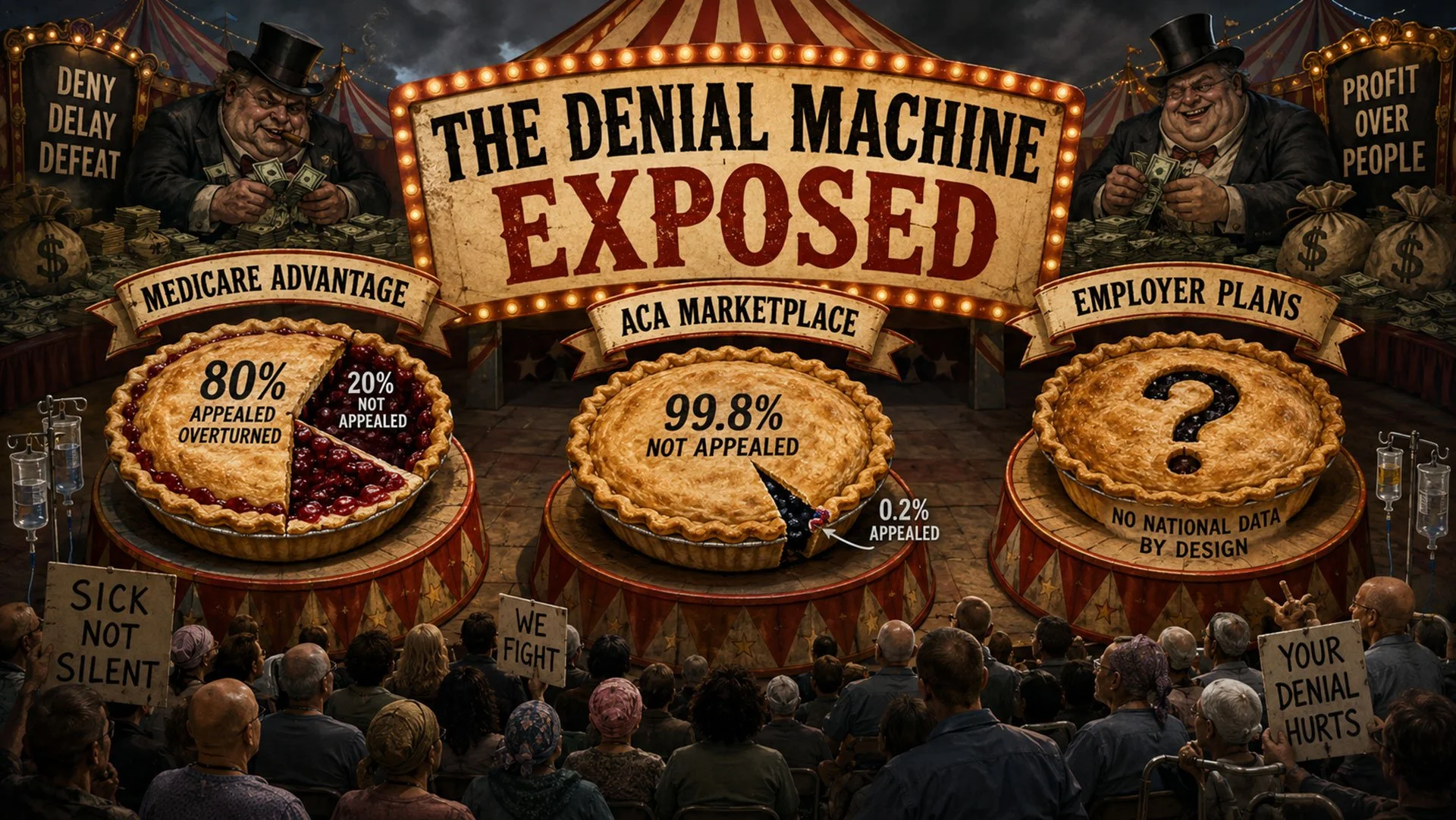
In Medicare Advantage, more than 80% of appealed prior authorization denials get overturned. In Affordable Care Act Marketplace plans, fewer than 0.2% of denied claims ever reach the appeals process. Those figures come from different parts of the insurance market, but together they expose the same structural reality. When patients manage to force an independent review, they frequently prevail. Most never get that opportunity because the system extracts a price long before anyone evaluates the underlying medical decision.
That distinction matters because public debate often begins and ends with denial rates. We argue over whether insurers reject too many claims, whether physicians order too much care, or whether prior authorization serves any legitimate purpose. Those questions deserve serious attention, but they focus on the visible outcome rather than the mechanism that produces it. The more revealing question asks why so few patients ever make it to an appeal when the likelihood of success can be so high. Once you ask that question, the conversation shifts away from individual cases and toward the incentive structure that governs the entire system.
Every complex system responds to incentives. Healthcare does exactly what its incentives reward. Airlines optimize around aircraft utilization. Banks optimize around capital efficiency. Retailers optimize around inventory turnover. Health insurers optimize around medical loss ratios, administrative costs, regulatory requirements, and shareholder expectations. None of those objectives automatically conflict with patient care. Insurance plays a legitimate economic role by pooling risk, negotiating prices, and managing finite resources. The problem begins when administrative complexity becomes financially valuable in its own right because every patient who abandons a claim before an independent review lowers costs without requiring anyone to prove the original denial was correct.
Behavioral economists have studied friction for decades because every additional step in a process reduces participation. Governments understand it when designing tax forms. Technology companies understand it when reducing the number of clicks required to complete a purchase. Banks understand it when they simplify loan applications. Health insurers understand it just as well. Every additional form, every request for another physician note, every phone transfer, every hour spent on hold, every letter filled with technical language, and every deadline imposed on someone already overwhelmed by illness increases the probability that the patient simply stops. The system does not need every patient to give up. It only needs enough patients to give up for the economics to work.
That reality rarely appears in policy discussions because we measure denials and completed appeals, but we rarely measure abandonment. We know how many claims insurers reject. We know how many appeals patients file. We even know how many appeals succeed. We know far less about the invisible middle where patients decide the burden outweighs the potential benefit. That decision rarely reflects agreement with the insurer. More often it reflects exhaustion. A parent caring for a sick child cannot spend another afternoon navigating customer service. A cancer patient recovering from chemotherapy may not possess the physical or emotional capacity to assemble medical records, gather supporting documentation, and meet a 30 day deadline. Someone working an hourly job cannot afford to lose another day’s wages sitting on hold with an insurance company. Those decisions disappear into the data even though they represent one of the largest costs the system imposes on patients.
The extraordinary Medicare Advantage reversal rate deserves far more scrutiny than it receives. An appeal reversal does not automatically prove an insurer acted in bad faith. Physicians disagree with one another. Clinical documentation sometimes improves during the appeals process. New information can legitimately change a coverage determination. Serious analysis requires acknowledging those possibilities because healthcare rarely produces simple villains and heroes. Even after accounting for those explanations, however, an appeal system that overturns more than 80% of challenged prior authorization denials forces an uncomfortable question. If independent reviewers conclude that the original decision should change so often, what happens to everyone who never reaches that independent review?
Nobody knows.
That uncertainty represents a policy failure in itself because a functioning market depends on information. We cannot improve what we refuse to measure. Every conversation about utilization management should include not only denial rates and reversal rates, but abandonment rates as well. Without that information, policymakers cannot distinguish between a system that accurately identifies unnecessary care and a system that successfully discourages patients from exercising their legal rights.
The absence of comparable national data for employer sponsored insurance makes the problem even more significant. Roughly 180 million Americans receive coverage through their employers, yet no standardized national dataset tracks denial patterns, appeal rates, reversal rates, and administrative burden across that enormous segment of the market. Researchers piece together fragments from state regulators, employer surveys, litigation, and individual insurer reporting, but no comprehensive picture exists. That absence carries consequences. Employers cannot compare health plans based on how frequently employees encounter administrative barriers. Employees cannot make informed enrollment decisions based on actual claims experience. Regulators cannot identify systemic failures with confidence because the underlying information remains incomplete.
Markets reward transparency because transparency creates competition. Opaque markets reward incumbents because customers cannot evaluate quality beyond price. Healthcare continues to rely heavily on premium comparisons while leaving one of the most important measures of plan performance largely invisible. Consumers may know the monthly premium, deductible, and out of pocket maximum, but they rarely know how difficult it becomes to obtain medically necessary care after they become sick. That information often matters far more than the difference between one deductible and another.
The insurance industry frequently argues that utilization management protects patients from unnecessary care while controlling healthcare spending. That argument contains legitimate elements. American healthcare spends enormous sums on services that provide little clinical value. Every healthcare system requires some mechanism to distinguish between appropriate and inappropriate care because resources remain finite. Eliminating every form of review would neither improve outcomes nor reduce costs. The question, therefore, should never ask whether prior authorization exists. The better question asks whether the current design optimizes for clinical accuracy or administrative attrition.
Those objectives produce very different systems.
A system designed for clinical accuracy continually learns from its mistakes. High reversal rates trigger internal reviews. Recurring errors prompt changes in policy. Administrative processes become simpler because the organization benefits when correct decisions occur earlier. A system designed around attrition reaches a different equilibrium. Complexity becomes economically useful because abandoned appeals reduce spending regardless of whether the original denial withstands independent scrutiny. From the patient’s perspective, the difference becomes almost impossible to detect because both systems begin with the same denial letter.
My perspective comes from surviving brain cancer for 30 years, but the conclusion reaches far beyond oncology. I have watched patients with rare diseases, chronic illnesses, disabilities, mental health conditions, and common medical problems encounter the same administrative architecture regardless of diagnosis. The disease changes. The insurer changes. The physician changes. The software changes. The underlying incentives remain remarkably consistent. Patients often believe they failed because they lacked persistence or misunderstood the process. In reality, many encountered a system that quietly depends on human limits. Sick people possess finite energy. Families possess finite time. Employers grant finite flexibility. Financial resources remain finite. The system understands those constraints because it operates within them every day.
That reality explains why healthcare increasingly rewards institutional literacy rather than medical need. Patients with flexible work schedules, financial resources, strong physician advocates, experienced family caregivers, and professional familiarity with insurance navigate administrative barriers more successfully than patients who lack those advantages. The irony should concern everyone regardless of politics. The people most likely to require protection frequently possess the fewest resources available to secure it. That outcome reflects neither compassion nor efficiency. It reflects incentives that shift administrative costs away from insurers and onto patients, families, clinicians, and employers who absorb them without appearing on any balance sheet.
Changing those incentives requires more than public frustration because systems rarely respond to moral criticism alone. They respond when measurement, regulation, and financial incentives change together. Policymakers should require standardized reporting of denial rates, appeal rates, reversal rates, and appeal abandonment across every major insurance market, including employer sponsored coverage. Employers should evaluate health plans using measures of administrative performance alongside premiums and provider networks because employee productivity depends as much on navigating healthcare as accessing it. Regulators should measure patient burden with the same seriousness they measure financial performance. Independent patient navigation should become reimbursable infrastructure because modern healthcare has grown too complex to expect ordinary consumers to master it without professional assistance.
None of those reforms require abandoning markets or eliminating private insurance. In fact, they strengthen market performance by giving purchasers better information, rewarding organizations that reduce unnecessary administrative burden, and exposing practices that rely on opacity rather than value. Patient protection and economic efficiency often travel together when incentives align correctly. The current system too often separates them because it treats administrative friction as an acceptable method of cost control.
For decades, Americans have debated whether health insurance denies too much care. That conversation remains important, but it no longer reaches the heart of the problem. The more consequential question asks how many medically appropriate claims disappear before anyone outside the insurance company ever reviews them. Until we measure that invisible attrition, we will continue mistaking procedural fairness for actual access to care. A right that exists only for people healthy enough, wealthy enough, educated enough, and persistent enough to exercise it ceases to function as a meaningful protection. It becomes another administrative checkpoint in a system that quietly profits when patients run out of time before it runs out of paperwork.