The Deadliest Part of American Healthcare Might Be the Waiting
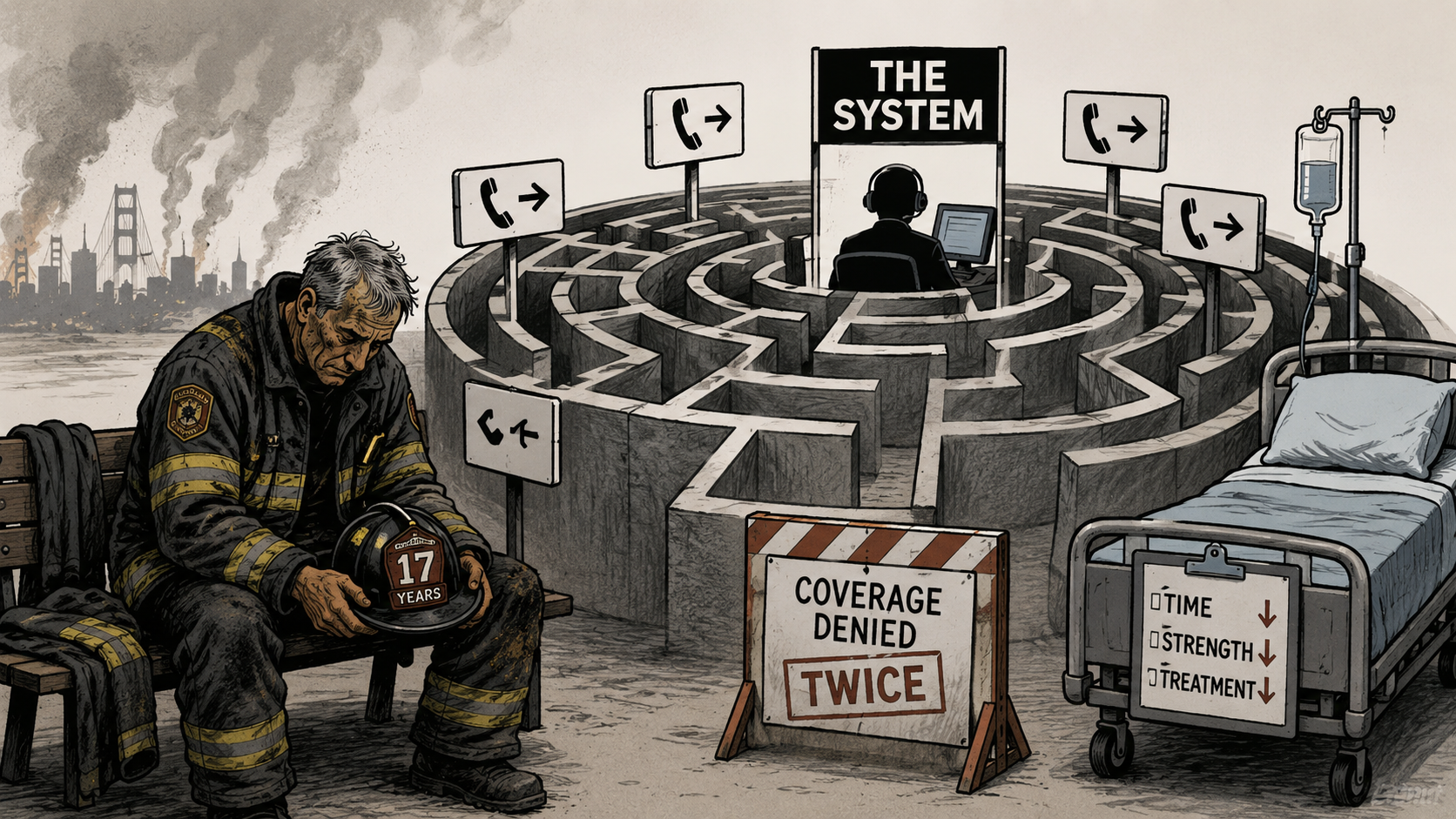
Blue Shield of California says a phone routing error prevented an oncologist from appealing a denied cancer treatment for retired San Francisco firefighter Ken Jones. The explanation sounds almost comforting because everyone has experienced technology failing at an inconvenient moment. Phones route incorrectly. Call centers make mistakes. Software breaks. Yet that explanation should leave us asking a much larger question. Why did a single administrative failure possess enough influence to affect the care of a man with Stage 4 cancer? The answer reveals far more about American healthcare than the error itself ever could.
According to published reporting, Jones’ oncologist attempted to appeal a denial for immunotherapy by calling the telephone number listed on the insurer’s denial letter. Instead of reaching the physician appeals process, the call routed into a member services line intended for patients. The physician reportedly spent hours attempting to navigate the system before ultimately filing a written appeal that also failed. Jones died weeks later. Blue Shield attributes the failed telephone appeal to a routing problem. The company maintains that its processes functioned as intended apart from that technical issue.
Most people will read that story and conclude that somebody entered the wrong phone number into a database or configured the wrong destination inside a call center. That explanation feels satisfying because it suggests an isolated operational mistake. Large organizations inevitably make mistakes. Software fails. Human beings misconfigure systems. Those failures deserve correction, but they rarely explain why harm occurs. Complex institutions almost never collapse because of one broken component. They produce harm when every surrounding safeguard accepts the failure instead of correcting it.
Healthcare often describes prior authorization as a clinical quality tool, and in many circumstances it genuinely serves that purpose. Every payer has a legitimate responsibility to prevent ineffective care, duplicative testing, unnecessary procedures, and unsafe prescribing. No serious observer believes every physician recommendation should receive automatic approval regardless of evidence or cost. Healthcare requires stewardship because resources remain finite. The problem begins when administrative complexity evolves from a method of clinical review into an independent mechanism that influences who ultimately receives care.
Economists understand this phenomenon better than most healthcare debates acknowledge. Markets respond to incentives with remarkable consistency. Organizations optimize around whatever behavior the financial model rewards. If reducing unnecessary utilization improves margins, organizations invest in utilization management. If administrative friction lowers spending because some appeals never reach completion, that friction acquires economic value whether anyone openly intends it or not. Nobody needs to instruct employees to deny appropriate care when enough procedural barriers naturally reduce the number of successful appeals.
This distinction matters because the costs of administrative complexity rarely appear where the decisions originate. Every hour an oncologist spends navigating telephone trees represents physician time diverted away from patients. Every nurse assigned to prior authorization represents clinical labor redirected toward paperwork. Every office employee who prepares appeals instead of helping families absorbs costs that never appear on an insurer’s financial statements. Providers carry those expenses. Patients carry the consequences. The organization that creates the friction often bears only a fraction of its true economic impact.
Healthcare economists refer to this dynamic as cost shifting. Patients experience it very differently. They experience delayed treatment, postponed imaging, interrupted therapy, and exhausting conversations with representatives who lack authority to resolve the underlying issue. None of those individual interactions appears catastrophic. Together they become an invisible tax on illness itself. The patient battling cancer suddenly needs to become an amateur attorney, insurance specialist, pharmacist, accountant, and project manager before receiving therapy that their physician already recommended.
The healthcare industry frequently defends prior authorization by pointing out that many requests eventually receive approval. Statistically, that statement often proves correct. Yet statistics about eventual approval overlook the most clinically important variable in many diseases. Time carries therapeutic value. Oncology understands this instinctively because tumors continue growing while paperwork circulates between departments. Even when treatment cannot cure advanced cancer, physicians fight for additional months of meaningful life because those months contain anniversaries, graduations, family dinners, and ordinary Tuesdays that patients desperately want to keep. Delay changes outcomes even when eventual approval arrives.
Jones’ oncologist reportedly explained exactly that point. He observed that cancer therapies become harder to deliver and less effective as patients grow weaker, adding that even additional years or months of quality life matter profoundly to patients and their families. That observation reflects decades of oncology rather than emotional advocacy. Clinical medicine has always recognized that timing shapes effectiveness. Administrative systems often behave as though timing represents an inconvenience rather than a therapeutic variable.
The healthcare industry understandably objects when critics portray insurers as villains. The objection deserves consideration because caricatures rarely produce useful policy. Insurance companies perform legitimate economic functions. They negotiate prices, spread risk across populations, manage finite resources, and attempt to restrain unnecessary spending. Employers depend upon them to moderate premium growth. Governments rely upon similar mechanisms inside Medicare and Medicaid. Utilization management did not emerge from cruelty. It emerged because unchecked healthcare inflation threatens employers, taxpayers, and patients alike.
The problem lies elsewhere. Financial accountability and clinical accountability often reside inside different institutions with different incentives. Physicians answer for patient outcomes. Hospitals answer for quality metrics. Insurers answer for medical spending. Each organization can legitimately satisfy its own responsibilities while collectively producing worse outcomes for patients. Nobody wakes up intending to shorten someone’s life. Yet nobody owns the cumulative effect of thousands of administrative decisions that gradually consume the limited time available to people facing serious illness.
Large organizations naturally diffuse responsibility because specialization increases efficiency. One department writes policy. Another processes claims. Another manages appeals. Another oversees customer service. Another contracts with outside vendors to operate call centers. Each employee sees only a narrow slice of the entire process. Patients encounter the entire system simultaneously. They experience the combined effect rather than the individual components. That difference explains why institutional explanations often sound reasonable while patient experiences sound incomprehensible. Both perspectives accurately describe different parts of the same machine.
Healthcare has solved similar problems before by changing incentives rather than demanding better intentions. Hospitals substantially reduced preventable infections after reimbursement incorporated quality measures. Manufacturers improved safety when liability changed the economics of defective products. Pharmaceutical companies accelerated research into rare diseases after Congress created financial incentives through the Orphan Drug Act. Organizations responded exactly as markets predict they will. They invested resources where the incentive structure rewarded improvement.
Administrative safety deserves similar treatment. Regulators already measure waiting times inside emergency departments because delays create measurable harm. Healthcare should apply comparable thinking to administrative care pathways. Appeals should reach qualified reviewers within defined timeframes. Physicians should possess direct access to clinical decision makers without navigating consumer call centers. Health plans should measure successful completion of appeals rather than simply documenting procedural compliance. Purchasers of health insurance should evaluate administrative burden alongside premiums because hidden friction ultimately becomes visible cost somewhere else in the system.
My perspective comes from decades spent living inside American healthcare rather than observing it from outside. Cancer taught me medicine. Survivorship taught me administration. They are different disciplines. The first required physicians, nurses, and scientists. The second required insurance representatives, billing departments, benefit manuals, formularies, appeals, and endless documentation. Patients should never need mastery of both simply to survive. Yet millions quietly develop expertise in bureaucracy because the system increasingly demands it.
That reality also explains why professional patient navigation deserves recognition as healthcare infrastructure rather than charitable support. Navigation reduces missed treatment, abandoned therapy, unnecessary hospitalizations, and preventable financial distress. Every study demonstrating improved coordination ultimately points toward the same conclusion. Helping patients move efficiently through administrative barriers improves both human outcomes and economic performance. Those goals reinforce each other far more often than healthcare policy acknowledges.
Whether Blue Shield’s routing explanation proves entirely accurate ultimately matters less than many people assume. A resilient healthcare system anticipates human error because human error remains inevitable. Commercial aviation expects equipment failures and builds redundant protections around them. Modern surgery expects mistakes and requires multiple verification steps before an operation begins. Healthcare financing should adopt the same philosophy. No patient with life threatening illness should depend upon the correct routing of a single telephone call for access to timely treatment.
Ken Jones’ story deserves attention because it exposes a weakness that extends well beyond one insurer or one unfortunate sequence of events. Administrative friction has become so deeply embedded within American healthcare that we increasingly accept it as normal. It should never feel normal when physicians spend hours searching for someone authorized to discuss a patient’s care. It should never feel normal when seriously ill patients become full time managers of their own insurance disputes. Most importantly, it should never feel normal when organizations describe those failures as isolated technical problems after the system has already produced irreversible consequences.
American healthcare does not require perfect institutions because perfection remains impossible in any market this large or this complex. It requires incentives that consistently reward timely access, transparent accountability, and administrative reliability with the same seriousness that we already reward cost control. Until those incentives align, every routing error will look like an isolated mistake while quietly reflecting a much larger design problem.